Well, Dorian Gray was barely subtext. The editor censored the first edition without Wilde’s permission and even then there was such an uproar that the second edition (released the next year) was much more heavily edited–that’s the version most of us are familiar with. The original version contained such lines as,
“It is quite true I have worshipped you with far more romance of feeling
than a man should ever give to a friend. Somehow I have never loved a
woman.” And everyone knew Wilde was queer.
Meanwhile, Dracula frames gayness in monstrous terms. This is a literary device that’s been used in many queer stories in homophobic times: make it tragic, horrifying, monstrous, and the cishet audience will feel comfortable in their removal from it, while the queer audience recognizes their otherness.
And unlike Wilde, Doyle was staid, and respectable, and not especially radical; and his characters’ queerness was framed in purely emotional terms. They are devoted, tender, adoring, intensely intimate, but never sexual. Doyle repeatedly makes Holmes seem to be removed from lust by nature; frames his queerness as an absence of feeling toward women, rather than a physical desire for men. And Victorians loved intimate friendships. They considered them to be quite separate from sexual passion. A man could promise his friend to love him forever, offer all his loyalty, share his rooms, and take his arm in the street. As long as there wasn’t a hint of carnality, no one minded. (Honestly, quite a number of Victorians didn’t mind if there was; but publishing a book about the subject brought out the cultural gatekeepers.)
@a-candle-for-sherlock I recommended for @brilliantorinsane ’s book list Richard Dellamora’s ‘Masculine Desire: the Sexual Politics of Victorian Aestheticism’, a difficult but brilliant book on exactly this subject. You’ve just summed up its 223 pages in a paragraph.
Intensely homoerotic friendships, love, emotional passion, deep devotion between men were accepted – just – as long as they could be fitted into a paradigm where those men also were married, or were planning on marrying, or even had been previously married to a woman, and any sexual activity was male/female. Women were predicated as the gatekeepers of male’s sexual desires. And a large part of the discourse around what was acceptable between men was played out in those male spaces where women were absent: universities, the church, the army, political fora, clubs. It was there, in the absence of women, that men policed themselves and others most strongly to ensure that friendships remained acceptably pure. Reading the literature, it is quite clear that men who broke the rules – men such as Wilde, who were openly sexual with other men – posed a tremendous threat to all those who carefully constructed their lives to fit with the socially acceptable model. If Wilde could make it clear that sex and love went together, then what of those men who loved other men deeply, whose emotional lives were completely centred around other men, but who refrained from physical expression of their love? When society so strongly condemned genital expression of love, but allowed intense devotion, where does that leave men who felt their affections needed physical as well as emotional, expression?
(This is where my Watson in SFISYF is at the moment. He is deeply, intensely devoted to his Holmes. But where can he go with that love, when society applauds it as an essential aspect of male hegemony when it is chaste comradeship and soldierly devotion without sex, but condemns it as the most vile of sins if it is expressed sexually?
His is the dilemma faced by many. And Holmes’ dilemma is similar, in that he knows his own desires, but has been taught to consider carnality – the matters of the flesh – as incompatible with chaste comradeship and soldierly devotion.)
There was a lot of discourse centred on Greek concepts of love at this time. The Judaeo-Christian contempt for the body and its needs and wants, the neo-Platonist ideas of the ideal society, the Greco-Roman concepts of how men should achieve dominance through Empire, were in conflict with the actual evidence (written materials, art, ceramics) that, whatever Plato said about the best loves being pure, men in Greece and Rome engaged unashamed in genital activity with each other.
Judaeo-Christian tradition condemned sexual activity between males. Plato considered it to be a factor that detracted from the highest form of love. In Rome, sexual excesses and male/male activity were associated with the least praiseworthy emperors – Caligula, Nero, Heliogabalus. For upper and middle class Victorian men taught to propagate and support the societal paradigm of Empire, the need to integrate these two aspects of male/male interaction – the strong homosocial bonding needed to make Empire work, and the intense emotional ties it required – with a complete absence of physical expression of love produced a psychic conflict that many of them struggled in vain to resolve.
This is one reason why when men such as John Addington Symonds and Edward Carpenter did form happy homosexual partnerships, it was often with men of a lower social class – men unburdened by the neuroticism developed by education in public schools and its consequent mindset. It is why Maurice can be happy with Alec, but not with Clive. It is why the Dublin Castle Scandal, the Cleveland Street Affair and the Wilde trials happened: in all three of those ‘moments’ which tipped society into homophobic retreat, one of the things that was most strongly reprobated by judges, juries and public alike, was that there was a transgressive sexual relationship not just between men, but between men of different classes. These relationships between Gustavus Cornwall and the renter, Jack Saul, between Lord Arthur Somerset and the Earl of Euston and their telegraph boys, between Wilde, and his street lads, struck at the basic of the social compact: that homoerotic devotion in the chaste Greek mode was acceptable so long as compulsory heterosexuality was also forcing men to marry and breed to maintain society. If society allowed for men to be devoted to, to marry other men, England might fall, and worse, the hegemony of the monied upper classes might be broken.
(And don’t even get me started on what that meant for women. Nobody even considers the life of Gustavus Cornwall’s childless wife, to whom he’d probably transmitted the syphilis that eventually killed him. Una Troubridge, lesian lover of Radclyffe Hall was treated all her life for the syphilis her philandering husband gave her as a wedding present. Mary Benson, wife of the Archbishop of Canterbury, forced into a marriage with him at an age too young to say no, had lesbian affairs all through her married life. And there are other examples.)
It is impossible for us to consider the relationship of Holmes and Watson, and what it might have been without considering its social and political context. Doyle wrote as a man of his time, imbued with its ideas and ideals and subject to its neuroses. To understand what he writes, it’s also necessary to understand where he’s writing from.
Excellent précis! Thank you so much for the tag. I feel like “subtext” is a somewhat misused word in lots of fandom discussions, and context is often overlooked entirely. This is a very helpful reminder.
Every queer person I know over the age of 30 is fucking appalled by the state of the queer community, and I have heard some absolutely stellar anti-gatekeeping tirades from queer grandparents. I had a long conversation with a 43 year old pansexual who told me the infighting is almost certainly because we’ve collectively forgotten our joint history and have become more interested in individual social clout than actually advancing the movement for across the board queer equality.
So this is a reminder, I guess, that our elders are on our side. The gatekeeping and the exclusionary behavior is crap.
Stop👏calling👏us👏queer
If you don’t identify as queer then I’m not fucking talking about you, am I.
This TERFy “stop saying queer!” horse shit is exactly one of those appalling things, by the fucking way.
I’m honestly really curious to see how many people actually accept it. Because there are allot of people who don’t believe it’s real. Or at the least don’t accept it when somebody they know come out as asexual.
which is always better than not acknowledging your friends are bisexual, so yay
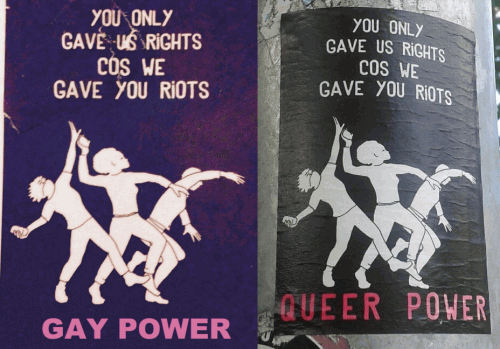
‘Queer’ was reclaimed as an umbrella term for people identifying as not-heterosexual and/or not-cisgender in the early 1980s, but being queer is more than just being non-straight/non-cis; it’s a political and ideological statement, a label asserting an identity distinct from gay and/or traditional gender identities.
People identifying as queer are typically not cis gays or cis lesbians, but bi, pan, ace, trans, nonbinary, intersex, etc.: we’re the silent/ced letters. We’re the marginalised majority within the LGBTQIA+ community, and
‘queer’ is our rallying cry.
And that’s equally pissing off and terrifying terfs and cis LGs.
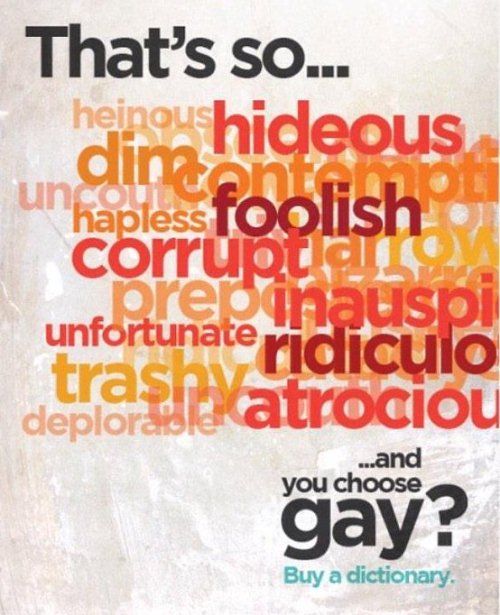
There’s absolutely no historical or sociolinguistic reason why ‘queer’ should be a worse slur than ‘gay.’ Remember how we had all those campaigns to make people stop using ‘gay’ as a synonym for ‘bad’?
Yet nobody is suggesting we should abolish ‘gay’ as a label. We accept that even though ‘gay’ sometimes is and historically frequently was used in a derogatory manner, mlm individuals have the right to use that word. We have ad campaigns, twitter hashtags, and viral Facebook posts defending ‘gay’ as an identity label and asking people to stop using it as a slur.
Whereas ‘queer’ is treated exactly opposite: a small but vocal group of people within feminist and LGBTQIA+ circles insists that it’s a slur and demands that others to stop using it as a personal, self-chosen identity label.
Why?
Because “queer is a slur” was invented by terfs specifically to exclude trans, nonbinary, and
intersex people from feminist and non-heterosexual discourse, and was
subsequently adopted by cis gays and cis lesbians to exclude bi/pan and ace
people.
It’s classic divide-and-conquer tactics: when our umbrella term is redefined as a slur and we’re harassed into silence for using it, we no longer have a word for what we are allowing us to organise for social/political/economic support; we are denied the opportunity to influence or shape the spaces we inhabit; we can’t challenge existing community power structures; we’re erased from our own history.
Pro tip: when you alter historical evidence to deny a marginalised group empowerment, you’re one of the bad guys.
“Queer is a slur” is used by terfs and cis gays/lesbians to silence the voices of trans/nonbinary/intersex/bi/pan/ace people in society and even within our own communities, to isolate us and shame us for existing.
“Queer is a slur” is saying “I am offended by people who do not conform to traditional gender or sexual identities because they are not sexually available to me or validate my personal identity.”
“Queer is a slur” is defending heteronormativity.
“Queer is a slur” is frankly embarrassing. It’s an admission of ignorance and prejudice. It’s an insidious discriminatory discourse parroted uncritically in support of a divisive us-vs-them mentality targeting the most vulnerable members of the LGBTQIA+ community for lack of courage to confront the white cis straight men who pose an actual danger to us as individuals and as a community.
Tl;dr:
I’m here, I’m queer, and I’m too old for this shit.
I know I keep reblogging posts like this, but it matters to me. “Queer is a slur” is a TERF dogwhistle, and a lot of the younger generation is falling for it. Please pay attention to history and ask questions about who’s behind social media campaigns that undermine the inclusivity of your community.
Queer is an excellent word, especially when your identity doesn’t fit neatly within one little label. Queer is also an explicit rejection of normative expectations sexuality and gender. It’s radical as fuck.
I saw a sad facebook post from the gay bookstore back in Ann Arbor where I used to live about how they hadn’t sold any books that day so I went on their online store and bought a couple, and while you don’t get #deals like elsewhere online, I’d love it if y’all would consider buying your next gay book from them instead of like, Amazon.
Common Language is a great bookstore and while I’ve only been there once, I follow it on Instagram and really want to see it succeed!