A blog dedicated to ace and aro people who are wlw in any form or fashion
Sorry this is long I just have so many feelings about this!
Maybe you are homoromantic asexual and want the partnership/cuddles/etc and not the actual sex or maybe you are demisexual and need to feel deeply about a person before sexual feelings develop. Sexuality can be fluid over your lifetime. I assumed I was straight, because compulsory heterosexuality, then thought maybe I was bi because I liked girls. Eventually I realized I wasn’t developing any crushes on guys, so I thought I must be a lesbian and eventually realized that I am more accurately pansexual and demisexual, because I develop love and sexual feelings for people regardless of their sex/gender, but only after I am deeply attached emotionally (and when I was in high school I was only that close to women so of course I identified as a lesbian.) As an adult I found all the words for me. Don’t worry so much about the permanency of a label. Discovering a new facet of yourself doesn’t invalidate what you experienced or understood before.
Also worth noting is that some ace people are sex repulsed and others have sexual feelings in general, but they don’t experience sexual attraction, so they might masturbate rather than enjoy sex with a partner. Still others are fine having sex out of love for their partner and enjoy feelings that I would say are comparable to compersion (they polyamory concept which is the opposite of jealousy basically meaning being happy for your partner’s happiness; in that case it is enjoying their happiness with another partner but I think it is a similar to enjoying experiencing something with your partner that you enjoy their enjoyment of, rather than enjoying or seeking out the experience yourself. Kinda like being willing to watch a movie or TV show you don’t care about just because your partner likes it.)
If you have a crush on a straight person and you find yourself thinking “I wish you were gay!” – No, you are not predatory. You’re not “forcing your lifestyle on someone else”. You’re not a creep.
You’re just having a crush.
There are people out there who love to point at us and call us predatory, simply for existing. They forget that a gay boy thinking “I wish my cute classmate was gay” is just as innocent as a straight boy thinking “I wish the cute girl in my class was into me”.
Straight people just don’t wish for others to be straight because they already assume everyone is straight.
I used to think this like “Hmm I think I’m bi but I’m not really interested in men anymore” turns out I was just gay the entire goddamn time. I think for me it was just like denial + compulsory heterosexuality + feeling like I “can’t afford to be choosy” (ie feeling like no one except men wanted to date me). Not saying that’s necessarily what you’re going through but I thought it might be helpful
I’m not gonna deny that compulsory heterosexuality is a thing and that it’s part of why I’ve dated so few women. But….I really was attracted to men. Hell, with the recent ex, the first time I saw him I went “whoa, that guy is hot.” I hit on him specifically because I wanted to have sex with him, and I really enjoyed having sex with him.
And that’s what feels so odd to me–having that attraction just up and disappear.
When I came of age sexually I couldn’t understand why anyone would ever want to have sex with someone who wasn’t the same gender as them. Like, how were you even supposed to touch someone’s genitals if they weren’t the same as yours, eeew. I didn’t identify as a lesbian, but honestly I was pretty much exclusively same gender attracted. And then in my late teens and twenties I got increasingly attracted to men. Now that I’m in my thirties I am probably more attracted to women and nonbinary people as a general rule but I remain physically attracted to my husband and every now and again I see a man that makes me think, “hot damn.”
Your attraction to men might come back and it might not. Use whatever labels feel appropriate to you, and date who you’re attracted to.
Yeah, I’m trying to relax about it and not get so hung up on it? I’m queer, I’m mostly into women, that should be enough.
I mean I know why I’m finding it difficult–both that worry that I’m doing the biphobic “pick a side” thing somehow subconsciously*, and that having a huge part of my identity shift on me like that, a part of me that felt intrinsic to how I define myself, just feels strange. Like what other part of how I define myself can change like that? Am I gonna stop liking bicycles? Am I gonna lose interest in fandom stuff? It’s like waking up one day and looking in the mirror and having some distinctive part of your face change, and having to wonder when the hell that happened, or if anyone else has noticed.
(*I do feel a sort of strange relief sometimes and then I’m mad at myself for feeling it, even though I understand why I’m feeling it.)
I identified as bi for years, then thought I was just a lesbian, then met my now husband and I was like ok except for that one. (we were friends for quite awhile before I discovered my attraction to him. surprise I’m actually pan and demisexual and was more likely to be close enough to girls to develop attraction to them). Now we are happily poly and I have partners of more multiple genders. I don’ t get it when people just know their orientation and stay that way forever. Must be cool, but in my experience and that of my partners it isn’t usual unless you are straight.
it’s sort of funny that the current cultural idea of the flapper dates not from the 1920s, but the 1950s when costume designers took the radical, gender-fluid, sexual, sexually liberated ideas and fashions of the 20s and made them sexy. as in sexual objectifying.
because 1950s and fuck female agency.
If you would like, I would love to hear more about this. What, exactly, happened, and what was the true 1920s aesthetic, untainted by 50s views?
hokay. so it’s the 1950s and it’s the heyday of the studio system and writers and movie makers (and audiences) want rom coms and frolicking films and lighthearted fun, but there’s just one problem.
WWII
but that was the 1940s! you say
you’re right.
but in order to set a film in the 1950s, writers and film makers have to establish what the male lead character did during the war or risk it coming across like he didn’t, well, serve. can’t have a shirker or a coward and rejected for medical reasons really doesn’t fly in the 1950s. and there’s only so many times you can write about soldiers and sailors and airmen and the occasional spy before it starts to become stale. and it doesn’t terribly fit with the fluffy writing because, well, war and death and tens of millions of people dead. contemporary films more fall in the line of what we now call film noir. men and women who have been damaged by war, but that’s another topic.
sooooo, you do period pieces. no one wants to do the 1930s because that’s the great depression. so 1920s. frolicking and gay and fabulous!
(Great War, what Great War?)
but the thing is, the 1920s, especially in Paris and Berlin, were a massively transgressive, reversal, and experimental time period in art, fashion, society, and all over. but only a little bit in america because honestly we were barely touched by wwi so it’s not like we’re partying to forget an entire generation of young men killed off and entire towns wiped off the face of the earth using weapons the likes of which had never been seen before. the us as a whole mostly heard about sarin gas, not see it poison entire landscapes and men and animals dropped to the ground and die in truly horrific ways.
the europe that emerged from wwi was massively shell shocked, angry, and living in a surreal dream of everything being upwards and backwards and live now because tomorrow you may die and it’s all nonsense anyway. it’s a world in which surrealism and dadaism and german expressionism make sense because fuck it all.
you get repudiation of the old, experimentation, deliberate reversals, transgressive behavior, and if there’s an envelope to push, you tear it open. France calls the 1920s “Années folles”, the crazy years.
the things we’re doing now, with fluidity and experimentation and exploration of gender and sexuality and presentation? the 1920s did that already. it’s drag and androgyny and blatant homosexuality. it’s extramarital affairs and sex before or without marriage, it’s rejection of marriage as an idea and an institution, it’s playing with gender and gender roles and working women and unrestrained art and
it’s everything the 1950s hated. or more accurately: absolutely terrified of.
the flappers of the 1920s went to college and cut their hair to repudiate a century of a woman’s hair being her crowning glory. they wore obvious makeup and makeup in ways that are not terribly appealing now and weren’t terribly appealing then, but they signaled you were part of the tribe.
they were women who wanted independence and personal fulfillment.
“She was conscious that the things she did were the things she had always wanted to do.“
so the 1950s didn’t want that. they wanted films with dancing and chorus lines and pretty girls to be looked at. they wanted spaghetti straps and fringed dresses that moved pretty when the chorus girls danced.
1920s fringe doesn’t. 1920s fringe is made of silk, incredibly dense, incredibly heavy, sewn on individually by hand, and rather delicate. the all-over fringe dress didn’t exist until the 1950s invention of nylon and continuous loops that could be sewn on in costume workshops by the mile on machines.
(this is before “vintage” exists. to the 1950s, the 1920s (or earlier) wasn’t vintage, it was old-fashioned. démodé. out of style. last last last last last season.)
1950s 1920s-set movies have clothes that are the 1950s take on it. the dresses have a dropped waist, but they’re form-fitting, figure-revealing. the actresses are pretty clearly wearing bras and 50s girdles under them a lot of the time. they’re not
the woman on the far left is basically wearing a man’s suit with a skirt. la garçonne. some women went full-out and wore pants. you could be arrested for that. they were. still wore pants. and pyjama ensembles in silk and loud prints.
or class photo of ‘25
or even
not that 1920s dresses could be sexy or sexual; they often were. i’ve seen 20s dresses that were basically sideless and held together with straps. but it’s sort of like how the mini skirt went from being a thing of sexual liberation to an item of sexual objectification.
it’s ownership and it’s agency and it’s hard to put a name or finger on it, but you just know. sex goddess versus sex icon.
My Grandmother used to have to bind her chest to get the silhouette fashionably androgynous.
I have a daughter who’s almost five, and this year in preschool she’s had a Best Friend. She had friends before at her previous daycare, but this one is different – whether it’s because of age or personality or something specific about the chemistry between them. Best Friend has really big feelings about my kid. Best Friend doesn’t merely squee when my kid shows up; she also gets morose when Kid doesn’t come to school (to the point of crying at home, her mom tells me), and jealous when Kid wants to play by herself or with someone else, and one time I even saw her attempt to make Kid jealous in return (it didn’t really work; Kid just got upset that she was being misunderstood). Big Feelings!
It’s been so fascinating to watch this unfold over the last year, if somewhat unnerving at times, and I’ve been working to help Kid set up good boundaries. (She’s done surprisingly well.) If we were seeing this kind of behavior in middle-childhood, we would definitely think “puppy love.” In a teen or adult, I’d have my ears perked up for signs of intimate partner violence. In a preschooler? I don’t really know. Are possessiveness or mild obsessiveness normal in friendships at this age? Is Best Friend going to look back at this intense friendship in 20 years and think, yep, that’s when I knew I was gay?
Anyway, thinking about this brought me back to that question of love and Sherlock (what doesn’t?). Possessiveness is not normal for adults in friendship – I mean, it’s not healthy in romance either, but we have a frame for understanding it. That’s what makes John’s side of the equation hard to understand: Mr. It’s All Fine Except When You Imply It About Me gets upset when Sherlock appears romantically interested in anyone else. And everything in his body language at those moments, everything in the way he talks about Sherlock on the blog, tells us he knows exactly how fucked up this is. That doesn’t suggest wedding bells, exactly, but it does raise questions we want answers to (or at least, I do).
But then there’s Sherlock, who is possessive in a really different way – a way that suggests he thinks the right and proper state of affairs is for John’s world to revolve around him. He maintains this thoughtless self-centeredness until halfway through that wedding speech in TSoT, at which point a switch flips and his love for John takes on a character that is both selfless and undeniably romantic. I’ve seen plenty of meta about how this speech serves as an accelerated puberty for Sherlock, and I think that works here. Growing up for him happens when he learns how to love like an adult. Where possessiveness is what triggers my suspicions with John, my certainty about Sherlock emerges in its absence.
Tagging @unreconstructedfangirl who had a good thread about love and friendship not long ago.
Thank you for tagging me! I love your last paragraph, SO MUCH.
Where possessiveness is what triggers my suspicions with John, my certainty about Sherlock emerges in its absence.
Yes. YES. Exactly.
However! I’m not sure I agree that possessiveness, jealousy and obsessiveness aren’t “normal” in friendship. I have felt all of those things in relationships that were clearly and unambiguously friendships, which is to say not romantic relationships (though, I must say that I am increasing unsure why these two things are somehow defined as mutually exclusive categories – why isn’t a friendship a kind of romance?). Maybe these feelings aren’t admirable, but they are real things that people feel in all kinds of relationships. Perhaps it’s not useful to view them as not normal, or unhealthy, or even as things that sort the relationship into a category of love vs. friendship where those two relationship concepts mutually exclude one another? Perhaps, as you say, the issue is learning to love in a more mature way – a way that recognises the personhood and agency of the beloved; A way that recognises the limits of one’s right to act upon those feelings in a way that curtails the freedom of the beloved.
Also? I don’t feel like the territory of friendship is so unlike the territory of love. I think those territories overlap one another in all kinds of ways and cannot be cleanly separated. The ambiguity of the relationship between John and Sherlock doesn’t bother me at all, and that is because an undefined intensity of connection that is neither one thing nor the other, or is both, feels REAL to me. It feels like a think that exists, and that I feel, and that we don’t know how to talk about because our words to describe what a relationship is excludes that territory. That unnamed land is uncomfortably unsayable, so we want to push it to a point – force it to define itself – and I think that definition would be reductive of it’s beauty and complexity. Maybe your daughter’s friend will grow up and realise that she has always loved girls… or maybe not. Who knows! What I don’t quite understand is the rage we all seem to have for applying labels that don’t quite seem to fit.
All that said, I agree with you about this difference between the character of Sherlock’s love and John’s as it is realised on the show. I think it’s why John beating Sherlock up didn’t surprise me and felt exactly in character. It’s probably why there is a draft of a controversially titled and never published post in my draft box from months ago called “John Watson, Self-obsessed Arsehole”, which is not to say that I don’t love John as a character, just that I cannot approve of his actions and think he has his head up his own arse when it comes to Sherlock.
I do think Sherlock learns to love selflessly, and I agree that John isn’t there yet, and his love is selfish. It’s why I find him harder to love than Sherlock.
But, that’s just me, maybe.
I am interested in all the points being made here and don’t want to detract from them at all, as this post relates to Sherlock, but I’m a teacher, so here are my 2 cents on preschool behavior: This behavior is completely normal on both their sides. Some kids at this age experience an intense and jealously guarded bond with one friend and others are more like butterflies flitting from friend to friend, and every shade in between those polarities. Some kids understand the jealous ones and some are completely baffled by it. However, normal isn’t always the same thing as acceptable. It is normal for children to act out aggressive feelings physically, but we still correct it, and they still have bathroom accidents at that age too, but we are guiding toward complete and consistent potty training of course. The same is true with more clingy or obsessive friendships. It is great that she loves your daughter so much, but hopefully teachers are involved in guiding her to understand that sometimes people need to play with others or by themselves. If this isn’ t guided, it can eventually manifest as exactly the kind of obsessive/possessive behavior we find in abusive relationships, but there are years and years for helping this child find balance. Learning boundaries and consent does start that young, so it is great you are helping your daughter with that. If people are treating the other girl’s behavior as cute, you might want to talk about shaping the behaviours over time, but it seems like you have a very positive relaxed attitude about the whole thing, which is lovely. (As for the point about sexuality, I haven’t seen any correlation to sexuality at all, though if the friend was a boy I’m sure people would be assigning sexual or romantic overtones to it. Sometimes the jealous behavior is a sign people look back on as ‘yep that was my first crush’ and other times it is more indicative or not having learned to share yet.)
is inherently a part of my identity. It makes me feel comfortable and home. Online I can identify as a polyamorous, pansexual, demisexual genderqueer leaning towards feminine but irl queer is a fine umbrella for all of that without having to be super specific.
This is a list of Christian writers, pastors, and leaders, who believe that Jesus loves Gay people and Gay couples.
If you are being mistreated or ignored by Christian parents or Christian community, I recommend introducing them to the differing perspectives within their own religion.
1. Dr. David Gushee – “Changing our Mind”
2. Justin Lee – “Torn”
3. J.R. Daniel Kirk – look him up on YouTube or find his blog
5. Misty Irons – she’s not fully affirming, but she’s a good step forward for most conservatives – her blog is on point (also her key note speech from the Gay Christian Network Conference this past year (2016))
6. Tony and Peggy Campolo – Peggy has been an advocate and ally for years, Tony just became fully affirming (accepting). They are well-respected people
7. Matthew Vines – check out his book, blog, or his organization “The Reformation Project”
8. Dr. Throckmortan – if your parents are hung up on thinking you can change or that you can just become straight, have them check out Dr. Throckmortan’s recent blog posts on the topic. He’s still relatively conservative, but He’s a HUGE leap forward for many conservatives & I highly recommend his writing.
9. Julie Rogers – I highly recommend her blog and her recent writings. She is a lesbian woman who holds strongly to her faith, yet believes the God accepts and affirms gay couples.
10. Organizations: The Gay Christian Network. The Reformation Project. New Directions (Canada). PFLAG. Everyone is Gay.
11. Finally, these are a few people who are teaching a harmful message about the LGBT community – stay away from them – Christopher Yuan, Rosaria Butterfield, and Kegan Wesley (among others)
This list is an abbreviated version of a longer list that I created.
I hope that it comes in handy for anyone who struggles to integrate their faith and sexuality, or for those whose parents use faith to justify treating them badly.
If you need to talk or want me to give you more information or better resources that might address your specific questions or your parents’ specific fears, please feel free to send me a message.
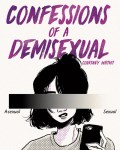
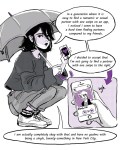
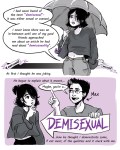
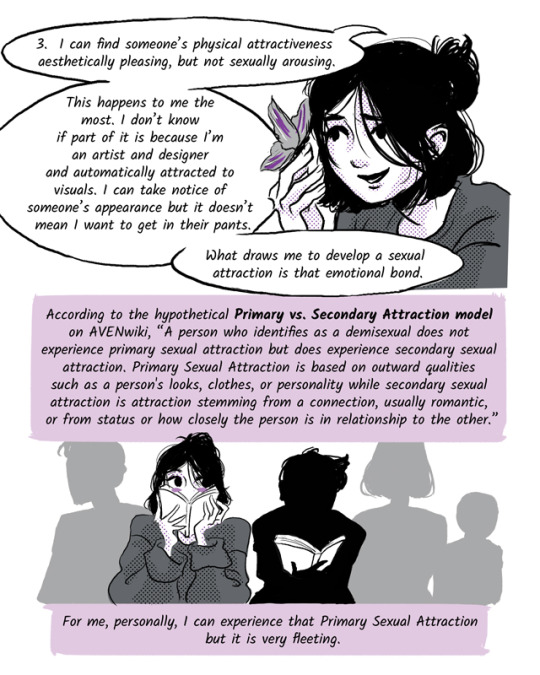
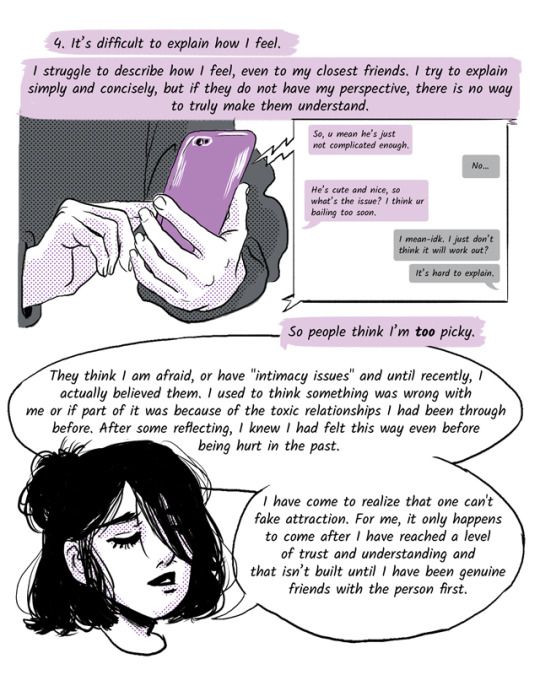
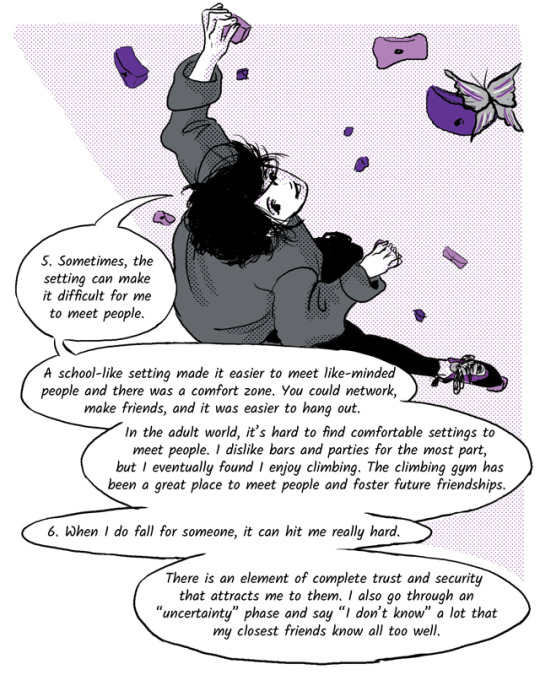
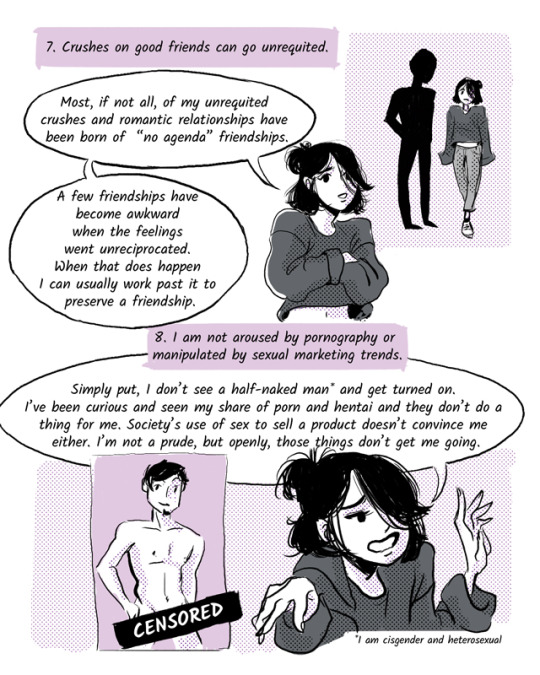
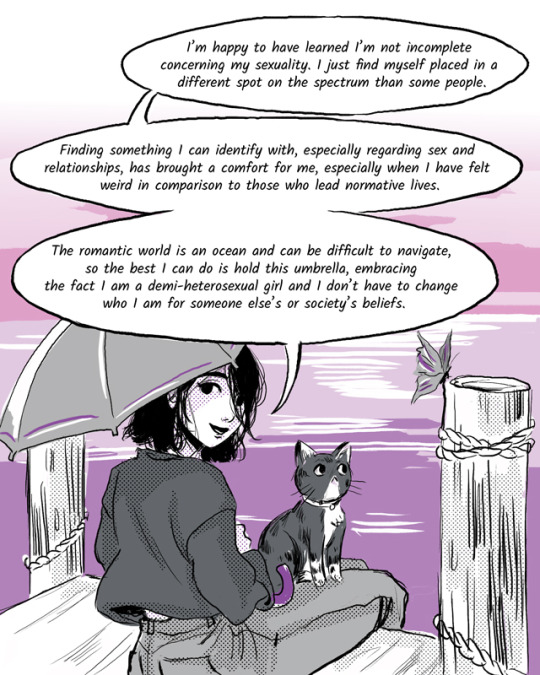
I have come to realize I identify as a demisexual. After trying to figure out a way to explain to my friends and family, I wanted a visual to help me explain it and what it means to me. I searched the internet and I couldn’t really find a comic that could help visualize my personal feelings on the topic so I decided to put this together.
I had a lot more information I wanted to include, but I didn’t want it to be overwhelming as I felt this was already a pretty informative piece. I feel like if there is more to share, including my personal experiences, or to help clarify misconceptions, etc. I will consider it!






 Beltainefaerie's Flights of Fancy