Drug-resistant HIV strain discovered in Philippines could trigger new epidemic, scientists warn

news-queue:

A drug-resistant strain of the HIV virus discovered in the Philippines has the potential to spark a new epidemic, scientists have warned.

HIV prevalence among Filipinos has risen sharply in the past decade, at a time when infection rates across the world are beginning to decline.

The United Nations estimates the number of new cases identified in the Philippines each year has risen by 140 per cent since 2010.

Researchers are concerned a new drug-resistant version of the virus, HIV subtype AE, could be fuelling the epidemic.

The strain is more aggressive, more resistant to antiretroviral drugs and progresses to Aids faster than the HIV subtype B generally found in western countries.

“The HIV virus has the potential to transform itself into a new and different virus each time it affects a cell,” Dr Edsel Salvana, director of the Institute of Molecular Biology and Biotechnology at the University of the Philippines told DW.

“There are nearly 100 different subtypes of HIV, with new subtypes being discovered every day.

“Most HIV infections in the Western world are of subtype B. Most of the research that we have on HIV is also on subtype B, though it accounts for only about 12 per cent of all global HIV infections.

“We have discovered that the explosion of HIV in the Philippines is due to a shift from the Western subtype B to a more aggressive HIV subtype AE.”

Dr Salvana added: “Those infected by the HIV subtype AE are younger, sicker patients who are more resistant to antiretroviral drugs. We are also seeing a faster progression to Aids under subtype AE.”

Around 5,000 people in the Philippines were living with HIV in 2006, compared to around 56,000 in 2016, according to UNfigures.

The number of new cases being diagnosed has also spiked in recent years, with some 10,000 new cases identified in 2016 alone, giving the country the fastest-growing HIV rate in the Asia-Pacific region.

Dr Salvana warned work done in recent decades to combat the HIV virus risked being undone if research was not conducted into the new strain.

“HIV is not done yet. We cannot think of HIV as a single virus but as a collection of viruses that are evolving, with a new mutation that can possibly set off a new epidemic.

“The gains that we have made in decreasing HIV infection rates will be short-lived without research and treatment for HIV subtype AE,” he added.

“This is urgently needed. Specifically for the Philippines, we need more scientists willing to do research work on HIV.”

Drug-resistant HIV strain discovered in Philippines could trigger new epidemic, scientists warn

*curtsies* So, I really, REALLY don’t want to offend anyone, Duke, but a question has been bothering me for a really long time and I was afraid to ask it because I didn’t want to piss off anyone and since you’re really eloquent and knowledgeable, I thought I’d ask you. So here it goes: you always say that arts and sciences are equally important, but how can analysing Chaucer or ecopoetics or anything similar compare to biomedicine or engineering in improving human lives? I’m genuinely curious!

dukeofbookingham:

*Curtsies* All right. Let me tell you a story: 

When I lived in London, I shared a flat with a guy who was 26 years old, getting his PhD in theoretical physics. Let’s call him Ron. Ron could not for the life of him figure out why I was wasting my time with an MA in Shakespeare studies or why my chosen method of providing for myself was writing fiction. Furthermore, it was utterly beyond him why I should take offense to someone whose field literally has the word “theoretical” in the title ridiculing the practical inefficacy of art. My pointing out that he spent his free time listening to music, watching television, and sketching famous sculptures in his notebook somehow didn’t convince him that art is a necessary part of a healthy human existence. 

Three other things that happened with Ron: 

  1. I came home late one night and he asked where I’d been. When I told him I’d been at a friend’s flat for a Hanukkah celebration, he said, “What’s Hanukkah?” I thought he was joking. He was not.
  2. A few weeks later, I came downstairs holding a book. He asked what I was reading and when I said, “John Keats,” he (and the three other science grad students in the room) did not know who that was. This would be like me not knowing who Thomas Edison is.
  3. One night we got into an argument about the issue of gay marriage, and at one point he actually said, “It doesn’t affect me so I don’t see why I should care about it.”

Now: If Ron had ever read Number the Stars, or heard Ode to a Nightingale, or been to a performance of The Laramie Project, do you think he ever would have asked any of these questions? 

Obviously this is an extreme example. This guy was amazingly ignorant, but he was also the walking embodiment of the questions you’re asking. What does art matter compared with something like science, that saves people’s lives? Here’s the thing: There’s a flaw in the question, because art saves lives, too. Maybe not in the same “Eureka, we’ve cured cancer!” kind of way, but that doesn’t make it any less important. Sometimes the impact of art is relatively small, even invisible to the naked eye. For example: as a young teenager I was (no exaggeration) suicidally unhappy. Learning to write is what kept me (literally and figuratively) off the ledge. But I was one nameless teenager; in the greater scheme of things, who cares? Fair enough. Let’s talk big picture. Let’s talk about George Orwell. George Orwell wrote books, the two most famous of which are Animal Farm and 1984. You probably read at least one of those in high school. Why do these books matter? Because they’re cautionary tales about limiting the power of oppressive governments, and their influence is so pervasive that the term “Big Brother,” which refers to the omniscient government agency which watches its citizens’ every move in 1984, has become common parlance to refer to any abuse of power and invasion of privacy by a governmental body. Another interesting fact, and the reason I chose this example: sales of 1984 fucking skyrocketed in 2017, Donald Trump’s first year in office. Why? Well, people are terrified. People are re-reading that cautionary tale, looking for the warning signs. 

Art, as Shakespeare taught us, “holds a mirror up to nature.” Art is a form of self-examination. Art forces us to confront our own mortality. (Consider Hamlet. Consider Dylan Thomas.) Art forces us to confront inequality. (Consider Oliver Twist. Consider Audre Lorde. Consider A Raisin in the Sun. Consider Greta Gerwig getting snubbed at the Golden Globes.) Art forces us to confront our own power structures. (Consider Fahrenheit 451. Consider “We Shall Overcome.” Consider All the President’s Men. Consider “Cat Person.”) Art reminds us of our own history, and keeps us from repeating the same tragic mistakes. (Consider The Things They Carried. Consider Schindler’s List. Consider Hamilton.) Art forces us to make sense of ourselves. (Consider Fun House. Consider Growing Up Absurd.) Art forces us to stop and ask not just whether we can do something but whether we should. (Consider Brave New World. Consider Cat’s Cradle.) You’re curious about ecopoetics? The whole point is to call attention to human impact on the environment. Some of our scientific advances are poisoning our planet, and the ecopoetics of people like the Beats and the popular musicians of the 20th century led to greater environmental awareness and the first Earth Day in 1970 . Art inspires change–political, social, environmental, you name it. Moreover, art encourages empathy. Without books and movies and music, we would all be stumbling around like Ron, completely ignorant of every other culture, every social, political, or historical experience except our own. Since we have such faith in science: science has proved that art makes us better people. Science has proved that people who read fiction not only improve their own mental health but become proportionally more empathetic. (Really. I wrote an article about this when I was working for a health and wellness magazine in 2012.) If you want a more specific example: science has proved that kids who read Harry Potter growing up are less bigoted. (Here’s an article from Scientific American, so you don’t have to take my word for it.) That is a big fucking deal. Increased empathy can make a life-or-death difference for marginalized people.

But the Defense of Arts and Humanities is about more than empirical data, precisely because you can’t quantify it, unlike a scientific experiment. Art is–in my opinion–literally what makes life worth living. What the fuck is the point of being healthier and living longer and doing all those wonderful things science enables us to do if we don’t have Michelangelo’s David or Rimbaud’s poetry or the Taj Mahal or Cirque de Soleil or fucking Jimi Hendrix playing “All Along the Watchtower” to remind us how fucking amazing it is to be alive and to be human despite all the terrible shit in this world? Art doesn’t just “improve human lives.” Art makes human life bearable.

I hope this answers your question. 

To it I would like to add: Please remember that just because you don’t see the value in something doesn’t mean it is not valuable. Please remember that the importance of science does not negate or diminish the importance of the arts, despite what every Republican politician would like you to believe. And above all, please remember that artists are every bit as serious about what they do as astronomers and mathematicians and doctors, and what they do is every bit as vital to humanity, if in a different way. Belittling their work by questioning its importance, or relegating it to a category of lesser endeavors because it isn’t going to cure a disease, or even just making jokes about how poor they’re going to be when they graduate is insensitive, ignorant, humiliating, and, yes,  offensive. And believe me: they’ve heard it before. They don’t need to hear it again. We know exactly how frivolous and childish and idealistic and unimportant everyone thinks we are. Working in the arts is a constant battle against the prevailing idea that what you do is useless. But it’s bad enough that the government is doing its best to sacrifice all arts and humanities on the altar of STEM–we don’t need to be reminded on a regular basis that ordinary people think our work is a waste of time and money, too. 

Artists are exhausted. They’re sick and tired of being made to justify their work and prove the validity of what they do. Nobody else in the world is made to do that the way artists are. That’s why these questions upset them. That’s why it exasperates me. I have to answer some version of this question every goddamn day, and I am so, so tired. But I’ve taken the effort to answer it here, again, in the hopes that maybe a couple fewer people will ask it in the future. But even if you’re not convinced by everything I’ve just said, please try to find some of that empathy, and just keep it to yourself. 

bosetop:

lagonegirl:

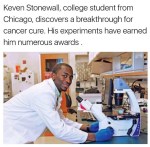
Black Chicago Teen, Keven Stonewall, Discovers Breakthrough In Colon Cancer Vaccine

When Keven Stonewall was in the fifth grade, he received four microscopes for Christmas from his parents. They did not realize then that his interest in biology would eventually lead him to discover a major breakthrough in the cure for colon cancer.

Colon cancer kills more Black People

Colon cancer is the third most common cancer among black men and women, according to The Cancer Prevention Foundation. Black people are diagnosed with colon cancer more than any other ethnic group.

Breakthrough results

Keven’s research earned him numerous awards, and he was a finalist for the Intel International Science and Engineer Fair in 2013. The results of his research were even presented at the national meeting for the Society for ImmunoTherapy of Cancer in Washington, D.C., and credit was given to Keven for his lead in the research.

source

First of all he’s hot as hell! 

This man has made a great contribution to society. He is a great inspiration to people out there, and just being a young black scientist as well will definitely help get more minorities and especially black men into pursuing and achieving their dreams. Lord protect this brother!   

Thank you Keven Stonewall for making Black History! 

SHOUT THIS OUT EVERYWHERE

Note to my ex.

wambamanxiousman:

punkpoemprose:

marvelousmacey:

iamfrenchfrie:

mieshasmoore:

iamchinyere:

Today my professor told me every cell in our entire body is destroyed and replaced every seven years. How comforting it is to know that one day I will have a body that you will have never touched.

This just made me feel so warm.

thank you.

Important especially for victims of abuse, remember your body is yours and it heals in more ways than you realize.

Okay, so I just want to say that this isn’t necessarily true. Most of your cells have died and regrown several times in seven years, but some haven’t, and some have died and won’t return. The seven year cell renewal is a myth perpetuated by popsci in magazines everywhere.

That being said, anywhere they may have touched you, your skin, your hair, your nails and so on, was changing the moment they departed your life, even before that. Your skin became skin they’ve never touched within 27 days. Your hair grows (on average) six inches per year, so depending on how long yours is, you were rid of their touch there within a few years tops. Your nails will completely regrow within six months tops. You were a body they never touched within three or four years. You will be a body they never touched within three or four years.

You have been rewriting your body, you are your own, you are constantly changing, and you are the only one who owns your body 100% of the time.

I’m here for correcting science myths in supportive ways.

A Patient Gets the New Transgender Surgery She Helped Invent | WIRED

kiriamaya:

thefingerfuckingfemalefury:

deliciouspirategod:

thefingerfuckingfemalefury:

ayellowbirds:

sapphic-sex-ed:

transgals:

Wanted to share this with my girls!!

To summarize, a vagina can now be constructed from peritoneal tissue, meaning that it will self-lubricate, doesn’t require prior electrolysis, will be stretchier than one made from skin tissue, and doesn’t have any external grafting sites to worry about.

-*Mod Star*

This is absolutely wonderful news!

SO AWESOME ❤

Wonderful news y’all!

I am SO HAPPY about it 😀

!!!!!!!!!!!!!!!!!!!!!!!!!!!!!!!!!!!!!!!!!

A Patient Gets the New Transgender Surgery She Helped Invent | WIRED

Sunlight to clean water from plastic waste

materialsworld:

Harnessing the sun’s radiation to help rid the oceans of microplastics contamination is one of several technical innovations to be developed by a new EU-funded project. Beginning in November 2017, a system developed at KTH Royal Institute of Technology in Sweden for breaking down microplastics from personal care products will be tested for implementation in homes and wastewater treatment plants.

While exposure to sunlight can degrade plastics into harmless elements, it’s a slow process. In some cases plastics can take several years to decompose. Joydeep Dutta, chair of the Functional Materials department at KTH, said this system will speed up that process by making more efficient use of available visible light and ultraviolet rays from the sun.

The system involves coatings with material of nano-sized semiconductors that initiate and speed up a natural process called photocatalytic oxidation, Dutta said. In a test household, these nano material coated filter systems will be placed at the exit of wastewater from homes. Similarly, in wastewater treatment plants, these devices will be used to initiate microplastics degradation after the classical treatments are completed.

The photocatalytist membranes were created in partnership with the Swedish company, PP Polymer AB.

Photocatalytic oxidation with titanium oxide and zinc oxide semiconductors has been used to convert volatile pollutants, oils and other substances into harmless elements such as water and CO2. Similar in concept to photosynthesis, photocatalysis activates the breakup of compounds by exciting electrons, which then causes water molecules to split into their constituent parts, hydrogen and oxygen. The material captures enough solar radiation from a minimum of available light to set off a reaction with the molecules of the plastic. The radicals then exchange electrons with the atoms that comprise plastic molecules, effectively pulling these contaminants apart into harmless compounds of CO2 and water.

‘The semiconductor material is able to excite the molecules and set off this process using the 40 percent of solar radiation that is visible light,’ Dutta said.

Nearly every beach worldwide is reported to be contaminated by microplastics, according to the Norwegian Institute for Water Research. And, as if that weren’t bad enough, marine life ingest these plastics, which also adsorb pollutants such as DDT and PCB.

‘These plastics will start accumulating in the food chain, transferring from species to species, with direct adverse consequences to human population,” Dutta says. “Tackling plastic pollution at its source is the most effective way to reduce marine litter.’

The project, titled Cleaning Litter by Developing and Applying Innovative Methods in European Seas (CLAIM), will also deploy floating booms at river mouths in Europe to collect visible plastic waste; and ferry routes in Denmark, the Gulf of Lyon, Ligurian Sea and Saronikos Gulf will be used to test a plastics measuring system that could be later deployed on shipping vessels.

Source: KTH The Royal Institute of Technology