So I will admit I was feeling funny about going to the Field Museum because of the whole “look at display of objects from colonized groups” thing. Especially because of the Black Panther post with commentary on museums.
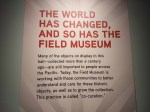
But boy, the Field Museum really does seem to be doing a fair amount towards rectifying past attitudes and actions. I took these two pictures and there were at least two others I wish I had remembered to take pictures of. I was thrilled to see such obvious mentions of this kind of thing instead of a lack of change or pretending it didn’t happen.
@kaijutegu I’ve been meaning to post these for the past few days, every time I see the BP museum post go by again!
This is great, but I would be really curious to see what tribe responses to these efforts have been. I know a lot of tribes struggle with NAGPRA recognition and have to be “validated” through historical records written mostly by white explorers. I would hope the Field Museum would take a more proactive approach. I also hope there’s an effort to return these artifacts to their homes and help those populations with preservation on their own terms, rather than maintaining those items in their own care (unless that permission has been specifically granted).
@upperpaleolithic Idk if you already did, but in case you didn’t, I would click to read the Black Panther post I linked! I know @kaijutegu talks a lot about returning artifacts to the groups they came from & such, and co-curation (which is the maintaining of objects at the museum, but with input from the original group).
I don’t think it’s in the link I included, but I also remember another discussion on that same post where people were talking about how there are still issues with paperwork & bureaucracy & difficulties with recognition or jumping through hoops to sort this kind of thing out. I think it was more about the availability of collections to scholars of color & scholars from the groups that those collections are from, but yeah. Still definitely some difficulties, and I’m sure not all museums have the funds or time or people necessary to be doing as much as they should with de-colonizing and all. But there is some progress and hopefully that will continue to spread and improve.
Loads of good stuff to talk about here! ’s gonna get long, but I hope you take the time to read it if you’re interested in this stuff! Also please let me know if you can’t see the links.
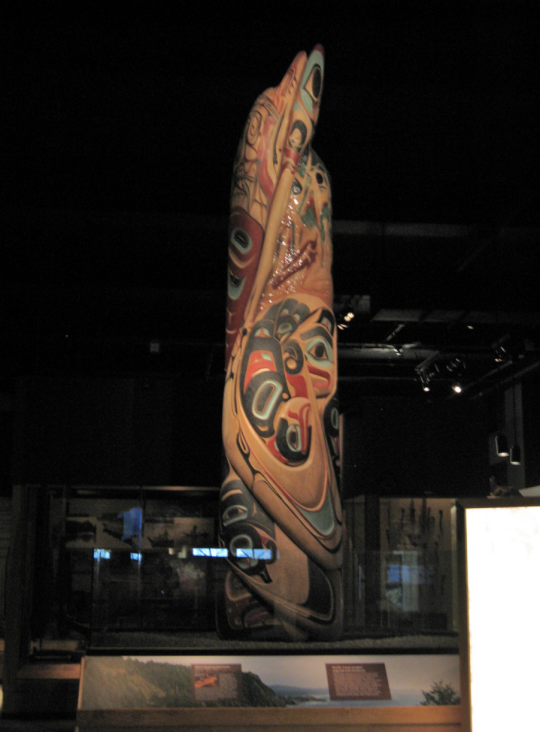
I’ve posted about it before, but the Field has an incredibly good repatriation department that actively does work with indigenous nations to get stuff home. But the goal isn’t “empty the museum,” the goal is “present indigenous history in a way that represents what the native group actually wants.” Case in point: this totem pole.
I told the story of it here, but the gist is there was this really awesome but totally stolen totem pole and the people who made it rather wanted it back, so back it went- but then the museum commissioned a couple of native artisans from that same group to create a new totem pole to take its place. When done well, repatriation’s not just about giving stuff back- it’s about building relationships with the groups. A lot of Native American groups want archaeology and museum exhibitions to happen- they recognize the scientific and social value. But they also generally don’t want to be objectified.
Another really good example of culture of origin reaction to repatriation/co-curation is the Maori response to the Field’s marae, or meeting house. The house was sold in the midst of a family dispute, and another one was constructed at the original site- and when the Field wanted to exhibit the house, their first point of contact was that family. One of the curators had been trying to talk to the descendants for years about the possibility of repatriation, but… ok, so this is another kinda sticky point about repatriation.
Not every object was stolen and/or excavated; some were actually sold- and there can be an enormous deal of shame surrounding past actions, which was the situation with the descent group for this marae. The fact that the museum bought is inconsequential to this shame- the shame here comes from the fact that it had been sold at all. A family elder/chief had sold it, and that was still a major source of family shame- like somebody selling Grandma’s headstone. When the museum tried to reach out to them, for quite some time it was like rubbing salt in this still-present wound. To the Maori, these houses are alive- spirits dwell in them- and they still have incredible spiritual significance to the Maori today, and so what the museum and the Maori ended up doing was… honestly, something really spectacular.
No, really, it’s cool as hell. The original creators’ direct descendants were flown other and stayed in Chicago for a while while they talked with the Field curators about what to do with the marae. It was restored and painted- not the standard methods for archaeological conservation, but that was less important than keeping the house the way the Maori wanted it. Maori groups regularly come in and have events there, and we do what we can to help keep the spirits warm. Sometimes people even sleep in there, because the Maori asked for that. Now, the big repatriation law in the US- NAGPRA (the Native American Graves Protection and Repatriation Act)- doesn’t cover non-Native North American groups, but this is something that the Field finds important for a lot of reasons. It’s not just about ethics- it improves the museum experience for guests as well. It adds context and shows cultural continuity for the creator cultures.
The Field also has co-curation in place pre-NAGPRA; the Pawnee Earth Lodge we have is a modern recreation that was built with the guidance of Pawnee elders back in 1977. It’s been rededicated, and there’s been drum circles and purification rituals held there by representatives of the Pawnee nation to cleanse the space. It would have been ethically tenuous to have a “genuine” earth lodge in the museum, but having one built for us that combines ancestral and modern Pawnee spiritualities and sensibilities is like I mentioned in the other post- it’s a way to show museum guests that Native Americans still exist and that these rich cultures and their traditions aren’t some relic of an ancient past.
But there’s a major design flaw in NAGPRA that makes repatriation extremely difficult sometimes, even when the museum itself wants to give stuff back. This barrier is the five year rule- basically, when NAGPRA was passed in 1990, museums had five years to identify all of the Native American stuff in their collections and list its tribal affiliation. In the bad old days of collecting, a lot of people didn’t bother to take down the names of the folks they took stuff from, and thanks to the way the US laws regarding tribal enrollment work, group affiliation can change, be subsumed into larger groups, or just not be federally recognized. So a lot of material got classified as “culturally unidentified,” and some museums aren’t making efforts to identify it. And legally, they don’t have to, because they were supposed to get that done within that five year period. Five years is a tiny amount of time to get a bulletproof cultural affiliation on artifacts and remains- big natural history museums have millions of objects in their collections sometimes.
Now, I can say with absolute certainty that the Field is not doing that, because I’ve actually worked on some of this material. A few years back, I was working on a project to identify several hundred boxes of that “culturally unidentified” stuff. These boxes were considered lowest priority because they only contained soil samples, rocks, animal bone, some lithic debitage, and ceramic potsherds, but the work still was important. When my chunk of the project was complete, our repatriation department sent notice to several of their native contacts. None of them wanted two hundred boxes of broken pottery back. Case closed- unless later on they decide they do want it, in which case now it’s been identified and so they’ll get it pretty quickly. That’s an example of a best-case scenario. When remains are involved, it gets a lot trickier. Sometimes two or more nations claim the same set of remains, or the museum drags its feet. Harvard’s Peabody Museum runs into this problem a lot- here’s an article from a few years back, if you want some scope on this kind of problem. If the Wampanoag and the Narragansett clam the same remains, and their historical territorial affiliations overlap, and DNA testing isn’t going to give a good outcome (some groups do not want DNA testing, and others are so closely related that haplogroup testing wouldn’t really be helpful at all, plus admixture over the years can make DNA testing even more complex), who’s in the right? Who gets the remains? Sometimes it works out- Kennewick Man, for instance, ended up buried in a location agreed upon by the groups that had claim to him, and most, if not all, of them participated in the interment ceremony. But other times, it doesn’t- and the legal battles wage on, which can get real expensive real quick for the native groups and museums, especially smaller museums that don’t have a big endowment. Fortunately, there are federal grants available to help. But this leads to another massive problem with NAGPRA…
NAGPRA has some serious budget issues.
Do you know who’s in charge of NAGPRA? It’s the National Park Service! You know, the one that our current president is decimating? This means that NAGPRA grants (aka money to be given to people trying to get their stuff back or money given to museums to help ID stuff) have been substantially reduced as well. In fact, they’ve been 100% reduced! That’s right, our wizened yam of a president requested a whopping ZERO DOLLARS for repatriation grants! It does seem like they did get some funding, as they haven’t closed down grant application- but I hope this stands as an illustration of the potential seriouness of this problem. In addition, part of the legal requirement for repatriation is publishing inventory completions and intents to repatriate in the Federal Register, and there’s a massive backlog of those.
Finally, the actual repatriation process does take some time. The NMAI has a really cool guide to safe repatriation online here; you really can’t just hand over the stuff and say “see ya! you’re on your own!” A lot of it’s actually poisonous, thanks to the old-timey pest treatment called “covering it in arsenic until the bugs are dead.”
Sara Jacobsen, 19, grew up eating family dinners beneath a stunning Native American robe.
Not
that she gave it much thought. Until, that is, her senior year of high
school, when she saw a picture of a strikingly similar robe in an art
history class.
The teacher told the class about how the robe was
used in spiritual ceremonies, Sara Jacobsen said. “I started to wonder
why we have it in our house when we’re not Native American.”
She said she asked her dad a few questions about this robe. Her dad, Bruce Jacobsen, called that an understatement.
“I
felt like I was on the wrong side of a protest rally, with terms like
‘cultural appropriation’ and ‘sacred ceremonial robes’ and ‘completely
inappropriate,’ and terms like that,” he said.
“I got defensive
at first, of course,” he said. “I was like, ‘C’mon, Sara! This is more
of the political stuff you all say these days.’”
But Sara didn’t
back down. “I feel like in our country there are so many things that
white people have taken that are not theirs, and I didn’t want to
continue that pattern in our family,” she said.
The robe had been
a centerpiece in the Jacobsen home. Bruce Jacobsen bought it from a
gallery in Pioneer Square in 1986, when he first moved to Seattle. He
had wanted to find a piece of Native art to express his appreciation of
the region.
The Chilkat robe that hung over the Jacobsen dining room table for years. Credit Courtesy of the Jacobsens
“I just thought it was so beautiful, and it was like nothing I had seen before,” Jacobsen said.
The
robe was a Chilkat robe, or blanket, as it’s also known. They are woven
by the Tlingit, Haida and Tsimshian peoples of Alaska and British
Columbia and are traditionally made from mountain goat wool. The tribal
or clan origin of this particular 6-foot-long piece was unclear, but it
dated back to around 1900 and was beautifully preserved down to its long
fringe.
“It’s a completely symmetric pattern of geometric
shapes, and also shapes that come from the culture,” like birds,
Jacobsen said. “And then it’s just perfectly made — you can see no seams
in it at all.”
Jacobsen hung the robe on his dining room wall.
After
more needling from Sara, Jacobsen decided to investigate her claims. He
emailed experts at the Burke Museum, which has a huge collection of
Native American art and artifacts.
“I got this eloquent email
back that said, ‘We’re not gonna tell you what to go do,’ but then they
confirmed what Sara said: It was an important ceremonial piece, that it
was usually owned by an entire clan, that it would be passed down
generation to generation, and that it had a ton of cultural significance
to them.“
Jacobsen
says he was a bit disappointed to learn that his daughter was right
about his beloved Chilkat robe. But he and his wife Gretchen now no
longer thought of the robe as theirs. Bruce Jacobsen asked the curators
at the Burke Museum for suggestions of institutions that would do the
Chilkat robe justice. They told him about the Sealaska Heritage
Institute in Juneau.
When Jacobsen emailed, SHI Executive
Director Rosita Worl couldn’t believe the offer. “I was stunned. I was
shocked. I was in awe. And I was so grateful to the Jacobsen family.”
Worl said the robe has a huge monetary value. But that’s not why it’s precious to local tribes.
“It’s
what we call ‘atoow’: a sacred clan object,” she said. “Our beliefs are
that it is imbued with the spirit of not only the craft itself, but
also of our ancestors. We use [Chilkat robes] in our ceremonies when we
are paying respect to our elders. And also it unites us as a people.”
Since
the Jacobsens returned the robe to the institute, Worl said, master
weavers have been examining it and marveling at the handiwork. Chilkat
robes can take a year to make – and hardly anyone still weaves them.
“Our
master artist, Delores Churchill, said it was absolutely a spectacular
robe. The circles were absolutely perfect. So it does have that
importance to us that it could also be used by our younger weavers to
study the art form itself.”
Worl said private collectors hardly ever return anything to her organization. The federal Native American Graves Protection and Repatriation Act requires
museums and other institutions that receive federal funding to
repatriate significant cultural relics to Native tribes. But no such law
exists for private collectors.
Bruce
and Gretchen Jacobsen hold the Chilkat robe they donated to the
Sealaska Heritage Institute as Joe Zuboff, Deisheetaan, sings and drums
and Brian Katzeek (behind robe) dances during the robe’s homecoming
ceremony Saturday, August 26, 2017. Credit NOBU KOCH / SEALASKA HERITAGE INSTITUTE
Worl
says the institute is lobbying Congress to improve the chances of
getting more artifacts repatriated. “We are working on a better tax
credit system that would benefit collectors so that they could be
compensated,” she said.
Worl hopes stories like this will encourage people to look differently at the Native art and artifacts they possess.
The Sealaska Heritage Institute welcomed home the Chilkat robe in a two-hour ceremony over the weekend. Bruce and Gretchen Jacobsen traveled to Juneau to celebrate the robe’s homecoming.
Really glad that this is treated as hard hitting news, no really, I am



 Beltainefaerie's Flights of Fancy