IF YOU NEED TO CALL 911 BUT ARE SCARED TO BECAUSE OF SOMEONE IN THE ROOM, dial and ask for a pepperoni pizza. They will ask if you know you’re calling 911. Say yes, and continue pretending you’re making an order. They’ll ask if there’s someone in the room.
You can ask how long it will take for the pizza to get to you, and they will tell you how far away a dispatcher is.
My flat-mate’s date for the night was almost as drunk as her. She had passed out in her room and locked the door. He refused to leave because he wanted to have sex. He also demanded food because he was dealing with “whiskey dick”. He didn’t like the lack of food in the fridge. I called 911, did the stuff stated above, and he was getting PISSED about how long the “order” was taking. He took my phone, demanded they “hurry the fuck up”. Police arrived two minutes later, arrested him, and helped me file a police report. Pressing charges wasn’t necessary because he had warrants on him from THREE different states for the very thing he planned to do to me. Several months after this happened one of the officers informed me he was charged with two felonies because he crossed stay lines, and will be serving no less than 35 years in prison. The officer ripped into my flat-mate about her bringing home complete strangers, while drunk, knowing full well this shit could happen.
This was 14 years ago.
Do the pizza order, do it as calmly as you can. The dispatcher I spoke to said things like this:
“If he’s drunk say you want mushrooms.” I said I want extra mushrooms.
“If he’s threatening you with sexual assault say you want onions.” I said I want onions.
She went like this with different toppings and sauces for a description of him, like pineapple if he’s blonde, black olives if he’s tall, extra large if he’s tall, etc.
They’ve heard this sort of coded call before. They’re trained for it. They will understand what you’re saying. Order the pizza.
Really though. I’m in training for dispatch and this was one of the first things they taught us. Pretend you’re talking to a friend or relative, pretend you’re ordering pizza, we’ll figure it out. We’ll word questions so you can answer in an easy, casual way. Please, just make the call and we will do everything we can to help you.
and for those interested, you can find the report HERE
Just in case any dudebros are unclear on what this means: it means that your buddy who totally just had some bitch trying to ruin his life by accusing him of rape…almost certainly actually did rape her.
Just keep that in mind.
Yeah man, imagine that, bitches don’t be lying.
Can we put this into context? It means that 99.4% of rape allegations are true.
It means that 99.4% of rape allegations are true.
When you read through and learn about those 0.6% who did make false allegations, there are some seriously important things to note. Firstly :
“Furthermore, the report shows that a significant number of these cases involved young, often vulnerable people. About half of the cases involved people aged 21 years old and under, and some involved people with mental health difficulties. In some cases, the person alleged to have made the false report had undoubtedly been the victim of some kind of offence (sic), even if not the one which he or she had reported.”
And then, when you get into the case studies you find things like a 14 year old girl sleeping with an 18 year old. When discovered, she claimed the sex was non-consensual in fear of her father’s disapproval, but investigation of texts and emails found that to be untrue. THAT SAID, the 18 year old was found to have a history of pursuing and seducing many very young girls, and once he was counseled he expressed not only regret over his actions, but the knowledge that he was purposefully picking vulnerable girls who could be easily manipulated into consent.
Another case was a married couple, where the wife claimed rape and domestic violence, so the husband was arrested and held. After some contact between the two while he was incarcerated, she went back to him and wanted the charges dropped. It’s okay because she still loves him. When the DA decided to keep going, she suddenly said that she made it up and he never raped her at all. Further counseling revealed that the allegations were true, but she didn’t want to be without him so she lied about the allegations being false. I don’t know about you, but this kind of sounds like classic domestic violence, and the kind of patterns you get into after living with an abuser.
The point I’m trying to make is that even though there are 0.6% false claims… when you break them down you find that there’s generally a lot of skeevy shit going on, and like the above quote, many of the alleged rape victims are actual victims of other abuses. For some of them, I’m guessing that an allegation of rape was the only way to bring enough attention to their abuse to finally get protection by law enforcement, or enough care from family to be freed from their abusive situations and moved somewhere safe. Some are mentally ill and have been taken advantage of, or are victims of statutory rape because they are not even remotely mature enough to truly consent to a sexual relationship with an adult. These cases aren’t just as simple as, “some bitch regretted sex and cried rape”.
So, when I was in junior high, back in the Cretaceous Period, 😉 I checked out a book from the library about a junior high girl who is a photographer and whose sister gets cancer and dies. It was a beautifully written book, and I enjoyed angst because I was, you know, a junior high girl. 😉 So I read it over and over and over again. I checked it out from the library dozens of times.
One day, my mother noticed and asked what I was reading, and I started waxing enthusiastic about the book and what happens in it and I was just really happy to share, and she asked me, “Why do you like reading that? Do you want your sister to die?”
I didn’t respond well.
Now that I’m an adult, I understand that my mother primarily read for wish-fulfillment (historical romances, mostly), and that she furthermore believed that this was why everyone else read.
This is not why everyone else reads.
Many people read because they want to know what it would be like to be someone else. Someone of a different gender. Someone who lives in a different place. Someone with different skills. Someone whose life is completely different from theirs. Some of these people are happiest when a character is complicated.
People do this to authors, too, by the way. They assume that authors who write convincingly about rape or child abuse have been raped or abused themselves. This is not necessarily true. Mystery writers are not all homicidal maniacs. I know that will shock some of you. 😉
Stories are important. They teach us about life.
To make a long story short, if you think you can psychoanalyze a fan (or an author) based on their reading (or writing) preferences, you are wrong.
To drag this over to what prompted the rant, a fan telling another fan that they think Snape is a racist and therefore if they like Snape they are also a racist is approximately as valid as insisting that everyone who likes the Harry Potter series wishes both of their parents had been murdered.
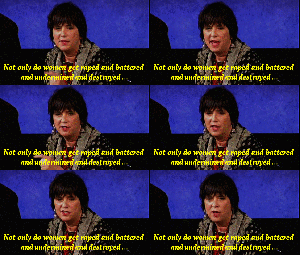
(Left to Right): Peter Buffett, Jimmie Briggs, Joe Ehrmann, Tony Porter, Dave Zirin and Moderator Eve Ensler.
MIC DROP
I 100% agree with the intent of this statement, (that women shouldn’t have to fix everything and that the overwhelming majority of rapists are men), but I just want people to know that if you have been raped by a woman, I’m sorry this happened to you and your experience is valid. I hope you get all the support you need too. Pandora’s Project has resources and forums to help.
When I first encountered the literary classic Lolita, I was the same age as the infamous female character. I was 15 and had heard about a book in which a grown man carries on a sexual relationship with a much younger girl. Naturally, I quickly sought out the book and devoured the entire contents on my bedroom floor, parsing through Humbert Humbert‘s French and his erotic fascination for his stepdaughter, the light of his life, the fire of his loins — Dolores Haze. I remember being in the ninth grade and turning over the cover that presented a coy pair of saddle shoes as I hurried through the final pages in homeroom.
Although I remember admiring the book for all its literary prowess, what I don’t recall is how much of the truth of that story resonated with me given that I was a kid myself. Because it wasn’t until I reread the book as an adult that I realized Lolita had been raped. She had been raped repeatedly, from the time she was 12 to when she was 15 years old.
As a young woman now, it’s startling to see how that fundamental crux of the novel has been obscured in contemporary culture with even the suggestion of what it means to be “a Lolita” these days. Tossed about now, a “Lolita” archetype has come to suggest a sexually precocious, flirtatious underage girl who invites the attention of older men despite her young age. A Lolita now implies a young girl who is sexy, despite her pigtails and lollipops, and who teases men even though she is supposed to be off-limits.
In describing his now banned perfume ad, Marc Jacobs was very frank about the intentions of his sexy child ad and why he chose young Dakota Fanning to be featured in it. The designer described the actress as a “contemporary Lolita,” adding that she was “seductive, yet sweet.” Propping her up in a child’s dress that was spread about her thighs, and with a flower bottle placed right between her legs, the styling was sufficient to make the 17-year-old look even younger. The text below read “Oh Lola!,” cementing the Lolita reference completely. The teenager looks about 12 years old in the sexualizing advertisement, which is the same age Lolita is when the book begins.
And yet Marc Jacobs’ interpretation of Lolita as “seductive” is completely false, as are all other usages of Lolita to imply a “seductive, yet sweet” little girl who desires sex with older men.
Lolita is narrated by a self-admitted pedophile whose penchant for extremely young girls dates all the way back to his youth. Twelve-year-old Dolores Haze was not the first of Humbert Humbert’s victims; she was just the last. His recounting of events is unreliable given that he is serially attracted to girl children or “nymphets” as he affectionately calls them. And his endless rationalizing of his”love” for Lolita, their “affair,” their “romance” glosses over his consistent sexual attacks on her beginning in the notorious hotel room shortly after her mother dies.
This man who marries Lolita’s mother, in a sole effort to get access to the child, fantasizes about drugging her in the hopes of raping her — a hypothetical scenario which eventually does come to fruition. Later on as he realizes that Lolita is aging out of his preferred age bracket, he entertains the thought of impregnating her with a daughter so that he can in turn rape that child when Lolita gets too old
Lolita does make repeated attempts to get away from her rapist and stepfather by trying to alert others as to how she is being abused. According to Humbert, she invites the company of anyone which annoys him given that the pervert doesn’t want to be discovered. And yet, he manipulates her from truly notifying the authorities by telling her that without him — her only living relative — she’ll become a ward of the state. By spoiling her with dresses and comic books and soda pop, he reminds her that going into the system will deny her such luxuries and so she is better off being raped by him whenever he pleases than living without new presents.
Given that Humbert is a pedophile, his first-person account is far from trustworthy when deciphering what actually happened to Lolita. But, Vladimir Nabokov does give us some clues despite our unreliable narrator. For their entire first year together on the road as they wade from town to town, Humbert recalls her bouts of crying and “moodiness” — perfectly understandable emotions considering that she is being raped day and night. A woman in town even inquires to Humbert what cat has been scratching him given the the marks on his arms — vigilant attempts by Lolita to get away from her attacker and guardian. He controls every aspect of her young life, consumed with the thought that she will leave him with the aid of too much allowance money or perhaps a boyfriend. He interrogates her constantly about her friends and eventually ransacks her bedroom revoking all her money. Lolita is often taunted with things she desires in exchange for sexual favors as Nabokov writes in one scene:
“How sweet it was to bring that coffee to her, and then deny it until she had done her morning duty.”
Lolita eventually does get away from her abusive stepfather by age 15, but the fact that she has been immortalized as this illicit literary vixen is not only deeply troublesome, it’s also a completely inaccurate reading of the book. And Marc Jacobs is not alone in his highly problematic misinterpretation of child rape and abuse as “sexy.” Some publications and publishing houses actually recognize the years of abuse as love.
On the 50th anniversary edition of Lolita, which I purchased for the sake of writing this piece, there sits on the back cover a quote from Vanity Fair which reads:
“The only convincing love story of our century.”
The edition, which was published by Vintage International, recounts the story as “Vladimir Nabokov’s most famous and controversial novel” but also as having something to say about love. The back cover concludes in its summary:
“Most of all, it is a meditation on love — love as outrage and hallucinations, madness and transformation.”
“Love” holds no space in this novel, which details the repeated sexual violation of a child. Although Humbert desperately tries to convince the reader that he is in love with his stepdaughter, the scratches on his arms imply something else entirely. Because the lecherous Humbert has couched his pedophilia in romantic language, the young girl he repeatedly violated seems to have passed through into pop culture as a tween temptress rather than a rape victim.
Conflating love or sexiness with the rape of literature’s most misunderstood child is dangerous in that it perpetuates the mythology that young girls are some how participating in their own violation. That they are instigating these attacks by encouraging and inciting the lust of men with their flirty demeanor and child-like innocence.
Let it be known that even Lolita, pop culture’s first “sexy little girl” was not looking to seduce her stepfather. Lolita, like a lot of young girls, was raped.
I was going through this at age 11 when i got my hands on the book, and i never read it as sexual. I cried and related to her on such a deep level. Anyone who thinks lolita is a love story is gross.
Too real. Lolita means so much to me, because I was raped by an older adult man when I was 15 and years later when I came forward about it people said it was my fault because I flirted with him. A friend of his even teased me with the comment “weren’t you his little Lolita?” Lolita. Is Not. A love story. The continuous sexual abuse of a teenage girl is not love.
What chaps my ass is that NABOKOV didn’t see it as a love story. He found Humbert repugnant and went out of his way to make him so.
He hated that people saw it as romantic when he’d meant to write a fucking horror novel.
Nabokov literally wrote Lolita to show how disgusting these abusive situations are but nOOOOoooooo pop culture decides to immortalize the scared little girl as a SEX ICON and call this messed up “relationship” LOVE.

















 Beltainefaerie's Flights of Fancy