I recently re-read Neil Gaiman’s Norse Mythology. The first time, I read it because I’m a huge Neil Gaiman fan. He’s probably my favorite contemporary fiction author, and American Gods is easily one of my favorite novels, with all of its magic crackling under America’s inherent weirdness. The second time, though, I read it with a more particular frame, to think more specifically about a cultural heritage that I have, as the descendent of Swedish immigrants, but one that I had not been taught or deeply considered.
Part of the desire to learn more about this cultural heritage and mythology comes from a place of personal history. Two years ago this summer, I took my then two-year-old son to Swedeburg, Nebraska, to bury my namesake, my great uncle Carl [1]. There in the cemetery surrounded by the mossy headstones of five generations of my Swedish Lutheran forebears, a sense of being from a place and having a thread back to another place out of my time and memory began to unspool. It’s been a quiet following of the thread, which feels only fitting for these stoic Scandinavians who came to farm the Midwest and start little churches and teach.
This contemplative unspooling has also come in the contemporary context of the Black Lives Matter movement, and with a desire to deconstruct the oppressiveness of what “White” means, as someone who definitely is lacking in melanin and comes genetically from northern Europe. Writing in the New York Times [2], professor and author Nell Irvin Painter says, “An essential problem here is the inadequacy of white identity. Everyone loves to talk about blackness, a fascinating thing. But bring up whiteness and fewer people want to talk about it. Whiteness is on a toggle switch between “bland nothingness” and “racist hatred.”…Eliminating the binary definition of whiteness — the toggle between nothingness and awfulness — is essential for a new racial vision that ethical people can share across the color line.”
Whiteness has always privileged my Protestant, northern European self. Even as it historically excluded Catholics, southern Europeans, and others, they have been, over time and in this country, sponged up into that emptiness. Whiteness is an erasure, of others and of the beneficiaries, an all-consuming blankness of power.
Breaking that toggle switch, filling that void of sameness, then, needs specificity. This is not to say that having a cultural heritage you are aware of and a participant in is a panacea for systemic injustice and prejudice, and history is filled with conflict because “you” are not like “me.” But if you are more aware of who you are and are comfortable with it, there is less need for an impulse to define yourself in opposition to, through power over others – if we white people are to dismantle whiteness, we need to know where to put ourselves.
Which brings us back to Norse mythology, something that I have claim to but have never learned. There is a grim inevitability in the Norse myths, in that we know how they end. All these tales are simply slouching towards Ragnarok, the final battle where the Aesir will be wiped out. In Gaiman’s hands it’s a dry, almost sardonic end, and one that is of the god’s own making, rooted in their own hubris and self-confidence. Odin, the All-Father, may have wandered the world, given up his eye and crucified himself for all the knowledge in the world, but all his power still makes him powerless to stop the end from coming. The strength of Thor and his hammer Mjölnir cannot win the battle.
The agents of this destruction are the children of Loki, the trickster god who the Norse gods don’t trust but believe they can control. Loki’s children are Jormungundr the Midgard serpent who is wrapped around the world and spits poison; Hel, the ruler of the dead who did not die valiantly, with her bowl Hunger, her knife Famine, and her bed Sickbed; and Fenris Wolf, the eater of the world, and enormous wolf bound and held captive through the treachery of the Aesir. The god Frey had a sword that could have defeated the fire demon Surtr, but he gave it up in pursuit of his wife Gerd.
As Gaiman puts it in his introduction, “It was the fact that the world and the story ends, and the way that it ends and is reborn, that made these gods and the frost giants and the rest of them tragic heroes, tragic villains. Ragnarok made the Norse world linger for me, seem strangely present and current, while other, better-documented systems of belief felt as if they were part of the past, old things.”
There is rebirth – man and woman survive Ragnarok and emerge from Yggdrasil, the immense tree of life that holds all the worlds together. Balder, Odin’s second son who was the “wisest, the mildest, the most eloquent” of the gods comes back from the underworld. If myths like this are passed down with morals or warnings that we are trying to discern or give our lives shape and meaning, then the promise of the world beginning anew, after foolishness, violence and destruction, that is worth holding on to. It also demands that we question ourselves and who we are in this, how our own actions and history must be confronted.
The other, more unsettling reason to read the Norse myths with an eye to dismantling whiteness is that white supremacists love their conception of Vikings, love a made-up all-white Norse myth, and have, through the prison-industrial complex, spread a racist version of Norse heathenism. [3] What would the All-Father say about these morons? Maybe Gaiman’s line about Ragnarok, “Twilight will come to the world, and the places where the humans live will fall into ruin, flaming briefly, then crumbling down and crashing into ash and devastation.”
David Perry of the University of Minnesota did have this to say about the misguidedness of Viking-loving white supremacists in the Washington Post [4], that “the Vikings of Europe did not exist in pure white racial isolation. The Vikings…tapped into rich multicultural trading networks — fighting when useful, but delighted to engage in economic and cultural exchange with great powers of Eurasia. That included the Jews of Khazaria, Christians dedicated to both Rome and Constantinople and Muslims of every sect and ethnicity. Islamic coins, in fact, have been found buried across the Viking world, a testimony to the richness of this exchange.”
There’s something profound about that exchange, pointing other ways forward than the pillaging, blood-soaked, domination stories and assumptions we’re living through. Whiteness does not have to exist in this way, we have been as flawed, as self-involved, as short-sighted and as vain as the Aesir, and there is an end coming. “Burn it to the ground,” like Michelle Wolf’s note before the White House Correspondent’s Dinner put it. [5] Or this excerpt from Danez Smith’s extraordinary new poem, ‘say it with your whole black mouth’: [6]
so many white people are alive because
we know how to control ourselves.
how many times have we died on a whim
wielded like gallows in their sun-shy hands?
here, standing in my own body, i say: the next time
they murder us for the crime of their imaginations
i don’t know what i’ll do.
i did not come to preach of peace
for that is not the hunted’s duty.
i came here to say what i can’t say
without my name being added to a list
A coda, of sorts. I think a lot about these Scandinavians on the prairie, and what they did to survive, and who they displaced to turn the open fields into farmland, and I don’t have any resolution in that. But I did, last weekend, find an extraordinary collection of poems, Sacred Hearts, by Phebe Hanson, published by Milkweed Editions in 1985. [7] The daughter of a Lutheran pastor who grew up on the prairie and then moved to Minneapolis to become a teacher, she immediately fit into my constellation of great aunts. The collection is full of spare, precise, and unblinking examinations of mortality, gender expectations, sexual violence, and change. For poems a year younger than I am and about experiences far older, they are also poems for now. This, from ‘Why I Have Simplified My Life,’ knocked me flat:
Tell yes about that cow that licked someone into being?
OH MAN OH BOY OH MAN
Okay. Auðumla.
Before all things, there were only the planes of endless fire and endless ice. Where these met, the primal ice began to melt, and from the drops of meltwater sprang a child; Ymir, the first being, who was both male and female and who could reproduce asexually. Ymir had many sons and daughters. From the line of Ymir comes the giants.
Also from the melt sprang Auðumla, the great cow, who licked at the ice for nourishment. As she licked at the ice, Ymir suckled from her and grew. As
Auðumla licked at the ice, her licks uncovered Buri, the first of the Aesir.
Buri had a son named Bor. (The name of Buri’s wife has been lost, but we can assume that he either created Bor asexually or married one of Ymir’s daughters. As Buri is the god of creation, either may be true)
Bor married a giantess named Bestla, the daughter of the giant Bolthorn and granddaughter of Ymir.
They had a son in turn, who they named Odin. Odin Borsson, who with his brothers Vili and Ve slew Ymir to create the world. Odin, who would take on a thousand more names in time, including Allfather.
To clarify…
Auðumla licked the blocks of salt ice into the shape of a man, which then lived.
…what, nobody is going to turn that into a I lik the bred poem?
Don’t look at me, I suck at poetry. But… it just seems like the Universe would want it to happen.
Considering the fact that poetry is a highly honorable pursuit and poets are held in high esteem YES SOMEONE DO THE THING THE GODS WISH IT
my name is cow
and long ago
when I cam
from melted sno
i hav a thirst
so in a trice
i mak a man
i lik the ice
A SKALD EMERGES
Oh I’ll do you one better.
In Old Norse:
Ek heiti kýr ok þá er svǫng ek neyti tungu eins ok eldfǫng
What/who do you want to know more about and also I will not shut up on this so be warned.
My name is Cow and when I’m hungry I use my tongue like fire-tongs
The world is new And I am cold My name is Cow
I lick a salt
I’M CRYIGNG IT’S SO BEAUTIFUL
I just want to add, for those who loved this as much as I did, you should also check out Ada Palmer’s brilliantIce and Fire, a song about the creation of the norse worlds, which features Auðumla the Ice Cow (the first thing in existence that wasn’t innately deadly) prominently. And all the names of Odin. I can’t seem to embed the player in a reply, but go. listen.
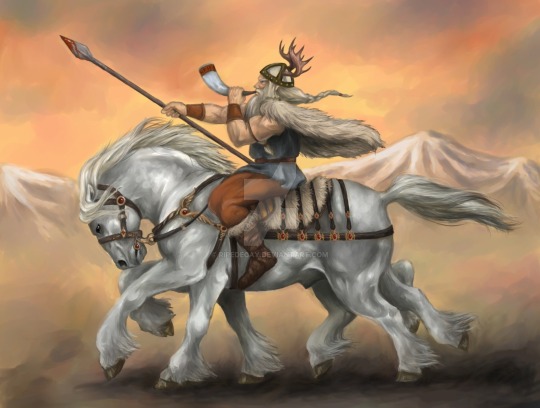
One thing I never really understood was Sleipnir (meaning “slippery one” fyi) in depictions of Norse mythology. Sleipnir is an eight-legged horse, the steed of Odin and the son of Loki, and he is commonly depicted like this:
(image not mine)
But why would you depict an eight-legged horse like this? Horses gallop the same way most other mammals run, with all feet leaving the ground at one point, so having extra feet here doesn’t seem like it could make the horse any faster. I’m also not sure it would give it any more stable footing, since it doesn’t have a wider base.
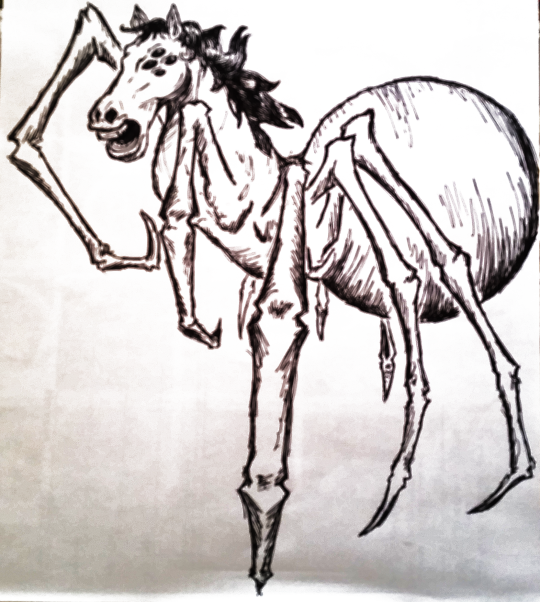
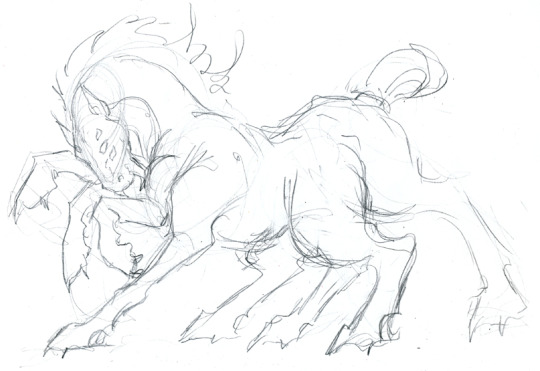
If you want a stable eight-legged form that can reach great speeds for its size, wouldn’t you want to start with what nature has already provided? Wouldn’t you want something more like… this?
(my drawing)
“But wait!” you might say, “Sleipnir was conceived when Loki, in horse-form, seduced another horse! That’s why it looks all horsey, just with extra bits!”
Well, that’s a good point, but consider that Loki as a deity was originally based off the spider, and his name even derives from the old Swedish word for spider (source). Therefore, it’s not too hard to believe Sleipnir inherited his horse half from his mother and the more spidery half from his father. In conclusion:
Spider-Horse, Spider-Horse, He does spider-things of course! Weaves a web, Makes you gawk, Riding round ‘til Ragnarok! Look out! Here comes the Spider-Horse.
I am all for creative interpretations of Sleipnir. And spiders, obviously. This is epic.
But just so you know, that journal is from the 60′s, and the current scholarly consensus no longer considers the spider etymology to be likely. We still aren’t sure where the name comes from, and probably won’t ever be, but I’ve seen quite a few more recent academics lean toward Old Norse luka, meaning “close”, “shut”, or “end.” (See Simek’s Dictionary of Northern Mythology.)
^^^^ my research found much the same. (which is sad, i like spiders)
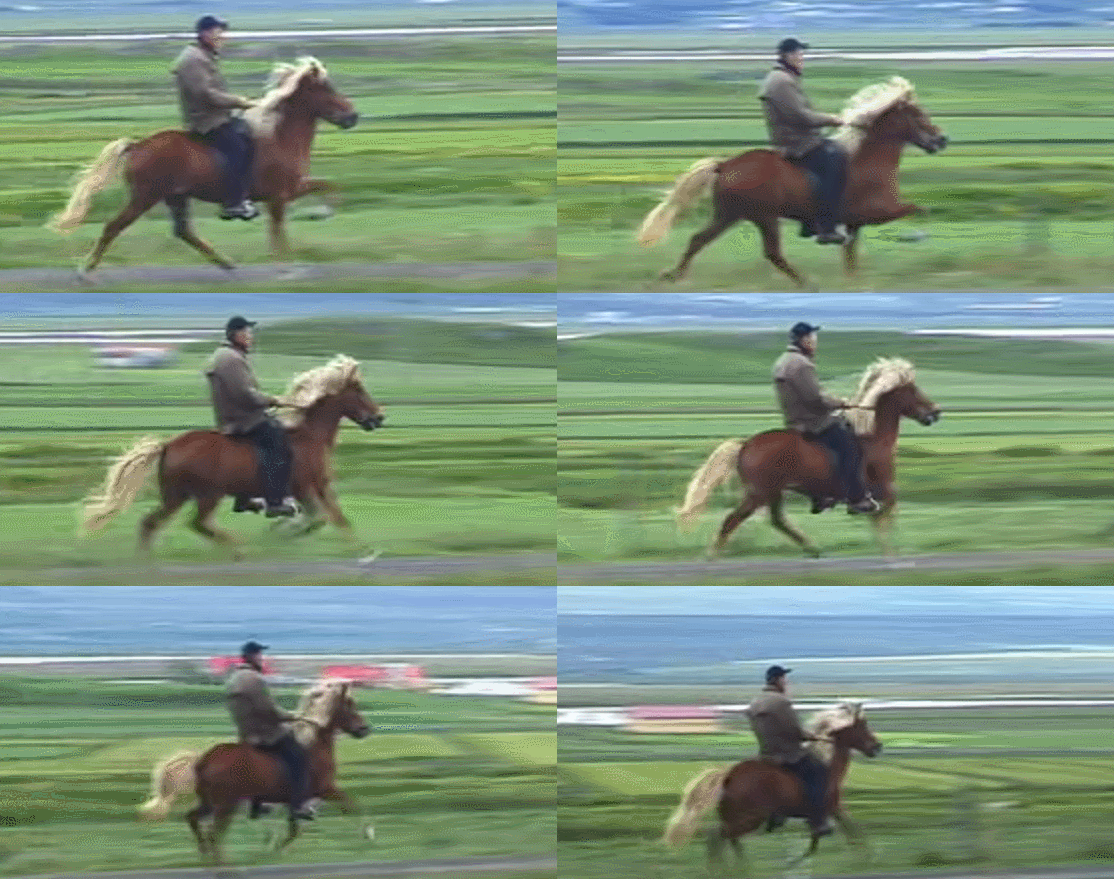
As far as Sleipnir having eight legs, it’s probably a reference to Icelandic horses. Icelandic horses are one of the few horse breeds with five gaits. They can do a walk, trot and canter/gallop, like most horses. But they have also evolved to have a tolt,
[ gif of a man riding a brown Icelandic horse doing a tolt. The back legs of the horse move rather stiffly back and forth, while the front legs are lifted up almost to the horse’s chest. While the horse bounces slightly, the man riding the horse could probably hold a glass of water without spilling. ]
which is fast, smooth and noted for its explosive speed and ability to cover long distances.
The second unique gait is called flugskeið, or flying pace.
[ a light brown Icelandic horse demonstrating the flugskeið. With the exception of the wind in the horses’ mane, the upper part of the horse and the rider seem to almost be still, with the background simply zipping by them. The horse’s legs, however, move fast enough to blur. Unlike with a full gallop, the horse does not fully extend its legs away from its body. This is particularly obvious in the front legs of the horse, which lift up to the chest of the horse and land under its chin the same way as in the tolt]
It is both smooth and fast, some horses being able to reach speeds of 30 mph. Not all Icelandic horses can do a flugskeið, but you’ll notice that when done properly the legs move in unison and so fast they can blur, giving the illusion of the horse having eight legs.
Anyways, here is a video to further emphasize how cool the flugskeið is;
I’d never heard this theory! That’s so neat.
The one I’ve read attributed the eight legs thing to a metaphor of a coffin + 4 pallbearers.
This is FASCINATING, and I adore Sleipnir! 😍 @tinaferraldo
You’ve brought my horse geek out now. You have been warned!
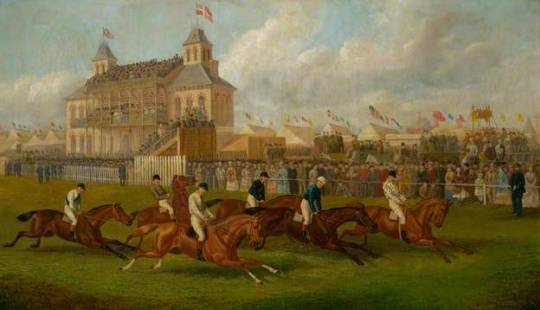
The thing is, until the late 1800s we didn’t know how horses moved.
In old paintings you typically see horses with their legs stretched wide as they thought that gave the appearance of great speed.
But it really just looks like Timmy’s big brother was being an evil bastard and bent the legs of his tin horses out .
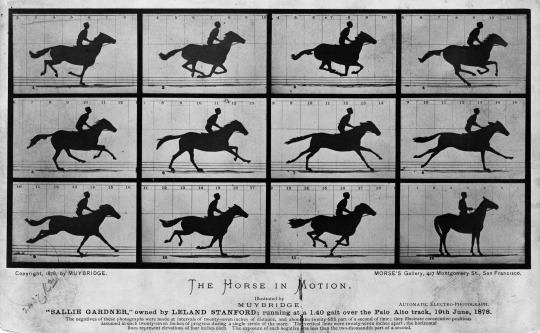
It’s completely unnatural looking, but horses moved too fast for us to be able to see how they moved, until Edward MAuybridge captured their motion in a series of consecutive photographs in 1878.
And for the first time we could see that all four legs did leave the ground. (and are never stretched uncomfortably wide!).
He also created the first motion picture as the individual photographs could be put together as a series of film frames (below).
So, all this is to say that back when Sleipnir was being dreamed up, they didn’t understand how animals moved and probably thought more legs = faster, and to a degree they were right, things on four legs run faster than bipeds so they continued that principle to its logical, if incorrect, conclusion.
THIS IS THE BEST HORSE MOVEMENT DISCOURSE EVER
or we can consider that norse epics were, above all else, poetry, and consider that the image of an eight-legged horse brings to mind a horse that moves like a spider – with that fast darting scuttle that so many people find terrifying. an alien horse. a divine horse. a monster.
(personally i find the spider run adorable, like when a cat gets startled and does the skitter. but i recognize this is an unusual reaction.)
So, inspired by the whole concept of a spider-horse I very loosely sketched this:
…To which my brother @foxofwar simply pointed out, that being a spider-horse, it’s a sporse.
Slightly off topic, but it isn’t unique to Norse mythology to give a magical horse unusual number of legs tho. In Hungarian folklore special horses (usually fond of eating cinders, capable of flying or running faster than the win or even faster than thoughts, usually liked to sass the hero of the tale) had 5, 6 or 7 legs.
Obviously those numbers were chosen because they held cultural significance (our dragons/giants had odd number of heads too), but it probably sounded like common sense that more legs=faster horse.
I have nothing to add but damn is this thread epic.
There’s a Peruvian horse breed called the Paso that has a fifth gait as well – kind of a smooth, toe-skimming shuffle between the trot and the canter. It’s smooth as butter.
Epic horse thread is epic. And fascinating 🙂
Mythology, gaited horses, Muybridge and a wee touch of biomechanics. 👌 well done with this blog bait. You have caught me. You have won



 Beltainefaerie's Flights of Fancy