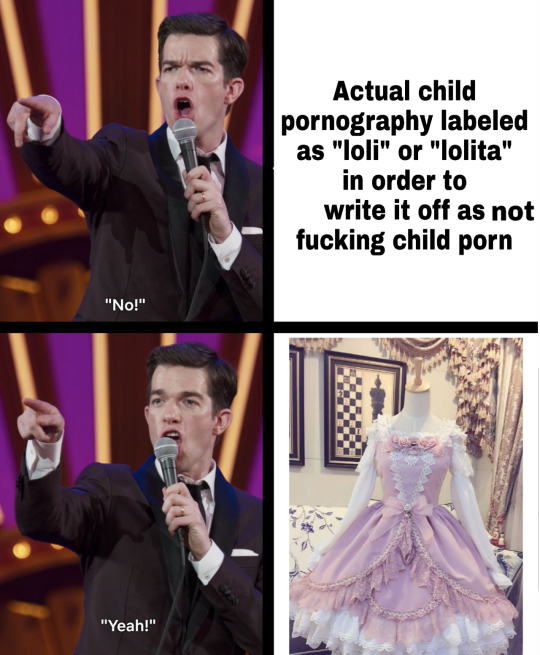
lolita fashion (NOT to be confused with loli/lolita cp) is so cute I just wish it were named something else
lmao then call it something else because there’s a reason it’s called lolita and they aren’t at all using it because of cute fashion.
The name Lolita has nothing to do with pedophillia. It was chosen by Japanese designers in the 70’s because it sounded old fashion and European so it fit the style. Due to a language barrier they did not know what connotations it had outside of Japan
The Lolita fashion community is very anti pedophillia, please do not try to say that we are fetishists for using the terminology our community has used since the 70s it is not our fault
Lolita fashion was intended to be intentionally childish, but not because it would be sexual to pedophiles. The original lolita fashion movement was a symbol of rebellion, of girls reclaiming their sexuality from a society that told them to dress formally at all times to find a husband.
These girls created fashion based around a little girl’s idea of fancy. It wasn’t good looking to men, but the women who wore it loved it, and that was the entire point.
Lolita fashion is basically the Flapper movement of Japan (which, for those who don’t know, was also a movement of young women defying traditional gender roles by dressing in ways they found fun instead of in ways that were deemed appropriate).
i have thought a lot about censorship and what is “appropriate”. not a lot of people know this, but lolita was written to show what we allow on our bookshelves: there being no swear words in it meant it was free from censorship. a book about child molestation was allowed because it didn’t explicitly use the word “fuck”. he wrote it to show we don’t really care about protecting children, and it ended up being seen as a romance.
someone once told me – actually, many people have – that lgbt content isn’t appropriate for children. any content. not just kissing. i’m drowned in questions: “won’t the parents have to explain it?” “kids shouldn’t be thinking about sex at this age, or do you think differently?” “what will the kids think?”
at six i saw disney movies. people kiss and get married. i didn’t ask “what does that mean.” i didn’t ask “are those people going to have sex?” i didn’t ask anything, because i was six, and no six year old thinks twice about these things. nobody ever “explained” being straight to me, it was a fact, and it existed, and i was fine with that. why would being gay require a thesis, i wonder.
someone once told me that the one of the reasons people hate lgbt individuals is because they can’t see us as anything but sexual. we’re not people, so much as sinners. that they don’t see love, they see sex. just sex. it’s perversion, not a matter of the heart. only of the body.
i think i was in my early twenties before i saw someone like me.
how old were you, though, before you saw violence? before you saw sexual assault on tv? i think something like that is only pg-13, and if it’s implied, they can get away with anything. i remember watching things and learning about blood, but knowing sex – sex was what was really wrong. sex was always rated r. sex was always kind of a bad word. i was told a lot that i wasn’t ready.
i had a dream last night that i made a site where people could ask any question they wanted about sex and get answered by a professional. it was shut down in moments because 15 year olds wanted to know if it should hurt, if “double-bagging” was a real thing, if this, if that. we shudder. don’t let the children know about that!
but at thirteen i had seen enough violence it no longer struck me. i couldn’t say “fuck” but i knew that if you break your femur, you can bleed out internally in under half an hour. in school i wasn’t allowed to write about loving girls because what would the administration think – but i could write about wanting to kill myself and people would say how lovely, how blistering.
i have thought a lot about censorship. sometimes people on this site try it with me: don’t write this, don’t be so nasty. some of it is intrinsic. we know as people with a uterus not to complain about “that time of the month”, we know better than to talk about sexual assault (how shameful), we know that talking about a vagina is somehow scandalous. i can say “dick” and nobody questions me. some people only refer to the bottom half of me by “pussy”. they won’t wrap a mouth around “vagina” like it’s poison to them. even discussing this, that the language halts, that there’s an intrinsic desire to say “girls” instead of “women” – feels naughty, illicit. not for children.
the other day someone suggested i make my blog 18+. i said, okay, it deals a lot with depression and other problems that might be for a mature audience. oh no, they said, that’s not it, i think that’s helpful. i said, okay. so what is it then. well, you’re gay. you write about loving women. and i said, i don’t write about sex often and they said. it’s not about the sex. but wlw isn’t for a general audience. teenagers aren’t ready.
oh.
lolita is recommended for high school and up. i think about that a lot. i know girls who love it, who say it speaks to them on a deep level. it’s beautiful prose, after all. that was the whole point of the novel. something that looked like a rose but was intrinsically awful. i think about how if i was a model they’d want me to look young, thin, prepubescent. how my body would be sold and how through the mall i walk by images of barely-clothed women while mothers cannot breastfeed in public without fear of retribution.
i think about how i can write a novel about violence and it will be pg-13 but if my characters say “fuck” twice it’s inappropriate. i said fuck three times so far in this post, which makes it only appropriate for adults.
i think about that, and how my identity is something that people suggest lines up with a swear word. that people shouldn’t talk about it. that it’s a vulgarity. bad for children, harsh, confusing.
fuck. i love women. which one makes this only for those over eighteen.
This is such a powerful post. Read it fully, and spread it around.
When I first encountered the literary classic Lolita, I was the same age as the infamous female character. I was 15 and had heard about a book in which a grown man carries on a sexual relationship with a much younger girl. Naturally, I quickly sought out the book and devoured the entire contents on my bedroom floor, parsing through Humbert Humbert‘s French and his erotic fascination for his stepdaughter, the light of his life, the fire of his loins — Dolores Haze. I remember being in the ninth grade and turning over the cover that presented a coy pair of saddle shoes as I hurried through the final pages in homeroom.
Although I remember admiring the book for all its literary prowess, what I don’t recall is how much of the truth of that story resonated with me given that I was a kid myself. Because it wasn’t until I reread the book as an adult that I realized Lolita had been raped. She had been raped repeatedly, from the time she was 12 to when she was 15 years old.
As a young woman now, it’s startling to see how that fundamental crux of the novel has been obscured in contemporary culture with even the suggestion of what it means to be “a Lolita” these days. Tossed about now, a “Lolita” archetype has come to suggest a sexually precocious, flirtatious underage girl who invites the attention of older men despite her young age. A Lolita now implies a young girl who is sexy, despite her pigtails and lollipops, and who teases men even though she is supposed to be off-limits.
In describing his now banned perfume ad, Marc Jacobs was very frank about the intentions of his sexy child ad and why he chose young Dakota Fanning to be featured in it. The designer described the actress as a “contemporary Lolita,” adding that she was “seductive, yet sweet.” Propping her up in a child’s dress that was spread about her thighs, and with a flower bottle placed right between her legs, the styling was sufficient to make the 17-year-old look even younger. The text below read “Oh Lola!,” cementing the Lolita reference completely. The teenager looks about 12 years old in the sexualizing advertisement, which is the same age Lolita is when the book begins.
And yet Marc Jacobs’ interpretation of Lolita as “seductive” is completely false, as are all other usages of Lolita to imply a “seductive, yet sweet” little girl who desires sex with older men.
Lolita is narrated by a self-admitted pedophile whose penchant for extremely young girls dates all the way back to his youth. Twelve-year-old Dolores Haze was not the first of Humbert Humbert’s victims; she was just the last. His recounting of events is unreliable given that he is serially attracted to girl children or “nymphets” as he affectionately calls them. And his endless rationalizing of his”love” for Lolita, their “affair,” their “romance” glosses over his consistent sexual attacks on her beginning in the notorious hotel room shortly after her mother dies.
This man who marries Lolita’s mother, in a sole effort to get access to the child, fantasizes about drugging her in the hopes of raping her — a hypothetical scenario which eventually does come to fruition. Later on as he realizes that Lolita is aging out of his preferred age bracket, he entertains the thought of impregnating her with a daughter so that he can in turn rape that child when Lolita gets too old
Lolita does make repeated attempts to get away from her rapist and stepfather by trying to alert others as to how she is being abused. According to Humbert, she invites the company of anyone which annoys him given that the pervert doesn’t want to be discovered. And yet, he manipulates her from truly notifying the authorities by telling her that without him — her only living relative — she’ll become a ward of the state. By spoiling her with dresses and comic books and soda pop, he reminds her that going into the system will deny her such luxuries and so she is better off being raped by him whenever he pleases than living without new presents.
Given that Humbert is a pedophile, his first-person account is far from trustworthy when deciphering what actually happened to Lolita. But, Vladimir Nabokov does give us some clues despite our unreliable narrator. For their entire first year together on the road as they wade from town to town, Humbert recalls her bouts of crying and “moodiness” — perfectly understandable emotions considering that she is being raped day and night. A woman in town even inquires to Humbert what cat has been scratching him given the the marks on his arms — vigilant attempts by Lolita to get away from her attacker and guardian. He controls every aspect of her young life, consumed with the thought that she will leave him with the aid of too much allowance money or perhaps a boyfriend. He interrogates her constantly about her friends and eventually ransacks her bedroom revoking all her money. Lolita is often taunted with things she desires in exchange for sexual favors as Nabokov writes in one scene:
“How sweet it was to bring that coffee to her, and then deny it until she had done her morning duty.”
Lolita eventually does get away from her abusive stepfather by age 15, but the fact that she has been immortalized as this illicit literary vixen is not only deeply troublesome, it’s also a completely inaccurate reading of the book. And Marc Jacobs is not alone in his highly problematic misinterpretation of child rape and abuse as “sexy.” Some publications and publishing houses actually recognize the years of abuse as love.
On the 50th anniversary edition of Lolita, which I purchased for the sake of writing this piece, there sits on the back cover a quote from Vanity Fair which reads:
“The only convincing love story of our century.”
The edition, which was published by Vintage International, recounts the story as “Vladimir Nabokov’s most famous and controversial novel” but also as having something to say about love. The back cover concludes in its summary:
“Most of all, it is a meditation on love — love as outrage and hallucinations, madness and transformation.”
“Love” holds no space in this novel, which details the repeated sexual violation of a child. Although Humbert desperately tries to convince the reader that he is in love with his stepdaughter, the scratches on his arms imply something else entirely. Because the lecherous Humbert has couched his pedophilia in romantic language, the young girl he repeatedly violated seems to have passed through into pop culture as a tween temptress rather than a rape victim.
Conflating love or sexiness with the rape of literature’s most misunderstood child is dangerous in that it perpetuates the mythology that young girls are some how participating in their own violation. That they are instigating these attacks by encouraging and inciting the lust of men with their flirty demeanor and child-like innocence.
Let it be known that even Lolita, pop culture’s first “sexy little girl” was not looking to seduce her stepfather. Lolita, like a lot of young girls, was raped.
I was going through this at age 11 when i got my hands on the book, and i never read it as sexual. I cried and related to her on such a deep level. Anyone who thinks lolita is a love story is gross.
Too real. Lolita means so much to me, because I was raped by an older adult man when I was 15 and years later when I came forward about it people said it was my fault because I flirted with him. A friend of his even teased me with the comment “weren’t you his little Lolita?” Lolita. Is Not. A love story. The continuous sexual abuse of a teenage girl is not love.
What chaps my ass is that NABOKOV didn’t see it as a love story. He found Humbert repugnant and went out of his way to make him so.
He hated that people saw it as romantic when he’d meant to write a fucking horror novel.
Nabokov literally wrote Lolita to show how disgusting these abusive situations are but nOOOOoooooo pop culture decides to immortalize the scared little girl as a SEX ICON and call this messed up “relationship” LOVE.

 Beltainefaerie's Flights of Fancy