operationsc:

flubz:

you-or-your-memory:

carryonmy-assbutt:

merinnan:

myangelofthelord:

merinnan:

marimopet:

gotitforcheap:

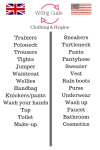
if you’re american and coming to australia, I’m gonna go ahead and say that you should be 100 percent way more worried about being king hit by a dude named “dane” in a bintang singlet than any fucking spiders that exist here

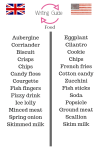
what does this say in english

“Good sir, if you are a resident of the United States of America and coming to visit the sunny land of Australia, allow me to inform you that you should be rather more concerned about being sucker punched by a gentleman named ‘Dane’ who is likely to be seen wearing a wifebeater with a beer company logo on it than by any of the dangerous spiders that exist on this lovely continent”.

ok so what does it say in american

“You’re more likely to get sucker punched/cold-cocked by an asshole than you are to be bitten by a spider”.

thank you

Well rattle my spoons, that don’t make a lick of sense. Wot in tarnation does this hootenanny say?

“If ya mosey on by Australia, you best be fixin’ to get to some fisticuffs more’n checkin fer spiders.”

This is a Rosetta Stone for a single language

l3monsoda:

I’m so shocked. I have gone my whole life not knowing there was a second part to the saying “Jack of all trades master of none.” I’ve literally used it to be self depreciating because I thought it was suppsed to be a dig on lacking skill, focus, perserverance and dedication. So imagine my shock to find out the second part is “Is oftentimes better than a master of one.” Like what?

My whole life I’ve been lied to. It’s like that moment you learn “Blood is thicker than water.” Is actually “The blood of the covenant is thicker than the water of the womb.” But like on steroids. I never used to say or think blood is thicker than water but I used Jack of all trades all the time!!!

shipvicturi:

So, I have an American friend named Jane who married this English guy about 7 years ago. They live in Sussex together (god rest their souls), and they had a little boy pretty much right after they got married. As he grew up, they figured he would have a mix of their accents with a heavy lean towards English (because he’d go to school with English kids and teachers and the like.)

That’s not how it fucking worked out at all though. Instead, he says individual words with either an American or an English accent. Like, one second he’ll be like, “Daddy, I’m knackered” and the next he’ll be like, “AY YO MA WHERE YOU AT???” Every time they send me a video I just fucking piss myself listening to this kid.

ayellowbirds:

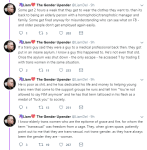
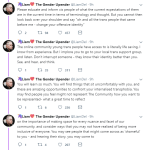
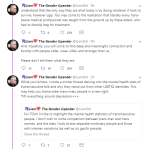
[image: a twitter thread by @LiamDel. Transcription follows]

TW: oldschool transphobia
The thing about “don’t use x term for x group” is this discussion really only exists online. Offline, there are many predominantly older people who identify in extremely individual ways that they spent decades fighting to be, that now get told they can’t

I know trans men that call themselves lesbians for so many reasons – maybe they never go on T or get any surgeries because its an intrinsic part of their identity and who they are to have the body they do – it bears scars of being in punchups with skinheads and police violence.

They never had the freedom to choose which identity they were – they were dykes for decades before we were born, and they’ve led the Pride parade with Dykes On Bikes and let countless queer women find safe haven in their home and cared for so many gay men as they died in the 80s.

They weren’t able to call themselves transgender. The language didn’t exist. The internet didn’t exist – I can’t stress how small each of our worlds was back then, how the flow of information was so slow and sterile. The idea of BEING transgender/queer DID NOT EXIST for so many.

You’ll see many older trans people that identify as ‘crossdressers’ or have zero intention of medical transition. They’re too old for surgery or too poor or discovered they were trans yesterday. They have ZERO idea wtf a truscum is, they have never heard the term transtrender.

Some get 2 hours a week that they get to wear the clothes they want to, then its back to being an elderly person with a homophobic/transphobic manager and family. Some get fired anyway for misunderstanding who can see what on FB – and older people don’t get employed again easily.

If a trans guy said they were a guy to a medical professional back then, they got put in an insane asylum. I know a guy this happened to. He’s not even that old. Once the asylum was shut down – the only escape – he accessed T by trading E with trans women in the same situation.

He is poor as shit, and he has dedicated his life and money to helping young trans men that come to the support groups he runs and tell him “You’re not allowed to say FtM anymore” and he has that term tattooed in his flesh as a medal of “fuck you” to society.

I know elderly trans women who are the epitome of grace and fire, for whom the term “transexual” was freedom from a cage. They, when given space, patiently point out to me that they are trans-sexual, not trans-gender, as they have always been the gender they are – woman.

Please educate and inform cis people of what the current expectations of them are in the current time in terms of terminology and thought. But you cannot then look back over your shoulder and say “oh and all the trans people that came before me – change your offensive identity”

The online community young trans people have access to is literally life saving, I know from experience. But I implore you to go to your local trans support group, and listen. Don’t interrupt someone – they know their identity better than you. See, and hear, and think.

You will learn so much. You will find things that sit uncomfortably with you, and these are amazing opportunities to confront your internalised transphobia. You may find people you feel might not represent The Community how you want to be represented- what a great time to reflect

on the importance of making space for every nuance and facet of our community, and consider ways that you may not have realised of being more inclusive of everyone. You may see people that might come across as ‘shameful’ to you – and hearing their story, you may come to

understand that the only way they are alive today is by doing whatever it took to survive, however ugly. You may come to the realisation that literally every trans-aware medical professional was taught from the ground up by these elders, who had to literally beg for treatment.

And, hopefully, you will come to find deep and meaningful connection and kinship with people older, wiser, sillier and stronger than us.

Please don’t tell them what they are.

While you’re here, I wrote a similar thread delving into the mental health stats of transmasculine folk and why they stand out from other LGBTIQ identities. This may help you frame older trans masc people in a new light.
TW: everything around depression+++

[link to another thread here]

Adding here – if you feel like an older person is offending you with their outdated language, assume they’ve never heard of twitter or any conversations we have here, and say something like “have you heard why some people don’t use x anymore?”
They’re usually excited to learn.

(If a t*rf shows up, consider not engaging – we have such a wholesome discussion happening here and you deserve better than spending time and energy on someone who won’t listen ♥)

rrdcooc:

heynowayimgay:

straight-outta-halloweentown:

As someone who headcanons Harry Potter to be of Indian descent it pleases me to think that his name is actually Hari, and that Aunt Petunia just Anglicized it because foreigners.

According to the interwebs, ‘Hari’ is a Sanskrit name meaning… Lion.

So yeah. Hari the mixed race savior of the Wizarding World.

Brown Hindu person here:

Hari is actually another name for Vishnu one of the three main gods in Hinduism. His job is protection. And he often comes down to Earth in different forms to save the world when the balance of good and evil is slipping.

Hari Puther, incarnation of Vishnu, protector of fucking everyone.

This is beautiful, and gives the whole thing new context. I love it.

scrumptiousangst:

fuyunoakegata:

mikkeneko:

coneycat:

reggiephelps:

aphnorwegian:

mxcleod:

egalitarianqueen:

kibosh-josh-mahgosh:

egalitarianqueen:

rougaroucojones:

radarmatt:

rougaroucojones:

karolinedianne:

spangledshieldsandsilverwings:

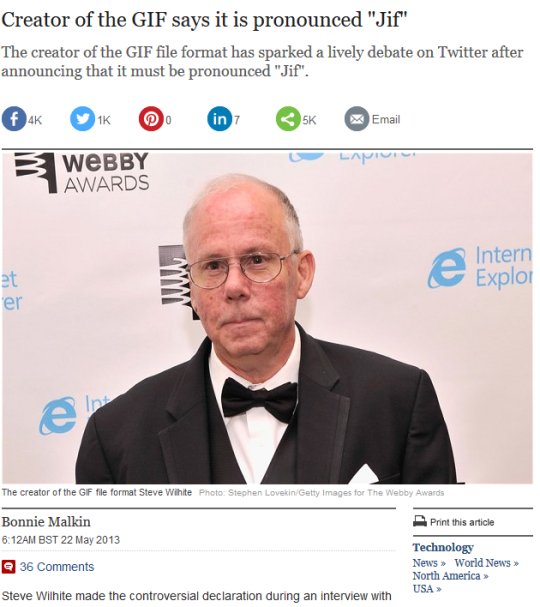
Gif stands for Graphics Interchange Format. when graphics is pronounced “JAFFICKS” Then I will pronounce Gif with a “J”

^ This

It’s followed by an R of course it would be a hard g. But Giraffe is a soft g. Genius is a soft g. Gin is pronounced with a soft g too. GIF is I following a g, it would be pronounced with a soft g.

It aint Jif peanut butter though.

It would still be pronounced like that. The general rule is if the g is followed by an e or i, it’s soft g. U or a consonant is generally a hard g.

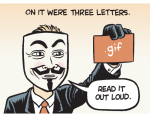
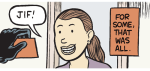
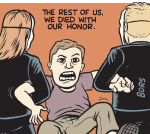
I will DIE WITH MY HONOR

Gear =/= Jear

Get =/= Jet

Gift =/= Jift

Give =/= Jive

In English, words with a ‘G’ followed by an ‘e’ or an ‘i’ can be pronounced with either a hard ‘G’ or a soft ‘G’.

Words with Germanic roots such as ‘gear’, ‘get’, ‘gift’, ‘give’ (see above) are pronounced with a hard ‘g’ while words with Latin or Greek roots such as ‘gem’, ‘general’, ‘giraffe’, ‘giant’, are pronounced with a soft ‘g’.

So no, it’s not exactly a “general rule” that ‘g’ followed by an ‘e’ or an ‘i’ makes a soft ‘g’ sound. 

Additionally, “GIF” is an ACRONYM starting with a word that begins with a hard ‘g’ sound, so “GIF” is therefore pronounced with a hard ‘g’.

We fight with honor

image
image
image

The gifs though.

I pronounce it with a hard G, but I reject the notion that “graphics” being pronounce with a hard G means that an acronym or initialism needs to follow the same rule. The acronym or initialism is free to follow its own rules, and you can ask an RCMP officer, an FBI agent, or a UN spokesperson for clarification.

The primary goal of communication should be clarity, and for the sake of clarity, it should be GIF with a hard G. Why? Because there is also a .JIF (and JFIF) type extension which is an entirely different thing, and there’s only one possible way to pronounce that one.

*now* I can reblog, because there won’t be a better reasoning than that ^^^

Another line of reasoning: people write Do you pronounce GIF as “gif” or “jif”. And if you think it’s a soft g, the question is nonsensical because both of those pronuncions are the same. You literally write “gif” to mean it’s a hard g. Because it obviously should be a hard g.

samanticshift:

samanticshift:

“i don’t judge people based on race, creed, color, or gender. i judge people based on spelling, grammar, punctuation, and sentence structure.”

i hate to burst your pretentious little bubble, but linguistic prejudice is inextricably tied to racism, sexism, classism, xenophobia, and ableism.

ETA: don’t send me angry messages about this…at all, preferably, but at least check the tag for this post before firing off an irate screed.

no one seems to be following the directive above, so here’s the version of this post i would like all you indignant folk to read.

no, i am not saying that people of color, women, poor people, disabled people, etc, “can’t learn proper english.” what i’m saying is that how we define “proper english” is itself rooted in bigotry. aave is not bad english, it’s a marginalized dialect which is just as useful, complex, and efficient as the english you’re taught in school. “like” as a filler word, valley girl speech, and uptalk don’t indicate vapidity, they’re common verbal patterns that serve a purpose. etc.

because the point of language is to communicate, and there are many ways to go about that. different communities have different needs; different people have different habits. so if you think of certain usages as fundamentally “wrong” or “bad,” if you think there’s a “pure” form of english to which everyone should aspire, then i challenge you to justify that view. i challenge you to explain why “like” makes people sound “stupid,” while “um” doesn’t raise the same alarms. explain the problem with the habitual be. don’t appeal to popular opinion, don’t insist that it just sounds wrong. give a detailed explanation.

point being that the concept of “proper english” is culturally constructed, and carries cultural biases with it. those usages you consider wrong? they aren’t. they’re just different, and common to certain marginalized groups.

not to mention that many people who speak marginalized dialects are adept at code-switching, i.e. flipping between non-standard dialects and “standard english,” which makes them more literate than most of the people complaining about this post.

not to mention that most of the people complaining about this post do not speak/write english nearly as “perfectly” as they’d like to believe and would therefore benefit by taking my side.

not to mention that the claim i’m making in the OP is flat-out not that interesting. this is sociolinguistics 101. this is the first chapter of your intro to linguistics textbook. the only reason it sounds so outlandish is that we’ve been inundated with the idea that how people speak and write is a reflection of their worth. and that’s a joyless, elitist idea you need to abandon if you care about social justice or, frankly, the beauty of language.

and yes, this issue matters. if we perceive people as lesser on the basis of language, we treat them as lesser. and yes, it can have real ramifications–in employment (tossing resumes with “black-sounding names”), in the legal system (prejudice against rachel jeantel’s language in the trayvon martin trial), in education (marginalizing students due to prejudice against dialectical differences, language-related disabilities, etc), and…well, a lot.

no, this doesn’t mean that there’s never a reason to follow the conventions of “standard english.” different genres, situations, etc, have different conventions and that’s fine. what it does mean, however, is that this standard english you claim to love so much has limited usefulness, and that, while it may be better in certain situations, it is not inherently better overall. it also means that non-standard dialects can communicate complex ideas just as effectively as the english you were taught in school. and it means that, while it’s fine to have personal preferences regarding language (i have plenty myself), 1) it’s worth interrogating the source of your preferences, and 2) it’s never okay to judge people on the basis of their language use.

so spare me your self-righteous tirades, thanks.