abo-watch:

sir-celestyn:

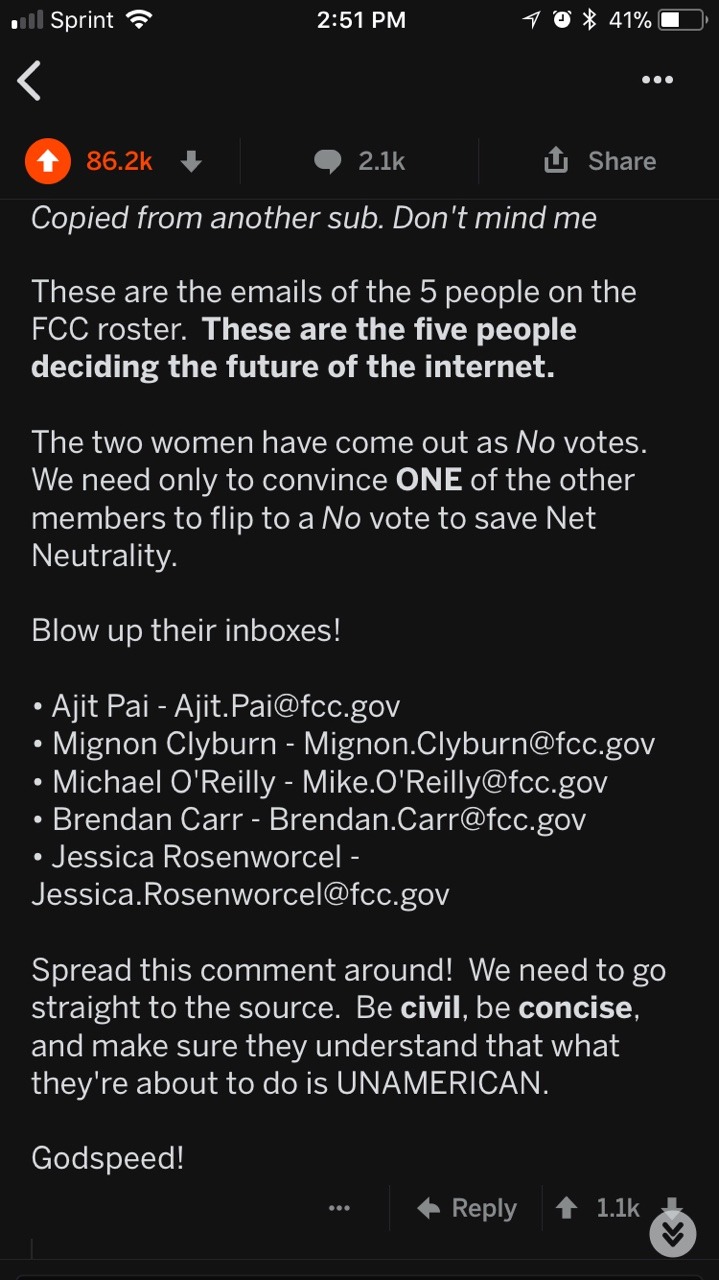
I don’t usually post things other than HP topics but here in the USA we are fighting again to keep our net neutrality. Please, any USA citizens who follow me, consider emailing these people and sharing this with everyone you know!

GET IT YALL WE CAN DO THIS PLEAE PLEASE PLEASE CAL AND SEND LETTERS AND EMAILS

MY FAMILYS BUSINESS WILL DIE WITHOUT THE INTERNET, WE WILL NOT BE ABLE TO AFFORD ADVERTISING IF THIS HAPPENS.

My entier family will loose everything we have without the largeat source of exposure we have, the internet. Please Im begging all of you to please contact these people and help save net neutrality.

rosalarian:

letterofone:

thegoodfoothousehold:

the-militant-catholic:

hidrihime:

liache:

ok kids repeat after me

vinegar and bleach makes chlorine gas, which is highly toxic

ammonia and bleach makes chloramine, which is highly toxic

rubbing alcohol and bleach makes chloroform, which is highly toxic

hydrogen peroxide and vinegar makes peracetic/peroxyacetic acid, which can be highly corrosive

be careful about your cleaning products and dont get yourself injured or potentially killed ok

why it so dangerous to be clean

As someone who’s job is to handle chemicals like this, I need to state that this information is IMPORTANT. Plenty of people have accidentally injured or killed themselves at home because they didn’t know what kind of reaction certain substances have with one another. Play it safe and don’t mix chemicals.

Also don’t use bleach to clean up urine it’ll create chloramine bc of the ammonia in it and you can give yourself chemical pnemonia that way

bleach is scary

Last night I was about to mix hydrogen peroxide with vinegar when I remembered seeing this post earlier in the day. Thank you.

Hello I’m 17 and am being kicked out of my home as soon as I’m 18 I’ve been trying to prepare my self for this and have estimated 7,350 dollars in my bank account I have no credit and my parents have repeatedly told me we are cutting you off and disowning me how fucked am I? Please any advice would be extremely helpful and very very appreciated

bitchesgetriches:

yournewapartment:

yournewapartment:

First of all- take a second to breathe. You are in a terrible situation, but you are strong and resilient and you have $7,000 in savings. You WILL get through this! Also you have more money than both my boyfriend and I put together currently, and we rent an apartment with 2 cats. You can do it!

I have a few questions for you-

1. Do you have a job?

2. Do you want to attend a university?

3. Are you opposed to living with roommates?

4. Do you have transportation?

My Parents Are Forcing Me To Move Out- What Can I Do?

I get a lot of questions about this. Here are some steps that you can take while still living in your parents house, steps that will help you work towards getting a place of your own. Stay strong! You’ll get through this.

1. Important Documents. Get as many of your important documents (social security card, birth certificate, tax forms, etc) as possible while you’re still living with your parents. You will need this information when you move out, and it may be harder for you to get these documents after you’ve moved out.

2. Get a job. If you’re still in school, limit yourself to a part-time job that can become a full-time job when you finish your education. You can’t save up money if you don’t have a job, and this will just force you to be dependent on your parents financially. 

3. Get transportation. Get yourself a mode of transportation that does not rely on your parents. Biking, walking, and using public transportation are all ways that you can get where you need to be without their help. You cannot rely on any car that’s in their name (even if they call it “your” car). I’ve had multiple friends dealing with difficult parents have their cars taken away from them in an attempt to further control their lives. 

4. Start saving money. Even if this just means saving $100 every two weeks, this is still a great start! 

5. Separate bank account. Speaking of saving money, get yourself a bank account that your parents don’t have access to. A friend of mine tried to move out of her home and her parents literally moved all her money into their account because they had joint access. If you cannot get a separate bank account, start saving money in cash in a good hiding spot.

6. Start paying for your own devices. You do not want your parents to be able to threaten to take your phone away if they don’t like the choices you’re making. You should also change any passwords on devices that your parents may know.

7. Utilize resources that get you out of the house. There are lots of spaces that you can hang out after school for free, including public parks and libraries. Join clubs and volunteer your time if you can’t stand being home.

8. File as independent on your taxes. We’re a while away from tax season, but remember to file as independent on your taxes. This means that your parents can no longer claim you as a dependent and will no longer receive a tax break from the government for housing you. What it means for you, is that you will no longer be considered part of their tax bracket. This means you’ll have a better chance at applying for financial aid, health insurance, car insurance, etc.

9. Involve your college. If you’re looking to go to university sometime in the future but are afraid you can’t afford it, find out if your college has any programs for independent students. Many SUNY schools have what is called the EOP Program and the Independent Student Program, which will pay for your college tuition based off your independent tax status. You cannot rely entirely on FAFSA to pay for your tuition! Talk to a school counselor and find out what is offered. PS: Many of these programs are first-semester admit only, so take that into consideration.

10. Keep your housing search a secret. I hate to generalize with parenting, but if your parents are threatening to throw you out or are forcing you to move out, it’s probably not a good idea to let them know that you’re going to move out. Oddly enough, two of my friends who have been in this very same situation got ready to move out of their respective homes, only to have their parents freak out. Even if your parents are saying that they’re going to force you to move out, they may not believe that you actually can and will do it. They may try to stop you or use emotional tactics to control you and keep you home. When you do move out- do not under any circumstance tell them your address.

11. Build your support system. Tell as many trustworthy people as you can what is happening, so that they can be there to support you during this time. You’ll have places to crash in if you need to, so your parent’s house isn’t your only option. I would try to tell at least one “Adult” in your life- a teacher, a counselor, your employer, etc. Obviously you don’t want them talking to your parents, but they may be able to offer support and confidence. 

12. Decide on an apartment budget. Decide what you can afford, based off of how much money you’re making. Find out if any of your friends are going to get their own place, and see if you can find a roommate. This will save you so much money and headache in the long run. If you can’t find a roommate and can’t afford an apartment, look into renting a room in a house or shared space.

13. Learn some life skills. Cooking, cleaning, sewing, basic repair, car maintenance, laundry, etc are all useful skills that you will need when you move out. Start mastering them now, and you’ll feel more confident when on your own.

14. Discount stores. Get familiar with shopping for yourself at discount stores. While shopping at the Dollar Store may not be ideal for you, I recommend that you buy all your starter groceries and household supplies there. Off-brand items will save you $$!

15. Make plans for pets. Do not leave your pets at your parent’s house. If you can’t move them into your new place, find a friend who can pet sit until you find a more comfortable situation. Do not let your parents hold your pets over your head as emotional leverage!

16. Be prepared to buy new furniture. Your parents may not allow you to take any furniture with you when you move. Be prepared to spend some money on things like mattresses, tables, cooking supplies, etc. Peruse local yard sales and bargain bins to see if you can scavenge any supplies. Hit up your friends and coworkers to see if they have any furniture/supplies they’re not using. Honestly this is how I got half of the furniture in my apartment.

17. Try to keep it positive. Throughout all of this, please remember that your parents do love you, even if they’re not expressing it in a positive way. Be above toxic behavior and any emotional bullying they may throw your way, and when you do move out try to let them know that you love them and hope they will support you. They may ignore you or refuse to talk to you for some time after you move out, and this is okay. They will eventually get to the point where they miss your contact, and you should be prepared for that opportunity to start fresh. I’ve known people whose relationship with their parents has improved 100% after they move out. Some personalities are just not meant to live together. Give them the time they need to adjust, and be proud of yourself for everything you’ve done!

I hope this helps!

This is one of the most important posts on Tumblr.
runningred:

I am really tired yall.

Lemme just preface this with saying that I am a writer. I have been writing for most of my life. I have taken actual classes about writing and about what fiction can offer you, me, and people as a whole. I have won an award for something that I wrote. I know and love fiction, be it in written form, graphic novels, or film. It is all so good and complex and it’s something I am passionate about. That said, let’s get into this.

A good majority of the discourse that goes on in most of the fandoms I’m in stem from the idea that violence and forbidden sexual acts in fiction will encourage those actions in reality. It is important to know, firstly, that the only time this happens is when a person is immature enough or not mentally healthy enough to distinguish reality from fiction. Growing up, my parents would often stop horror movies (back when I first started watching them) to ask me questions. To be fair, they were pretty shitty people, but in this one aspect, they were so good about making sure I knew this difference. “You know this is just a movie, right? None of the stuff on the tv is real.” They’d assure before continuing the film.

It’s not real.

Now, half of the stuff I read or watched back then was nowhere near pushing boundaries or making me think critically about society or whatever. However, I knew that what I watched wasn’t real. It was images on a screen. If I don’t like what I’m seeing, I can walk away. It doesn’t have to affect me, personally,  unless I let it.

Now, lets circle back. School. College. I took a writing class that used this book:

Granted, it was a screenwriting class and most of the chapters were about various script formats, but the beginning chapters focused on why we write and why we make the stories we do.

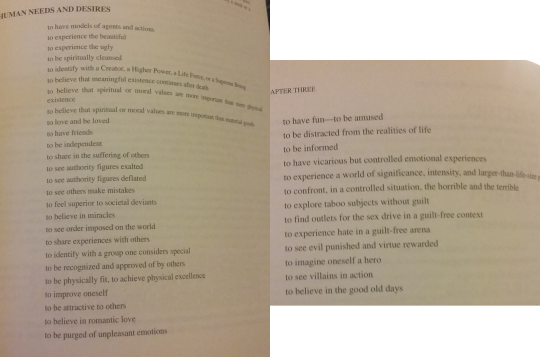
It had a section in it describing how human needs and desires are met through fiction. It detailed those needs in a list. This list:

Please draw your attention to the ones on the list that say that fictions helps people to:

Be purged of unpleasant emotions

To have vicarious but controlled emotional experiences

To confront, in a controlled situation, the horrible and terrible

To explore taboo subjects without guilt

Just because you personal don’t need various forms of ‘taboo’ media, doesn’t mean that others don’t. Media, in all of its forms, is a way for people to explore things safely. It’s an outlet that doesn’t harm anyone and it offers the creator and viewer/reader a safe way of exploring the complexities of situations (or in some cases relationships) that these people do not want to be involved in irl. Because we can distinguish reality from fiction. Because none of us are going out killing people or getting into abusive relationships or fucking our sibling.

While being critical of the media we consume is important and it is vital to dissect the whys of the media being created, there is a line between creating open discussion about these taboos, about the society and personal experiences that makes one need these outlets, and verbally abusing and harassing strangers.

If you want to create a dialogue about media or a ship you don’t agree with, fine. Talk about it. Dissect it. Really dig deep into the human condition and the psychology behind these outlets, but don’t shame people for them to the point of telling them to kill themselves or telling them they are human garbage or what the fuck ever.

Fiction isn’t always meant to be picturesque. It’s not always going to be SFW. If that isn’t your cup of tea, then great. Stop going into the tags of things that make you feel unhealthy. You do you. Keep yourself safe. Stop continuously exposing yourself to content that you can’t swallow. To keep getting involved, to keep harassing people, to keep abusing strangers shows that you don’t give a damn about the content. You need an excuse to bully someone else and indulge in holier-than-thou circle jerks with other people who also have no sense of what fiction is for.

Here’s my life. My husband and I get up each morning at 7 o’clock and he showers while I make coffee. By the time he’s dressed I’m already sitting at my desk writing. He kisses me goodbye then leaves for the job where he makes good money, draws excellent benefits and gets many perks, such as travel, catered lunches and full reimbursement for the gym where I attend yoga midday. His career has allowed me to work only sporadically, as a consultant, in a field I enjoy.
All that disclosure is crass, I know. I’m sorry. Because in this world where women will sit around discussing the various topiary shapes of their bikini waxes, the conversation about money (or privilege) is the one we never have. Why? I think it’s the Marie Antoinette syndrome: Those with privilege and luck don’t want the riffraff knowing the details. After all, if “those people” understood the differences in our lives, they might revolt. Or, God forbid, not see us as somehow more special, talented and/or deserving than them.
There’s a special version of this masquerade that we writers put on. Two examples:
I attended a packed reading (I’m talking 300+ people) about a year and a half ago. The author was very well-known, a magnificent nonfictionist who has, deservedly, won several big awards. He also happens to be the heir to a mammoth fortune. Mega-millions. In other words he’s a man who has never had to work one job, much less two. He has several children; I know, because they were at the reading with him, all lined up. I heard someone say they were all traveling with him, plus two nannies, on his worldwide tour.
None of this takes away from his brilliance. Yet, when an audience member — young, wide-eyed, clearly not clued in — rose to ask him how he’d managed to spend 10 years writing his current masterpiece — What had he done to sustain himself and his family during that time? — he told her in a serious tone that it had been tough but he’d written a number of magazine articles to get by. I heard a titter pass through the half of the audience that knew the truth. But the author, impassive, moved on and left this woman thinking he’d supported his Manhattan life for a decade with a handful of pieces in the Nation and Salon.

Example two. A reading in a different city, featuring a 30-ish woman whose debut novel had just appeared on the front page of the New York Times Book Review. I didn’t love the book (a coming-of-age story set among wealthy teenagers) but many people I respect thought it was great, so I defer. The author had herself attended one of the big, East Coast prep schools, while her parents were busy growing their careers on the New York literary scene. These were people — her parents — who traded Christmas cards with William Maxwell and had the Styrons over for dinner. She, the author, was their only beloved child.
After prep school, she’d earned two creative writing degrees (Iowa plus an Ivy). Her first book was being heralded by editors and reviewers all over the country, many of whom had watched her grow up. It was a phenomenon even before it hit bookshelves. She was an immediate star.
When (again) an audience member, clearly an undergrad, rose to ask this glamorous writer to what she attributed her success, the woman paused, then said that she had worked very, very hard and she’d had some good training, but she thought in looking back it was her decision never to have children that had allowed her to become a true artist. If you have kids, she explained to the group of desperate nubile writers, you have to choose between them and your writing. Keep it pure. Don’t let yourself be distracted by a baby’s cry.
I was dumbfounded. I wanted to leap to my feet and shout. “Hello? Alice Munro! Doris Lessing! Joan Didion!” Of course, there are thousands of other extraordinary writers who managed to produce art despite motherhood. But the essential point was that, the quality of her book notwithstanding, this author’s chief advantage had nothing to do with her reproductive decisions. It was about connections. Straight up. She’d had them since birth.
In my opinion, we do an enormous “let them eat cake” disservice to our community when we obfuscate the circumstances that help us write, publish and in some way succeed. I can’t claim the wealth of the first author (not even close); nor do I have the connections of the second. I don’t have their fame either. But I do have a huge advantage over the writer who is living paycheck to paycheck, or lonely and isolated, or dealing with a medical condition, or working a full-time job.
How can I be so sure? Because I used to be poor, overworked and overwhelmed. And I produced zero books during that time. Throughout my 20s, I was married to an addict who tried valiantly (but failed, over and over) to stay straight. We had three children, one with autism, and lived in poverty for a long, wretched time. In my 30s I divorced the man because it was the only way out of constant crisis. For the next 10 years, I worked two jobs and raised my three kids alone, without child support or the involvement of their dad.
I published my first novel at 39, but only after a teaching stint where I met some influential writers and three months living with my parents while I completed the first draft. After turning in that manuscript, I landed a pretty cushy magazine editor’s job. A year later, I met my second husband. For the first time I had a true partner, someone I could rely on who was there in every way for me and our kids. Life got easier. I produced a nonfiction book, a second novel and about 30 essays within a relatively short time.
Today, I am essentially “sponsored” by this very loving man who shows up at the end of the day, asks me how the writing went, pours me a glass of wine, then takes me out to eat. He accompanies me when I travel 500 miles to do a 75-minute reading, manages my finances, and never complains that my dark, heady little books have resulted in low advances and rather modest sales.
I completed my third novel in eight months flat. I started the book while on a lovely vacation. Then I wrote happily and relatively quickly because I had the time and the funding, as well as help from my husband, my agent and a very talented editor friend. Without all those advantages, I might be on page 52. OK, there’s mine. Now show me yours.

Ann Bauer, ““Sponsored” by my husband: Why it’s a problem that writers never talk about where their money comes from”, http://www.salon.com/2015/01/25/sponsored_by_my_husband_why_its_a_problem_that_writers_never_talk_about_where_their_money_comes_from/ (via angrygirlcomics)

dogsanddiscourse:

gnclesbian:

psa: please don’t use the phrase “sexuality is fluid” because not everyone’s sexuality is fluid. instead say “sexuality can be fluid”.

yes! the whole “sexuality is fluid” or “exceptions always exist” or “everybody’s a bit bi” is harmful towards gay people (specifically lesbians) bc then many people will use this reasoning to guilt trip gay people into “just trying the opposite gender” which is Yikes

I think maybe it even undermines bisexuality as a true thing, because if you equate straight people having that one girl crush in high school or whatever with bisexuality, then they also don’t understand why it wasn’t just a phase, a passing fancy or a choice. Like sure I felt like that one time but then I kept dating Steve and now we’re married uwu. See you can choose to ignore it! BLEH.

lilfxo:

pseudo-euphoria:

closet-keys:

precioustranswoman:

tezzington:

precioustranswoman:

closet-keys:

my two cents about pornhub trying getting a bunch of good publicity lately by plowing roads, posting a sex ed page, & disabling “straight” porn on women’s day: 

y’all should spend less time making jokes about pornhub and more time supporting sex workers politically, socially & financially for their work instead of supporting a site that profits off devaluing their labor

yeah if you can, buy porn from sex workers. If you really can’t afford anything or don’t want to, try streaming sites (where you can give camgirls extra viewers as payment) like myfreecams, etc (or perhaps other sites that allow trans women <.<)

Didn’t pornhub just give out like student grants or something to sex workers

Isn’t every single video on pornhub stolen work from sex workers, uploaded without their consent, and from which they make $0.00?

#the answer is yes #stealing work and then paying back literally nothing to a select few is literally evil?

MindGeek is destroying the porn industry like its.. a big problem

http://fusion.net/story/212078/how-mindgeek-transformed-the-economics-of-porn/

http://www.slate.com/articles/technology/technology/2014/10/mindgeek_porn_monopoly_its_dominance_is_a_cautionary_tale_for_other_industries.html

I’m thoroughly convinced this has so little notes because people would rather giggle about how “chaotic good” pornhub is and keep using it instead of offering up the fact that they are stealing from people who can’t afford to be stolen from.