one of the more valuable things I’ve learned in life as a survivor of a mentally unstable parent is that it is likely that no one has thought through it as much as you have.
no, your friend probably has not noticed they cut you off four times in this conversation.
no, your brother didn’t realize his music was that loud while you were studying.
no, your bff or S.O. doesn’t remember that you’re on a tight deadline right now.
no, no one else is paying attention to the four power dynamics at play in your friend group right now.
a habit of abused kids, especially kids with unstable parents, is the tendency to notice every little detail. We magnify small nuances into major things, largely because small nuances quickly became breaking points for parents. Managing moods, reading the room, perceiving danger in the order of words, the shift of body weight….it’s all a natural outgrowth of trying to manage unstable parents from a young age.
Here’s the thing: most people don’t do that. I’m not saying everyone else is oblivious, I’m saying the over analysis of minor nuances is a habit of abuse.
I have a rule: I do not respond to subtext. This includes guilt tripping, silent treatments, passive aggressive behavior, etc. I see it. I notice it. I even sometimes have to analyze it and take a deep breath and CHOOSE not to respond. Because whether it’s really there or just me over-reading things that actually don’t mean anything, the habit of lending credence to the part of me that sees danger in the wrong shift of body weight…that’s toxic for me. And dangerous to my relationships.
The best thing I ever did for myself and my relationships was insist upon frank communication and a categorical denial of subtext. For some people this is a moral stance. For survivors of mentally unstable parents this is a requirement of recovery.
If it wasn’t stated outright – it wasn’t said.
It’s important to communicate this frankly, too. Make it clear that you can’t know or respond to their concerns unless they actually bring them up. Be proactive in telling the people you care about that you need them to tell you when something’s wrong, and that you’ll listen.
I also want to bring up that passive-aggressive behaviour and a heavy reliance on subtext can itself be a toxic coping mechanism in response to a fear of not being listened to when talking about things directly –
normalizing actual direct communication
creates a safe space for everyone. It’s good for your loved ones too when you set boundaries around this and follow through on your commitment to have these conversations.
Okay, everybody, I don’t talk much on here but this is important and I can’t find any other posts about it here.
There’s a little app called Be My Eyes. It’s been on iPhone for a while now and on October 5th, it’ll be out for Android too.
What is Be My Eyes, you might wonder? Well, it’s a community of people helping people. Namely, sighted people helping blind people with simple tasks that require sight to be simple.
See the picture?
(for those who can’t see, the picture shows the app I’m action. It shows a phone camera pointed at two red cans of food. Text above depicts a sighted person explaining the right can is a can of tamatoes.)
In short, if you’re blind and have every had trouble finding your blue shirt, the app was made for you.
If your sighted and want to help, the app is for you too.
If you’re not, reblog and spread this so more people can see.
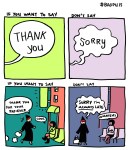
Shout out to people like me who have parents who are loving but are black holes of emotional labor… It took me a long time to realize that it’s okay to have mixed feelings about your parents, about your relationship with them.
Sometimes parents can love you but be somewhat toxic to you and your growth, and that’s a very hard realization to come to if you, like me, grew up extremely close to them.
Sometimes parents can love you genuinely but lack emotional maturity, forcing you to perform disproportionate amounts of emotional labor. Some parents manifest symptoms of their mental illness in ways that are toxic to your mental illness.
Some parents, like mine, try so hard to be good parents but fall back on habits of emotional manipulation because they haven’t processed their own traumas and are modeling behavior they grew up with. That doesn’t make their behavior acceptable, and it’s okay to feel exhausted and hurt when they betray you. You don’t have to forgive every mistake.
I want you to know that it’s okay to protect yourself, to need some space apart from them. The love you have for your parents is still valid, and you are making the right decision.
Placing a safe emotional distance between myself and my parents has been one of the most difficult, heartbreaking processes I’ve ever gone through… it hurts to try to curb the strength of your own natural empathy around people you love. It feels disingenuous to your heart’s natural state.
But I promise you, you are not hard-hearted or ungrateful, and you are not abandoning them. You are making a decision about your own emotional, mental, and spiritual health.
I know what it’s like in that confusing grey area of love mixed with guilt and anxiety, of exhaustion and quasi-manipulation and unreciprocated emotional labor, and I promise you, you are not alone.


 Beltainefaerie's Flights of Fancy