Sara Jacobsen, 19, grew up eating family dinners beneath a stunning Native American robe.
Not
that she gave it much thought. Until, that is, her senior year of high
school, when she saw a picture of a strikingly similar robe in an art
history class.
The teacher told the class about how the robe was
used in spiritual ceremonies, Sara Jacobsen said. “I started to wonder
why we have it in our house when we’re not Native American.”
She said she asked her dad a few questions about this robe. Her dad, Bruce Jacobsen, called that an understatement.
“I
felt like I was on the wrong side of a protest rally, with terms like
‘cultural appropriation’ and ‘sacred ceremonial robes’ and ‘completely
inappropriate,’ and terms like that,” he said.
“I got defensive
at first, of course,” he said. “I was like, ‘C’mon, Sara! This is more
of the political stuff you all say these days.’”
But Sara didn’t
back down. “I feel like in our country there are so many things that
white people have taken that are not theirs, and I didn’t want to
continue that pattern in our family,” she said.
The robe had been
a centerpiece in the Jacobsen home. Bruce Jacobsen bought it from a
gallery in Pioneer Square in 1986, when he first moved to Seattle. He
had wanted to find a piece of Native art to express his appreciation of
the region.
The Chilkat robe that hung over the Jacobsen dining room table for years. Credit Courtesy of the Jacobsens
“I just thought it was so beautiful, and it was like nothing I had seen before,” Jacobsen said.
The
robe was a Chilkat robe, or blanket, as it’s also known. They are woven
by the Tlingit, Haida and Tsimshian peoples of Alaska and British
Columbia and are traditionally made from mountain goat wool. The tribal
or clan origin of this particular 6-foot-long piece was unclear, but it
dated back to around 1900 and was beautifully preserved down to its long
fringe.
“It’s a completely symmetric pattern of geometric
shapes, and also shapes that come from the culture,” like birds,
Jacobsen said. “And then it’s just perfectly made — you can see no seams
in it at all.”
Jacobsen hung the robe on his dining room wall.
After
more needling from Sara, Jacobsen decided to investigate her claims. He
emailed experts at the Burke Museum, which has a huge collection of
Native American art and artifacts.
“I got this eloquent email
back that said, ‘We’re not gonna tell you what to go do,’ but then they
confirmed what Sara said: It was an important ceremonial piece, that it
was usually owned by an entire clan, that it would be passed down
generation to generation, and that it had a ton of cultural significance
to them.“
Jacobsen
says he was a bit disappointed to learn that his daughter was right
about his beloved Chilkat robe. But he and his wife Gretchen now no
longer thought of the robe as theirs. Bruce Jacobsen asked the curators
at the Burke Museum for suggestions of institutions that would do the
Chilkat robe justice. They told him about the Sealaska Heritage
Institute in Juneau.
When Jacobsen emailed, SHI Executive
Director Rosita Worl couldn’t believe the offer. “I was stunned. I was
shocked. I was in awe. And I was so grateful to the Jacobsen family.”
Worl said the robe has a huge monetary value. But that’s not why it’s precious to local tribes.
“It’s
what we call ‘atoow’: a sacred clan object,” she said. “Our beliefs are
that it is imbued with the spirit of not only the craft itself, but
also of our ancestors. We use [Chilkat robes] in our ceremonies when we
are paying respect to our elders. And also it unites us as a people.”
Since
the Jacobsens returned the robe to the institute, Worl said, master
weavers have been examining it and marveling at the handiwork. Chilkat
robes can take a year to make – and hardly anyone still weaves them.
“Our
master artist, Delores Churchill, said it was absolutely a spectacular
robe. The circles were absolutely perfect. So it does have that
importance to us that it could also be used by our younger weavers to
study the art form itself.”
Worl said private collectors hardly ever return anything to her organization. The federal Native American Graves Protection and Repatriation Act requires
museums and other institutions that receive federal funding to
repatriate significant cultural relics to Native tribes. But no such law
exists for private collectors.
Bruce
and Gretchen Jacobsen hold the Chilkat robe they donated to the
Sealaska Heritage Institute as Joe Zuboff, Deisheetaan, sings and drums
and Brian Katzeek (behind robe) dances during the robe’s homecoming
ceremony Saturday, August 26, 2017. Credit NOBU KOCH / SEALASKA HERITAGE INSTITUTE
Worl
says the institute is lobbying Congress to improve the chances of
getting more artifacts repatriated. “We are working on a better tax
credit system that would benefit collectors so that they could be
compensated,” she said.
Worl hopes stories like this will encourage people to look differently at the Native art and artifacts they possess.
The Sealaska Heritage Institute welcomed home the Chilkat robe in a two-hour ceremony over the weekend. Bruce and Gretchen Jacobsen traveled to Juneau to celebrate the robe’s homecoming.
Really glad that this is treated as hard hitting news, no really, I am
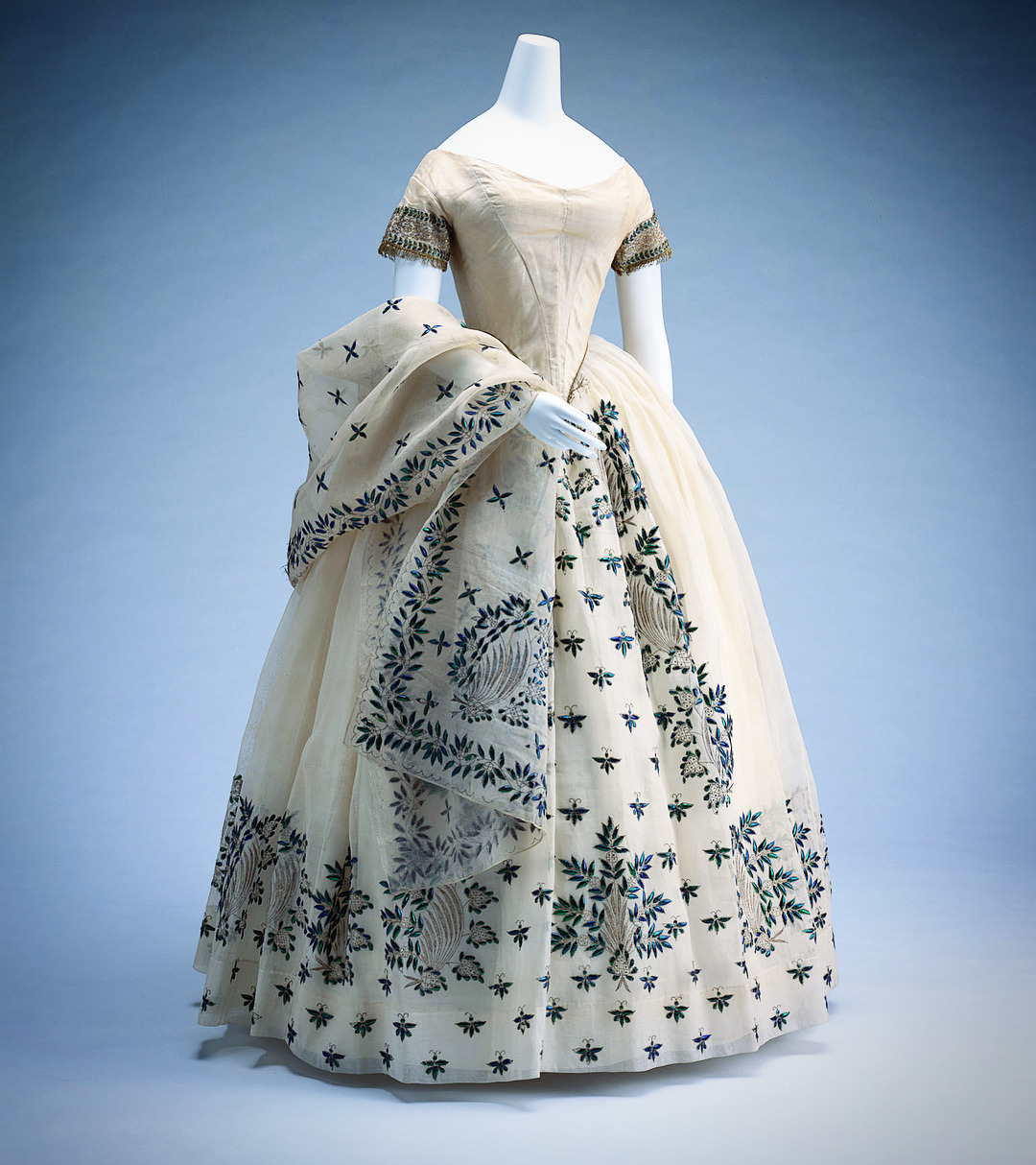
Evening Dress | c.1850 —This elegant dress is made of mull with applications of jewel beetle elytra. 1942 of these glistering forewings, with its color oscillating from green to purple, can be found on the dress, 1548 on the shawl.
India was colonized by the British Empire during the mid-18th century, and from the latter half of the 19th century onwards a vast variety of products using jewel beetle embroidery was being exported to the western European markets.
Beautiful and splendid decoration design with jewel beetle elytra originated during the time of the Mughal Empire that dominated most of the Indian subcontinent from the 16th to the mid-19th century. Examples of luxurious turbans with gold thread embroidery and wedding gowns from the Maharajas with jewel beetle applications are preserved in the National Museum, New Delhi, as well as in the Jai Singh II. City Palace Museum in Jaipur. Furthermore, there has been a tradition in India of applying jewel beetle elytra as an adornment to jewelry and paintings alike. This technique is thought to have derived from embroidery. #whattheywore #historicalfashion #fashion #fashiondesign #fashionhistory #historyoffashion #vintagefashion #art #vintage #historicfashion #defunctfashion #historicalfashion #costume #costumedesign #couture #costumehistory #victorian #victorianfashion





















 Beltainefaerie's Flights of Fancy