i have a friend who is colorblind.
i have another friend with synesthesia where she sees colors when she listens to music
my colorbind friend has always wanted to see color and because my friend with synesthesia and my colorblind friend have the same taste in music, she describes color to my colorblind friend by relating it back to music
like “the sky is duke ellington’s satin doll”
and it is the purest thing this is what pure friendship is
Tag: friendship
if you can’t correct your friends when they’re wrong about something because you’re afraid they’ll lash out at your or otherwise hurt you then they’re not your friends.
if you can’t tell your friends when they’re being cruel to other people because you’re afraid they’re going to be cruel to you then they’re not your friends.
if your friendship with someone depends on always agreeing with them, always complying with what they want, and treating them as though they’re incapable of ever doing anything wrong or else they’ll turn on you and attack you (whether verbally or physically) then that is not a friendship and they are not your friends.
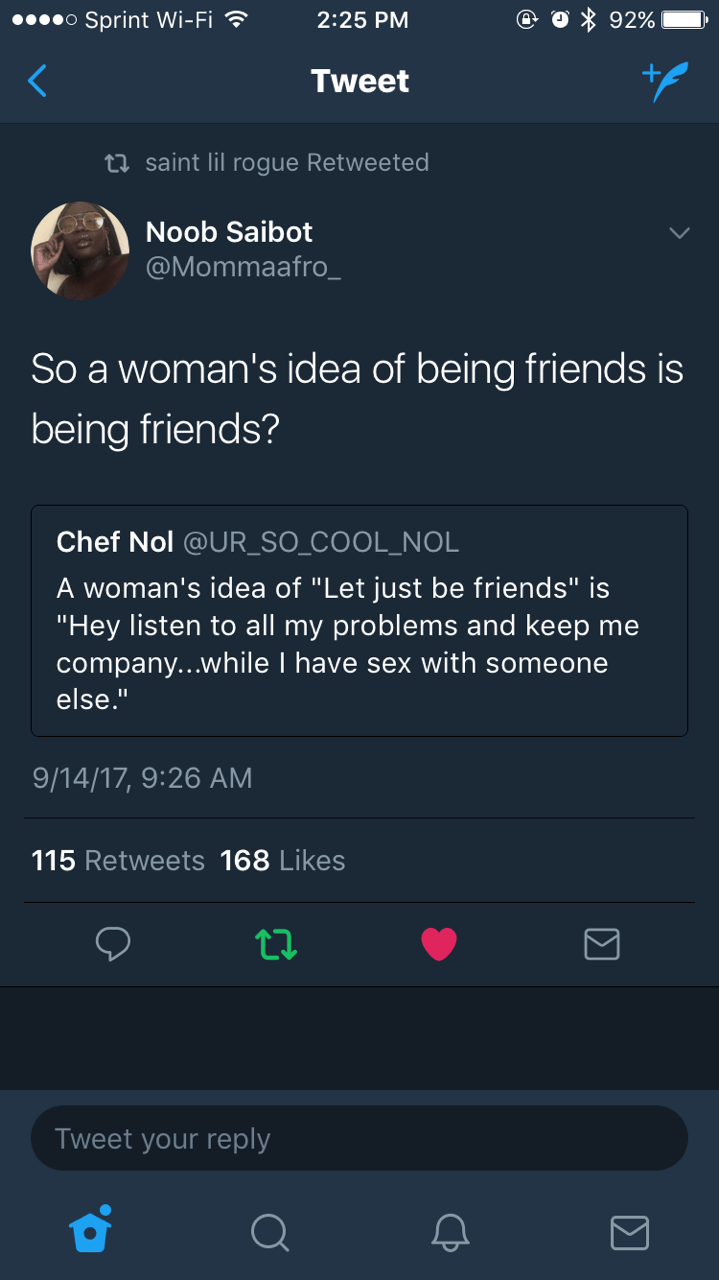
I’m????
Oh my God this actually explains so much.
So there’s a known thing in the study of human psychology/sociology/what-have-you where men are known to, on average, rely entirely on their female romantic partner for emotional support. Bonding with other men is done at a more superficial level involving fun group activities and conversations about general subjects but rarely involves actually leaning on other men or being really honest about emotional problems. Men use alcohol to be able to lower their inhibitions enough to expose themselves emotionally to other men, but if you can’t get emotional support unless you’re drunk, you have a problem.
So men need to have a woman in their lives to have anyone they can share their emotional needs and vulnerabilities with. However, since women are not socialized to fear sharing these things, women’s friendships with other women are heavily based on emotional support. If you can’t lean on her when you’re weak, she’s not your friend. To women, what friendship is is someone who listens to all your problems and keeps you company.
So this disconnect men are suffering from is that they think that only a person who is having sex with you will share their emotions and expect support. That’s what a romantic partner does. But women think that’s what a friend does. So women do it for their romantic partners and their friends and expect a male friend to do it for them the same as a female friend would. This fools the male friend into thinking there must be something romantic there when there is not.
This here is an example of patriarchy hurting everyone. Women have a much healthier approach to emotional support – they don’t die when widowed at nearly the rate that widowers die and they don’t suffer emotionally from divorce nearly as much even though they suffer much more financially, and this is because women don’t put all their emotional needs on one person. Women have a support network of other women. But men are trained to never share their emotions except with their wife or girlfriend, because that isn’t manly. So when she dies or leaves them, they have no one to turn to to help with the grief, causing higher rates of death, depression, alcoholism and general awfulness upon losing a romantic partner.
So men suffer terribly from being trained in this way. But women suffer in that they can’t reach out to male friends for basic friendship. I am not sure any man can comprehend how heartbreaking it is to realize that a guy you thought was your friend was really just trying to get into your pants. Friendship is real. It’s emotional, it’s important to us. We lean on our friends. Knowing that your friend was secretly seething with resentment when you were opening up to him and sharing your problems because he felt like he shouldn’t have to do that kind of emotional work for anyone not having sex with him, and he felt used by you for that reason, is horrible. And the fact that men can’t share emotional needs with other men means that lots of men who can’t get a girlfriend end up turning into horrible misogynistic people who think the world owes them the love of a woman, like it’s a commodity… because no one will die without sex. Masturbation exists. But people will die or suffer deep emotional trauma from having no one they can lean on emotionally. And men who are suffering deep emotional trauma, and have been trained to channel their personal trauma into rage because they can’t share it, become mass shooters, or rapists, or simply horrible misogynists.
The only way to fix this is to teach boys it’s okay to love your friends. It’s okay to share your needs and your problems with your friends. It’s okay to lean on your friends, to hug your friends, to be weak with your friends. Only if this is okay for boys to do with their male friends can this problem be resolved… so men, this one’s on you. Women can’t fix this for you; you don’t listen to us about matters of what it means to be a man. Fix your own shit and teach your brothers and sons and friends that this is okay, or everyone suffers.
The next time a guy says, “What? You don’t want to be my friend?” I’ll text him this and then ask if he really wants to be friends or just have another potential girlfriend.
y’all I am living for these analyses where the new way to fight the patriarchy is to teach men to love each other and themselves
Apropos of nothing, that is the sound of my world getting smaller. (Stands on a stack of Bird Scramble APAs and waves) HI @alarajrogers!
Friendship, romance, childhood, Sherlock
I have a daughter who’s almost five, and this year in preschool she’s had a Best Friend. She had friends before at her previous daycare, but this one is different – whether it’s because of age or personality or something specific about the chemistry between them. Best Friend has really big feelings about my kid. Best Friend doesn’t merely squee when my kid shows up; she also gets morose when Kid doesn’t come to school (to the point of crying at home, her mom tells me), and jealous when Kid wants to play by herself or with someone else, and one time I even saw her attempt to make Kid jealous in return (it didn’t really work; Kid just got upset that she was being misunderstood). Big Feelings!
It’s been so fascinating to watch this unfold over the last year, if somewhat unnerving at times, and I’ve been working to help Kid set up good boundaries. (She’s done surprisingly well.) If we were seeing this kind of behavior in middle-childhood, we would definitely think “puppy love.” In a teen or adult, I’d have my ears perked up for signs of intimate partner violence. In a preschooler? I don’t really know. Are possessiveness or mild obsessiveness normal in friendships at this age? Is Best Friend going to look back at this intense friendship in 20 years and think, yep, that’s when I knew I was gay?
Anyway, thinking about this brought me back to that question of love and Sherlock (what doesn’t?). Possessiveness is not normal for adults in friendship – I mean, it’s not healthy in romance either, but we have a frame for understanding it. That’s what makes John’s side of the equation hard to understand: Mr. It’s All Fine Except When You Imply It About Me gets upset when Sherlock appears romantically interested in anyone else. And everything in his body language at those moments, everything in the way he talks about Sherlock on the blog, tells us he knows exactly how fucked up this is. That doesn’t suggest wedding bells, exactly, but it does raise questions we want answers to (or at least, I do).
But then there’s Sherlock, who is possessive in a really different way – a way that suggests he thinks the right and proper state of affairs is for John’s world to revolve around him. He maintains this thoughtless self-centeredness until halfway through that wedding speech in TSoT, at which point a switch flips and his love for John takes on a character that is both selfless and undeniably romantic. I’ve seen plenty of meta about how this speech serves as an accelerated puberty for Sherlock, and I think that works here. Growing up for him happens when he learns how to love like an adult. Where possessiveness is what triggers my suspicions with John, my certainty about Sherlock emerges in its absence.
Tagging @unreconstructedfangirl who had a good thread about love and friendship not long ago.
Thank you for tagging me! I love your last paragraph, SO MUCH.
Where possessiveness is what triggers my suspicions with John, my certainty about Sherlock emerges in its absence.
Yes. YES. Exactly.
However! I’m not sure I agree that possessiveness, jealousy and obsessiveness aren’t “normal” in friendship. I have felt all of those things in relationships that were clearly and unambiguously friendships, which is to say not romantic relationships (though, I must say that I am increasing unsure why these two things are somehow defined as mutually exclusive categories – why isn’t a friendship a kind of romance?). Maybe these feelings aren’t admirable, but they are real things that people feel in all kinds of relationships. Perhaps it’s not useful to view them as not normal, or unhealthy, or even as things that sort the relationship into a category of love vs. friendship where those two relationship concepts mutually exclude one another? Perhaps, as you say, the issue is learning to love in a more mature way – a way that recognises the personhood and agency of the beloved; A way that recognises the limits of one’s right to act upon those feelings in a way that curtails the freedom of the beloved.
Also? I don’t feel like the territory of friendship is so unlike the territory of love. I think those territories overlap one another in all kinds of ways and cannot be cleanly separated. The ambiguity of the relationship between John and Sherlock doesn’t bother me at all, and that is because an undefined intensity of connection that is neither one thing nor the other, or is both, feels REAL to me. It feels like a think that exists, and that I feel, and that we don’t know how to talk about because our words to describe what a relationship is excludes that territory. That unnamed land is uncomfortably unsayable, so we want to push it to a point – force it to define itself – and I think that definition would be reductive of it’s beauty and complexity. Maybe your daughter’s friend will grow up and realise that she has always loved girls… or maybe not. Who knows! What I don’t quite understand is the rage we all seem to have for applying labels that don’t quite seem to fit.
All that said, I agree with you about this difference between the character of Sherlock’s love and John’s as it is realised on the show. I think it’s why John beating Sherlock up didn’t surprise me and felt exactly in character. It’s probably why there is a draft of a controversially titled and never published post in my draft box from months ago called “John Watson, Self-obsessed Arsehole”, which is not to say that I don’t love John as a character, just that I cannot approve of his actions and think he has his head up his own arse when it comes to Sherlock.
I do think Sherlock learns to love selflessly, and I agree that John isn’t there yet, and his love is selfish. It’s why I find him harder to love than Sherlock.
But, that’s just me, maybe.
I am interested in all the points being made here and don’t want to detract from them at all, as this post relates to Sherlock, but I’m a teacher, so here are my 2 cents on preschool behavior: This behavior is completely normal on both their sides. Some kids at this age experience an intense and jealously guarded bond with one friend and others are more like butterflies flitting from friend to friend, and every shade in between those polarities. Some kids understand the jealous ones and some are completely baffled by it. However, normal isn’t always the same thing as acceptable. It is normal for children to act out aggressive feelings physically, but we still correct it, and they still have bathroom accidents at that age too, but we are guiding toward complete and consistent potty training of course. The same is true with more clingy or obsessive friendships. It is great that she loves your daughter so much, but hopefully teachers are involved in guiding her to understand that sometimes people need to play with others or by themselves. If this isn’ t guided, it can eventually manifest as exactly the kind of obsessive/possessive behavior we find in abusive relationships, but there are years and years for helping this child find balance. Learning boundaries and consent does start that young, so it is great you are helping your daughter with that. If people are treating the other girl’s behavior as cute, you might want to talk about shaping the behaviours over time, but it seems like you have a very positive relaxed attitude about the whole thing, which is lovely. (As for the point about sexuality, I haven’t seen any correlation to sexuality at all, though if the friend was a boy I’m sure people would be assigning sexual or romantic overtones to it. Sometimes the jealous behavior is a sign people look back on as ‘yep that was my first crush’ and other times it is more indicative or not having learned to share yet.)
Normalize boys touching eachother without it being sexual. Normalize boys hugging. Normalize boys being affectionate. Normalize boys needing each other. Normalize strong friendships between boys.
Yes and also normalize gay relationships so we don’t have to try and make ever little affectionate touch into some kind of sexual identity clue just to see ourselves in media. These goals work well together. When more romantic love is represented, more casual touching can happily fall into the realm of friendship.
 Beltainefaerie's Flights of Fancy