zbornak:

staff:

laughingatmynightmare:

Ladies and Gentlemen, you might want to take off your trousers and slip into a bathrobe because things are about to get pretty steamy in here.

I’m beyond excited to officially unveil for you the beautiful cover of my upcoming book, “Strangers Assume My Girlfriend Is My Nurse!”

I’m sure many of you temporarily lost consciousness when your eyes fell upon the sheer sexiness of my girlfriend, Hannah, and I posing in such a sultry position, so I’ll give you a minute to regain your strength before I continue. I hope you’ll wipe up your drool and keep reading because I have a few very important things to say about this book.

My name is Shane Burcaw, and I was born with a lovely muscle-wasting disease called Spinal Muscular Atrophy. I’m working really hard to use my time on this earth to create a positive, lasting impact. Specifically, my goal is to change the way society looks at disability. This book is the next step in that journey.

One of the biggest stigmas about people with disabilities is that we are incapable and unworthy of romantic relationships. To give you an example, I run a YouTube channel with Hannah, and every time we post a new episode, people inevitably comment with theories as to why on earth we are dating. Here are just a few of my favorites:

“Don’t get me wrong – he seems like a good dude – but I ain’t buying it. She’s either his nurse or good friend and this is an act, or she’s got a couple screws loose.”

“Ask yourself, would you date him? NO, YOU WOULDN’T. What is the catch here?”

“This [relationship] is abnormal and frankly disgusting.”

Aren’t these fun? Jokes aside, this is but a small indication of the vast and innumerable ways that people with disabilities are discriminated against on a daily basis. I am determined to change that situation.

My strategy is humor. In “Strangers Assume My Girlfriend Is My Nurse” I use funny stories from my life to show readers that using a wheelchair is not some horrid, depressing existence. I’m a person, and my disability should not invoke pity or aversion, but rather, respect and love and kindness, just like we all deserve.

If you personally support that idea, please please please consider sharing this post. My ability to make a difference in this world is solely hinged upon spreading my story to as many people as possible, and YOU hold that power for me!

In celebration of my new book, and to raise funds for my nonprofit organization (which teaches children across the country about disability awareness and pride), I am hosting a HUGE online event scheduled for 8pm EST on November 27th. Entertainment will include a reading from “Strangers Assume”, an open Q&A where you can ask me anything you’d like, never-before-heard stories, and other special surprises! Your ticket purchase will help us provide adaptive technology to individuals living with muscular dystrophy in December 2018.

Thanks so much for reading and taking the time to share this exciting news. Below are all the important links you need regarding my new book and the live event on Nov 27th.

Pre-order “Strangers Assume” – https://www.amazon.com/Strangers-Assume-My-Girlfriend-Nurse/dp/1626727708

Pre-order autographed copy of “Strangers Assume” – https://www.laughingatmynightmare.com/shop

Nov 27th Exclusive Event Tickets – https://www.laughingatmynightmare.com/events

Matt Carr (genius photographer who shot the cover) Instagram – https://www.instagram.com/themattcarr/?hl=en

We here at Tumblr have been following Shane’s story since 2011 (!), and we couldn’t be more excited about his newest book. Congratulations, Shane! 
@spooniestrong

Disability is not an abusive roommate

realsocialskills:

Nondisabled storytellers often seem to think of disability as an abusive roommate coming and imposing its will on a disabled person. When they think about wheelchair users, they don’t think about the mobility that’s made possible by assistive technology. They think about how they’d feel if someone chained them to a wheelchair and forcibly prevented them from walking.

This misconception is dangerous. When people see disability-related limitations as similar to violent restraint, they don’t know know to tell the difference between the innate limitations of someone’s body and limitations being forcibly imposed on them by others. When people don’t understand the difference between living with a disability and living with an abuser, they assume that abusive experiences are inevitable for people with disabilities.

In reality, there’s nothing inevitable about abuse. Coming up against the limitations of your body is fundamentally different from being forcibly restrained by someone else. Whether or not you are disabled, having physical limitations is part of having a body. Being disabled means that you have a different range of physical limitations than most other people do, but they don’t come color coded ‘normal’ and ‘disabled’. When you’re used to the way your body works, the disability-related limitations feel pretty similar to those that aren’t disability-related.

Using assistive technology is pretty similar to using technology for any other important reason. Everyone uses technology to do things that their bodies alone would be too limited to do. Most people use cars to go further than they could walk; some people also use wheelchairs to go further than they could walk. Some people type or use communication tablets to say more than they could with their bodies alone; some people use musical instruments; some people use both. People with disabilities have different limitations, and as a result, often benefit from technology that wouldn’t be particularly useful to nondisabled people.

When technology is associated with disability, people tend to have the dangerous misconception that using it is the same as being restrained. This can very easily become self-fulfilling. When people prevent disabled people from doing things, their inability to do it is often misattributed to their disability. For instance:

Wheelchairs as restraints:

  • Anthony lives in a nursing home.
  • Anthony speaks oddly, and most people interpret most of what he says as meaningless. They say ‘Anthony doesn’t communicate’.
  • Anthony can walk and wants to walk, but the nursing him staff don’t let him. 
  • George, the supervisor, tells Sage, another staff member, ‘Anthony wanders. We need to keep him in his wheelchair to keep him safe. Just lock the seatbelt. After a few minutes, he stops resisting.’
  • Every morning, Sage puts Anthony in a wheelchair that he can’t move, and ties him down so he can’t escape.
  • Sage tells Marge, a new volunteer, ‘That’s Anthony. It’s so nice to have a volunteer – he’s been spending most of his time in the hallway lately. He doesn’t walk or talk, but he loves visiting the garden! Can you take him there?”
  • Marge and Sage don’t know what Anthony actually wants, and it doesn’t occur to them that it’s possible to ask.
  • Anthony actually hates the garden and hates being pushed by other people. He prefers to spend his time in the library or with children in the children’s wing.
  • Marge assumes that Sage is the expert on Anthony, and assumes that Anthony’s disability prevents him from walking and communicating.
  • Marge doesn’t know that Anthony has stopped talking because he’s constantly surrounded by people who refuse to listen to him. 
  • Marge doesn’t know that Sage is tying Anthony to a wheelchair against his will to stop him from going where he wants to go.
  • Marge doesn’t know that she’s doing something to Anthony against his will.
  • When people see disability and restraint as the same thing, they fail to notice that people with disabilities are being violently restrained — and often unwittingly participate in physical abuse of disabled people.

The disability-as-restraint misconception also causes people to fail to understand that when they deny people access to assisstive technology, they’re preventing them from doing things, eg:

Mobility:

  • Beck is an eight year old who can’t walk.
  • Beck has a wheelchair, but he’s not allowed to bring it to school.
  • At school, he’s strapped into a stroller that others push around. 
  • His classmate Sarah has *never* had a wheelchair that she can push herself.
  • At a staff meeting, Lee, their teacher, says “Because of their disabilities, Sarah and Beck can’t move around by themselves. Even though they stay in one place all day, they’re so fun to have in our class!”
  • Lee is missing the crucial fact that the reason Sarah and Beck are immobile is because they’re being denied access to assistive technology. 
  • When people see disability and externally-imposed limitation as the same thing, they don’t notice limitations being imposed on disabled people.

Communication:

  • Rebecca types on her iPad to communicate.
  • Clay takes away Rebecca’s iPad.
  • Clay tells Sophie, ‘Rebecca is nonverbal. Her disability prevents her from communicating, but we’re working on improving her speech.’
  • Sophie sees that Rebecca can’t talk, and assumes that it’s her disability that’s preventing her from communicating.
  • Actually, it’s *Clay* who is preventing Rebecca from communicating.
  • When people see disability and abuse as the same thing, they don’t notice abuse of disabled people.

It’s important to be clear on the difference between disability and abuse. Disability is not an abusive roommate; people with disabilities are only abused if someone is abusing them. When people with disabilities are restrained against their will, this is not caused by their disabilities; it’s caused by the people who are restraining them. Restraint is an act of violence, not an innate fact about disability. When wheelchairs are used as restraints, the wheelchair isn’t the problem; the violence is the problem. When people are denied access to assistive technology, it’s not their disability that’s limiting them; it’s neglect. When we stop conflating disability and abuse, we’re far less likely to see abuse of people with disabilities as inevitable.

ladyloveandjustice:

fandomsandfeminism:

lazdrax:

fandomsandfeminism:

“What? Like, a disabled protagonist? How would that even work? How could someone with a disability be the hero in an action show?” local anime trash boy wonders while sitting next to his box sets of Full Metal Alchemist, showing no hint of irony or self awareness. 

but is Ed really disabled? sure I get he lost his arm and leg

but he’s still able to move and do things perfectly

He has prosthetics. Having prosthetic limbs (that more than once break amd need repair) doesnt make him not disabled

It should also be noted that Ed:

-had to undergo very painful and lengthy surgery to get automail 

-had to relearn how to write because of his prosthesis (there’s a post going around showing he had to switch hands etc) and his handwriting is likely a lot worse due to that. This means automail isn’t super good for delicate work, unsurprising, considering what it’s made of. 

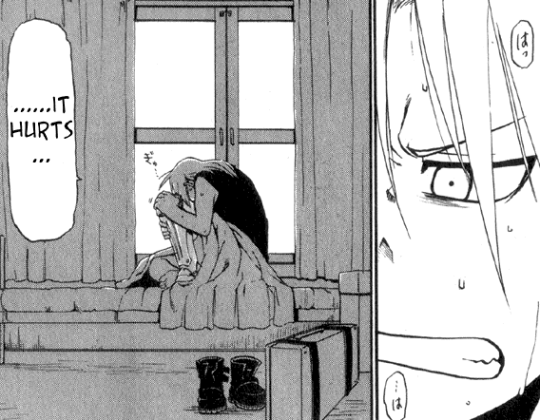
-experiences phantom limb pain and therefore other associated stuff (this was only really shown in the manga)

image

-cannot go anywhere too cold without changing his automail or he’ll get really bad frost bite and it will stop working

-cannot go anywhere too hot, period, because the metal attached and under his skin will overheat and he will be badly burned

-Reattachment is painful, but needs to be done frequently if he breaks or outgrows his automail

– it’s HEAVY so much so that the strain has the potential to cause stress on his body, enough that it’s even theorized as possibly stunting his growth.

-it requires really frequent maintenance or it will break down, as shown by how when he first moved out he forgot to do that and it…broke down.

-when it does need to be repaired, it takes time to do that, during which Ed uses regular prosthetics (that usually don’t quite fit him).

-costs a lot of money (not a problem for Ed due to high state alchemist salary/having mechanics as surrogate family, but explicitly noted to being the reason why most people in the fmaverse stick to regular prosthetics along with the painful surgery)

So Ed can’t actually do everything perfectly and experiences a lot of extra hassle, problems and pain people without automail don’t have to deal with!  And any advantages he does have are more suited to fighting than day to day life (being able to incorporate weapons/fake out people who want to blow up his arm). 

Arakawa did her research and thought it through. Automail is by no means a magic cure that solves all problems associated with losing a limb.

scrumptiousangst:

oockitty:

coldalbion:

grace-and-ace:

neddythestylish:

memelordrevan:

rosslynpaladin:

iamthethunder:

s8yrboy:

“If autism isn’t caused by environmental factors and is natural why didn’t we ever see it in the past?”

We did, except it wasn’t called autism it was called “Little Jonathan is a r*tarded halfwit who bangs his head on things and can’t speak so we’re taking him into the middle of the cold dark forest and leaving him there to die.”

Or “little Jonathan doesn’t talk but does a good job herding the sheep, contributes to the community in his own way, and is, all around, a decent guy.” That happened a lot, too, especially before the 19th century.

Or, backing up FURTHER

and lots of people think this very likely,

“Oh little Sionnat has obviously been taken by the fairies and they’ve left us a Changeling Child who knows too much, and asks strange questions, and uses words she shouldn’t know, and watches everything with her big dark eyes, clearly a Fairy Child and not a Human Like Us.”

The Myth of the Changeling child, a human baby apparently replaced at a young age by a toddler who “suddenly” acts “strange and fey” is an almost textbook depiction of autistic children.

To this day, “autism warrior mommies” talk about autism “stealing” their “sweet normal child” and have this idea of “getting their real baby back” which (in the face of modern science)  indicates how the human psyche actually does deal with finding out their kid acts unlike what they expected.

Given this evidence, and how common we now know autism actually is, the Changeling myth is almost definitely the result of people’s confusion at the development of autistic children.

Weirdly enough, that legend is now comforting to me.

I think it’s worth noting that many like me, who are diagnosed with ASD now, would probably have been seen as just a bit odd in centuries past. I’m only a little bit autistic; I can pass for neurotypical for short periods if I work really hard at it. I have a lack of talent in social situations, and I’m prone to sensory overload or you might notice me stimming.

But here’s the thing: life is louder, brighter and more intense and confusing than it has ever been. I live on the edge of London and I rarely go into the centre of town because it’s too overwhelming. If I went back in time and lived on a farm somewhere, would anyone even notice there was anything odd about me? No police sirens, no crowded streets that go on for miles and miles, no flickery electric lights. Working on a farm has a clear routine. I’d be a badass at spinning cloth or churning butter because I find endless repetition soothing rather than boring.

I’m not trying to romanticise the past because I know it was hard, dirty work with a constant risk of premature death. I don’t actually want to be a 16th century farmer! What I’m saying is that disability exists in the context of the environment. Our environment isn’t making people autistic in the sense of some chemical causing brain damage. But we have created a modern environment which is hostile to autistic people in many ways, which effectively makes us more disabled. When you make people more disabled, you start to see more people struggling, failing at school because they’re overwhelmed, freaking out at the sound of electric hand dryers and so on. And suddenly it looks like there’s millions more autistic people than existed before.

“…disability exists in the context of the environment.”

Reblog for disability commentary.

That last paragraph is absolutely important.

The need for glasses wasn’t noticed until reading became commonplace. From

People with disabilities finally get a way to save money

naamahdarling:

patchworkheart:

urbancripple:

urbancripple:

This is a wonderful and necessary change to existing laws.

So it looks like this post doesn’t work in mobile. Here’s the text of it for those who are having trouble: 

NEW YORK — Justin Bainbridge is 27 and works two jobs, but he wasn’t allowed to start saving money for his future until a few months ago.

Bainbridge has Down syndrome, and like other people with disabilities who receive government benefits, he can’t have more than $2,000 in savings. If he does, he would start to lose those much-needed benefits. But a new type of savings vehicle is giving Bainbridge, and others, a chance to save more cash.

Known as ABLE accounts, they let people with disabilities and their families save up to $14,000 a year without losing benefits. The accounts, which were made possible by a law signed two years ago, are operated by individual states and are similar to 529 college savings plans. So far, 16 states offer the plans and about 10 more are expected to do so this year. Most of the states let non-residents sign up. Each state has different rules or maintenance fees, with some charging as much as $15 every three months.

Disability advocates say the accounts are badly needed, since people with disabilities were forced to spend extra money to avoid losing benefits. With ABLE accounts, money saved can be used to buy anything that helps the life of the person with a disability, such as rent payments, school tuition or groceries.

“I’m saving for a new couch,” says Bainbridge, who shares a two-bedroom apartment in Omaha, Nebraska, with a friend.

Since June, he has put away more than $1,800 in an Enable account, the ABLE program run by Nebraska. He makes about $5,200 a year from his part-time jobs, one folding towels at a gym and another collecting movie tickets at a theater. But he still needs his monthly Supplemental Security Income cash benefit to help pay his rent and live independently, says his mother, Kim Bainbridge, who also stashes away money for him in the ABLE account.

“I can finally save for him after 27 years,” she says.For years, disability advocates have tried unsuccessfully to increase the $2,000 savings limit, which hasn’t been changed in nearly three decades.“It kind of shackles you to a life of poverty,” says Christopher Rodriguez, a senior public policy adviser at the National Disability Institute in Washington.The idea for ABLE accounts came about a decade ago from parents of kids with disabilities who were frustrated that they could not easily save money for their children. One of those parents, Stephen Beck Jr., spent years advocating and lobbying for a law. Beck unexpectedly passed away in 2014, just a few weeks before President Barack Obama signed it into law. To honor Beck, the law was named The Stephen Beck Jr. Achieving a Better Life Experience Act.His widow, Catherine Beck, is using an ABLE account to put away money for their 17-year-old daughter Natalie, who has Down syndrome and wants to go to cosmetology school to work at a nail salon. The Becks were able to easily save money for their eldest daughter, who does not have a disability. But for Natalie, they had to create a special-needs trust that required hiring a pricey lawyer to set up.“Her savings has not grown like her sister’s has,” says Catherine Beck, who lives in Burke, Virginia.To qualify for an ABLE account, the account owner must have had a disability before their 26th birthday. Anyone can put money in it, such as family or friends. If the account goes above $100,000, the person with the disability will lose monthly government cash benefits until it drops below that level again. Medicaid health benefits are never affected, no matter how much money is saved. Money can be invested in index funds and earnings are not taxed.“For the first time a lot of individuals will be able to work, save money and get some growth out of it,” says Adam Beck, director of MassMutual Center For Special Needs at The American College in Bryn Mawr, Pa.

When the person with a disability dies, Medicaid can claim any leftover money as payback for health care paid after the ABLE account was opened. Since each state has different rules and fees, the ABLE National Resource website has a tool that compares the programs.Matthew Shapiro, who lives in Richmond, Va., and works to promote the state’s ABLE program called ABLEnow, says finally being able to have some savings helped reduce his money worries. The 26-year-old, who has cerebral palsy, uses a power wheelchair to get around and unexpected repairs can be costly. He travels sometimes for his business, 6 Wheels Consulting, which helps educate companies and organizations on disability issues.“Being a person with a disability is expensive,” says Shapiro. “These accounts are so much needed.”

YES YES YES HALLELUJAH

*SOME people with disabilities.

This is cool for those people, and I’m so glad they’re being implemented. More every year!

But I’m still fucked!

Rules vary by state but you can be disqualified based on a number of criteria, one of which is your age at the time of onset of your disability.

For all that I’ve looked into, which is every ABLE program open to people nationwide, you have to have been 26 or younger. You have to be able to PROVE it started before then, meaning someone like me who has been symptomatic since childhood but was never diagnosed, is shut out.

Also, the money in these accounts can ONLY be used for approved expenses, usually related to the disability. So someone like me who has relatively few expenses directly related to my disability because you don’t need things like wheelchairs and access ramps for being bipolar, it won’t help, because it doesn’t necessarily allow you to buy things like food, clothing, pay for car repair, pay for house repairs, or any of the other daily or emergency expenses a disabled person might like to save for.

Some allow funds to be used for limited living expenses or education for the young. (Because fuck old people who want to go to school.)

I do not dispute that these accounts are helpful, but these are NOT a cure-all, or even a long-term solution, they are a stopgap measure, and what is truly necessary is a TOTAL overhaul of how we handle disability benefits nationwide.

I am concerned that articles like the above make it sound like this is helping most/all disabled people, when that could not be further from the truth. I’m afraid it will make nondisabled people think “Ah, it’s all taken care of then!” and ignore the monstrous issues still present. I’m afraid it will make lawmakers sit back and say “We’ve taken care of the people who REALLY need it, which is young people. Everyone else can get fucked.”

WE STILL NEED HELP.

PLEASE ADVOCATE FOR US. PLEASE ADVOCATE FOR EXPANDING THESE PROGRAMS.

People with disabilities finally get a way to save money

Fake Service Dogs?

trainingfaith:

You’re sitting at a cafe with your friend when suddenly a woman walks in with a toy poodle in her purse. The manager at the counter informs her “I’m sorry, but we do not allow dogs”. She replies with a heavy sigh and a “She’s a service dog. She can come with me”. Not knowing much about service dog law, and worrying about getting sued for asking further questions, he sits this woman down at a booth. There, she promptly unzips her purse and places the dog on the booth seat next to her. When the woman’s food comes out, the little dog begs and she feeds her bits off her plate. This dog is not public access trained, and proceeds to bark at those who walk by. This dog is a nuisance and causes many in the restaurant to complain. The manager cannot do anything but inform the unhappy customers that this is a service dog, so he can’t ask her to leave. In the end, it’s the customers who end up leaving.

Now I walk in with my highly trained service dog pressed against my leg in a perfect heel position, and I’m quickly bombarded by the manager telling me “No dogs! No dogs! We ALL know what happened last time”. Confused, I tell him “This is my medical alert and medical response service dog. Her right to accompany me is protected under federal law.” With a sigh, he seats me at a table far away from others where my dog promptly tucks under my feet, out of sight. When my food arrives my dog is still tucked tightly under the table because she knows she’s not supposed to eat when she’s on duty. She stays there ignoring those who walk past for the remainder of my meal. When we leave, a woman by the door exclaims “Woah, I didn’t know there was a dog here!”

See the difference?

Scenario number two occurs at a local grocery store when a man decides to bring his certified emotional support animal into the store with him. Upon entering he flashes a fancy ID card and certification papers. This dog is not as unruly as the first, but he still forges ahead of his handler, sniffs the food on display, and may seek attention from those who walk past. You find this dog adorable, and when he and his owner walk past you ask to pet him. The owner says yes and explains how all he had to do was go online, register his dog, and a few weeks later they sent him a vest, ID card, and certification papers.

Now I pull into the same grocery store. I’m in a rush to get an ingredient for a dish I’m making so I hurry into the store with my service dog next to me. I’m quickly stopped by a manager who demands to see my service dog’s certification card. Remember, this is NOT required by law, and most real service dog teams don’t have them. After 15 minutes of trying to educate, pulling up the ADA website on my phone, back and forth bickering, and drawing more of a crowd than I want to describe… I’m finally allowed in. I grab my ingredient, stand in line (where my service dog obediently moves between my legs to make space for those around me), and I get bombarded by people asking to pet my dog. I explain that she’s working, she has a very important job to do, and she’s not allowed to be pet while on duty. People walk away grumbling and complaining about how rude I was when other handlers like the man they met earlier allow their dog to be pet.

Moral of the story? Fake service dogs create real problems. The ones who are impacted the most are the true service dog handlers who rely on their dogs every day to help mitigate their disability. How would you feel if everywhere you went, you couldn’t make it 10 feet in the door because people were asking you questions? Imagine how much time that would take out of your already hectic day. Businesses lose customers because word gets out that there are unruly dogs in their store, customers become misinformed and start thinking some of these behaviors are okay, some people even start to believe the lies that anyone can just register their dog online and make him a service dog. The result? MORE fake service dogs. MORE real problems.

scrumptiousangst:

ayeforscotland:

benevolentlys:

thebibliosphere:

ironicbabylawyer:

ayeforscotland:

bendyluna:

ayeforscotland:

The state of the union.

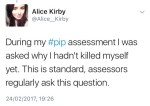
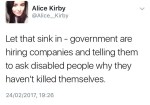
Westminster are demonising disabled people. This is sickening.

Or alternatively they have to ask about suicidal tendencies if there is any history of mental health or any detected mental health issue. It’s their duty of care, and yes if they asked something in that wording it would be horrible. People who claim PIP can also get it for mental health issues, so it is not in any way assuming that because someone is disabled they have to be mentally ill. These are medical professionals who have a duty of care.

There’s asking about suicidal tendencies and asking someone why they haven’t killed themselves yet.

That’s not a ‘duty of care’ line of questioning. To imply otherwise as some form of defence of asking people why they’ve not taken their own life is ridiculous.

During assessments, you’re made to re-live any trauma, to re-count any suicidal thoughts or self-harm in detail, you are asked to describe in great detail the most humiliating effects of your disability and after going through all that, your application is refused

👆👆👆👆👆

I’m 4000 miles away at present but my baby brother still calls me to cry about how he is treated by the people currently in control of whether or not he deserves PIP which is the only thing he has to live on apart from the help of my OAP parents who are also sick and struggling. 

He was disabled at birth through medical negligence, has been in a wheelchair ever since, has only one working hand, is considered legally blind, has epilepsy, asthma and a whole host of other chronic conditions including a non functioning bladder and most recently a decline in mental health from receiving no help with any of the above.

And the person asking him the questions at his appeal, with his medical records in hand, asked him in all seriousness why he felt justified in calling himself disabled which, Are. You. Fucking. Kidding. Me? 

He was later asked, by someone else, if his conditions were really as bad as he claimed, why he hadn’t attempted suicide yet. That was a real question, from someone in a position of authority, hired by the UK government to decide whether or not sick and disabled people qualify for financial help in order to live.

I’ve never considered violence an acceptable outlet for towering fury, but I’m one flight away from making an exception for a motherfucker.

These are the values of the current Westminster government. 

Local elections start around the country on May 4th 2017, followed by the general election a month later on 

8 June 2017. I’m begging you, I’m on my hands and knees pleading with you, vote. If you are old enough and eligible to do so, vote. I know May called for the snap election in the middle of exam time, this was not a coincidence. If you won’t be able to get to a polling station because of exams or other commitments, you can literally sign up to vote through postal vote by filling out a simple form found here, which incidentally is the same form you use to sign up if you are not yet registered at all either due to age or having moved recently or changed your name: 

 https://www.gov.uk/register-to-vote

It takes 5 minutes. I literally timed updating myself to vote through proxy as an absentee citizen.

Don’t let these people stay in power, don’t let them get away with eugenics masquerading as social reform. Please don’t stand on your pride, please don’t look at the other parties and think “well they’re all as bad as each other” because I’m telling you, as someone currently living in America under the Trump regime, they’re not all the same. Holy shit they are not the same. There’s corruption and then there’s making a pact with the Devil and wondering why everything is on fire

Vote. Help protect the most vulnerable people in our society and VOTE.

I’m mentally ill and I’m scared what will happen to me and others if May stays in power. PLEASE vote Labour.

(Unless you live in Scotland, Wales or Northern Ireland)

Then vote SNP, Plaid Cymru and Sinn Fein.

P