it’s sort of funny that the current cultural idea of the flapper dates not from the 1920s, but the 1950s when costume designers took the radical, gender-fluid, sexual, sexually liberated ideas and fashions of the 20s and made them sexy. as in sexual objectifying.
because 1950s and fuck female agency.
If you would like, I would love to hear more about this. What, exactly, happened, and what was the true 1920s aesthetic, untainted by 50s views?
hokay. so it’s the 1950s and it’s the heyday of the studio system and writers and movie makers (and audiences) want rom coms and frolicking films and lighthearted fun, but there’s just one problem.
WWII
but that was the 1940s! you say
you’re right.
but in order to set a film in the 1950s, writers and film makers have to establish what the male lead character did during the war or risk it coming across like he didn’t, well, serve. can’t have a shirker or a coward and rejected for medical reasons really doesn’t fly in the 1950s. and there’s only so many times you can write about soldiers and sailors and airmen and the occasional spy before it starts to become stale. and it doesn’t terribly fit with the fluffy writing because, well, war and death and tens of millions of people dead. contemporary films more fall in the line of what we now call film noir. men and women who have been damaged by war, but that’s another topic.
sooooo, you do period pieces. no one wants to do the 1930s because that’s the great depression. so 1920s. frolicking and gay and fabulous!
(Great War, what Great War?)
but the thing is, the 1920s, especially in Paris and Berlin, were a massively transgressive, reversal, and experimental time period in art, fashion, society, and all over. but only a little bit in america because honestly we were barely touched by wwi so it’s not like we’re partying to forget an entire generation of young men killed off and entire towns wiped off the face of the earth using weapons the likes of which had never been seen before. the us as a whole mostly heard about sarin gas, not see it poison entire landscapes and men and animals dropped to the ground and die in truly horrific ways.
the europe that emerged from wwi was massively shell shocked, angry, and living in a surreal dream of everything being upwards and backwards and live now because tomorrow you may die and it’s all nonsense anyway. it’s a world in which surrealism and dadaism and german expressionism make sense because fuck it all.
you get repudiation of the old, experimentation, deliberate reversals, transgressive behavior, and if there’s an envelope to push, you tear it open. France calls the 1920s “Années folles”, the crazy years.
the things we’re doing now, with fluidity and experimentation and exploration of gender and sexuality and presentation? the 1920s did that already. it’s drag and androgyny and blatant homosexuality. it’s extramarital affairs and sex before or without marriage, it’s rejection of marriage as an idea and an institution, it’s playing with gender and gender roles and working women and unrestrained art and
it’s everything the 1950s hated. or more accurately: absolutely terrified of.
the flappers of the 1920s went to college and cut their hair to repudiate a century of a woman’s hair being her crowning glory. they wore obvious makeup and makeup in ways that are not terribly appealing now and weren’t terribly appealing then, but they signaled you were part of the tribe.
they were women who wanted independence and personal fulfillment.
“She was conscious that the things she did were the things she had always wanted to do.“
so the 1950s didn’t want that. they wanted films with dancing and chorus lines and pretty girls to be looked at. they wanted spaghetti straps and fringed dresses that moved pretty when the chorus girls danced.
1920s fringe doesn’t. 1920s fringe is made of silk, incredibly dense, incredibly heavy, sewn on individually by hand, and rather delicate. the all-over fringe dress didn’t exist until the 1950s invention of nylon and continuous loops that could be sewn on in costume workshops by the mile on machines.
(this is before “vintage” exists. to the 1950s, the 1920s (or earlier) wasn’t vintage, it was old-fashioned. démodé. out of style. last last last last last season.)
1950s 1920s-set movies have clothes that are the 1950s take on it. the dresses have a dropped waist, but they’re form-fitting, figure-revealing. the actresses are pretty clearly wearing bras and 50s girdles under them a lot of the time. they’re not
the woman on the far left is basically wearing a man’s suit with a skirt. la garçonne. some women went full-out and wore pants. you could be arrested for that. they were. still wore pants. and pyjama ensembles in silk and loud prints.
or class photo of ‘25
or even
not that 1920s dresses could be sexy or sexual; they often were. i’ve seen 20s dresses that were basically sideless and held together with straps. but it’s sort of like how the mini skirt went from being a thing of sexual liberation to an item of sexual objectification.
it’s ownership and it’s agency and it’s hard to put a name or finger on it, but you just know. sex goddess versus sex icon.
My Grandmother used to have to bind her chest to get the silhouette fashionably androgynous.
I’m screaming you could not have missed the point of this post more
also yall saying “I know 14 year olds that look like this” no you don’t because this is what I meant:
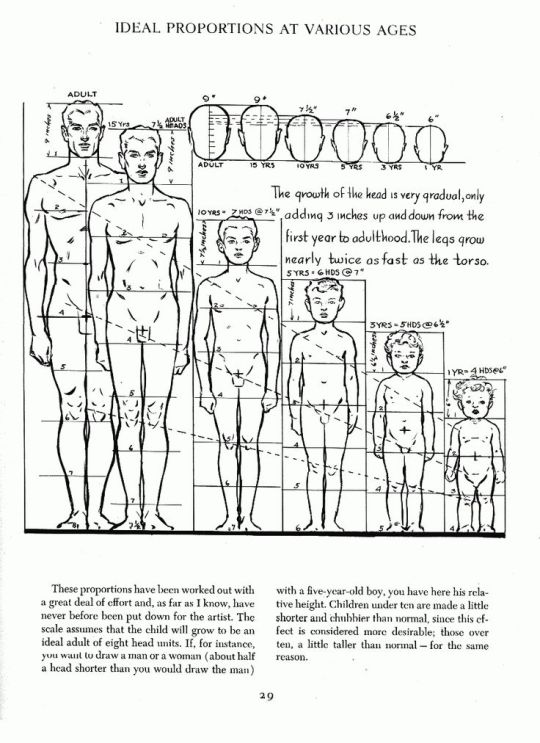
OK, so like… instead of shaming everyone for it, this is actually a legitimate problem where popular mediums get adults to play the roles of young teenagers, and art books don’t teach you how human children SHOULD look. It’s hard to find resources on learning this but you pick up tips every now and then. For example:-
Head to body proportions
If you normally draw an idealised body proportion of 1:8 heads high, try lessening that ratio for drawing young teenagers to 1:6 to show that the body is still growing.
Add baby fat
Unless your teenager is starved or gone through MASSIVE amounts of stress like abuse or war, they’ll probably still have a degree of baby fat on them. This rounds out features, and smoothes out wrinkles. Their skin is also elastic, so there isn’t much folding of the skin in areas of muscle, and the eyes.
Facial proportions
The younger a child is, the lower the eye level is in comparison to the head. To make a character younger, just lower the eye level, and shorten the nose length. To age them, lengthen the face
Fashion
Teenagers wear and say different things than an adult. Talk to actual teenagers if you can. Some teenagers are more mature than adults, and some meme 24/7. Some are goth, some are fashinistas etc… If you’re an adult, don’t assume that your current knowledge of teenagers is correct. You’ll probably find that your memory is skewed, and teen life has changed in the last 10 years. Specially if it was 20 years ago and pre-internet. IF they act like a teen and dress liek a teen, they’re more likely to read like a teen.
Google
I’m not joking- LOOK AT PHOTOS OF ACTUAL 14 YEAR OLDS. It’s not creepy, and it’ll do your art good knowing what you’re drawing.
Naturally there’s rule breaking in art everywhere, and you’ll get 14 year olds that do look mature for their age, biofemales that have large breasts already (I’m sorry to those people), and biomales that are in sports so have muscle mass (Likewise with anyone else), and sometimes art styles lean toward certain characteristics where everyone has a certain feature like large muscles, but the really strong ones have zero body fat. That happens. As long as you’re consistent and it’s obvious that a certain character IS younger, you can get away it.
Diversity is art is good. Try not to have “actors” with one certain body type and face shape cause you’re only limiting yourself with what you can do.
You can’t learn to draw from one art book no matter how good the teacher is. They likely lack in certain areas cause they have to cut some corners in teaching art. Most art books are giving you the building blocks so you can learn on your own. It’s not a single and complete resource on the subject.
And if you have questions on if you’re doing it right, just ask a teenager, or an adult that is doing it right 🙂 I’m yet to find a person that isn’t more than happy to help you if you ask nicely 🙂
i was just surprised by a video of acd with sound? his voice? i hadn’t ever heard it before and didn’t know that existed and now i’m always going to have to hear it in my head forever. do you know how mad i am. i did not !! consent!! to this knowledge!!
huh. i go to the store, i see this oddly named massive $5 chocolate bar and decide to treat myself. turns out to be anti-slavery chocolate. coolio kinda day.
i bought one of these with like salted caramel and it was soooo good
My ability to proofread increases by 1000% after I hit “Submit”.
this is often because when you’ve submitted something (like fanfiction to ao3) it will be in a different font, size and framing than in your word processor. The text will look different in the new environment so your brain stops skipping what looks familiar (like a typo that has been there since the beginning).
So, tip: revise your work in a different font and size. I guarantee you’ll catch more typos and mistakes than otherwise.
For all my writers (ones I follow and the ones that thankfully follow me)
My editing process is 5 stages, and I change font and size before each go around. It works a treat by making your brain actually SEE what it is looking at (and spotting the mistakes you didn’t see the first time around)
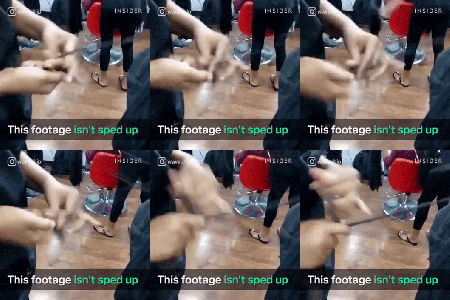
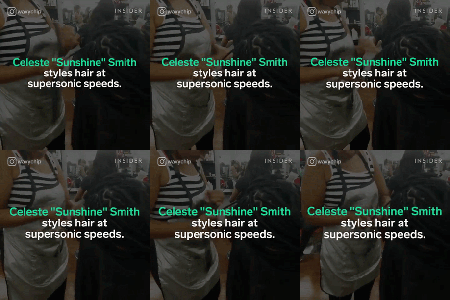
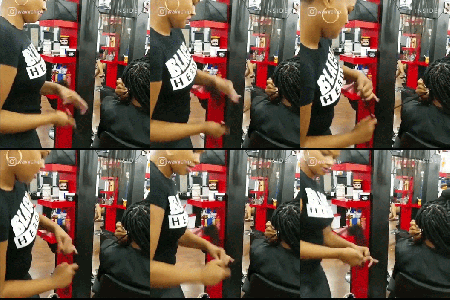
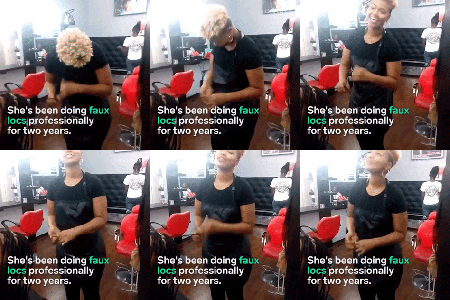
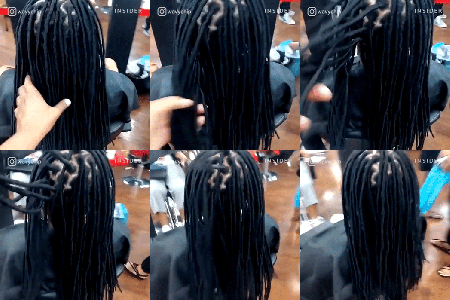
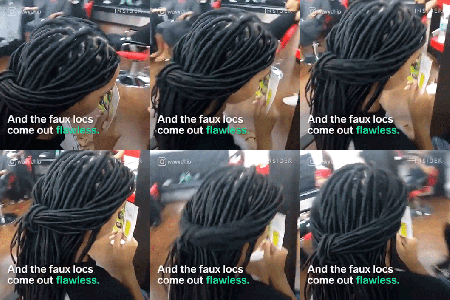
Amazing woman and amazing work! Looks like some kind of magic! I love our people and our culture to the moon and back!
It is maddening that white people love the culture that we produce so much, but seem ambivalent towards our suffering and what it costs to create such a gorgeous culture in the face of constant erasure and hate! And yes, whites wearing dreadlocks and faux locks absolutely is cultural appropriation!
#BlackPride
Always…ALWAYS link to the person’s profiles. You want them to get their shine, followers, and coin.






 Beltainefaerie's Flights of Fancy