I really don’t think people who aren’t Autistic or who don’t struggle with sensory issues understand that when it comes to certain stimuli, those things provoke actual feelings of pain, nausea, disgust, discomfort, etc for people that are Autistic/have sensory processing disorder.
Take “picky eating.” I was labelled a “picky eater” even as a little toddler. I couldn’t eat sauce, tomatoes, or have my food touching other foods. People said stuff like “She’ll grow out of it” or “She’ll eat it if she’s actually hungry” or “Tastebuds change; she’ll like it when she’s older!“
But the fact was, if it was a food I couldn’t eat, I literally couldn’t eat it. I’d try to eat lasagna and start crying, and gagging, and I’d have to spit it out. Guess what? I didn’t “eat when I was hungry” if it was one of those foods, I just didn’t eat. This was especially an issue when I started going to school and daycare (I eventually got a note from my doctors that detailed my Autism diagnosis and sensory problems, so that the local kids center would provide me with alternative meals. They treated it the same way they did with kids with allergies, basically.)
Also, I didn’t “grow out of it.” I still cannot eat tomatos, sauces, and most mixed food dishes. Because I just can’t even make my mouth chew and swallow without gagging and spitting the food out. Just a couple months ago I went to grab some chicken wraps from the local taco place, and I asked specifically that they hold the sauce. But they didn’t, so when I took a bite I got a mouthful of pain and chucked it right into my napkin (gross, I know. I’m making a point here though.)
So when Autistic people, or anyone with a sensory processing related disorder, tells you that they cannot handle something-whether that means being touched, wearing certain clothes, being around noise, or eating certain foods-remember what I just said. That’s how it feels, when people willfully ignore our reminders and warnings about our stimuli and triggers. That’s what you’re doing when you touch someone when they tell you it hurts them, or make them wear that suit or outfit, or put sauce on their food when they politely ask you not to. Granted, overload is different and presents differently in everyone, but bottom line-you’re choosing to disrespect someone’s boundaries, and their medical issues, and you are hurting them when you force certain stimuli on them after they’ve asked you to stop. Just respect people, and don’t shame people for not being able to handle or do the same stuff other people can.
I legitimately didn’t know this! Thank you for detailing it in such a straightforward way, I imagine it was annoying to get into the details of such uncomfortable experiences
The next time somebody gives you shit about your late autism diagnosis, remember that Anthony Hopkins was diagnosed as autistic when he was 70 years old.
People can go almost their whole lives and never know they’re autistic, but recognize they feel different from their peers.
And BTW Anthony Hopkins stims by rubbing his hands together, and being autistic is exactly why he’s such a good actor. He studies people’s mannerisms with an analytical mind, adopts those mannerisms for characters and turns out awesome performances. He’s a chameleon.
And we respond with a personal experience or anecdote
We’re not trying to make the conversation about ourselves.
Most times (at least with me), I have to find an experience within myself that is similar to what you’ve described
So I can furnish an appropriate emotional reaction to what you’re experiencing.
It’s sort of like when you ping an IP address to fix a faulty Wi-Fi connection.
It’s not personal, it’s just how I navigate Feelings™.
This is how many people on the Autism spectrum express empathy. We don’t say things like “You must have felt so…” like neurotypical people are used to. To us, that comes across as presuming to know. We look to when we felt something that seems similar, and offer that experience. That lets the other person decide whether we truly know how they feel.
When I do this I am trying to show you that I really do know how you feel, and not just saying something arbitrary to make you feel better. Since I’m not good at showing and expressing emotions or even knowing exactly what it is I am feeling, I barely know what others are feeling. But by relating situation to situation, I’m acknowledging what they are feeling now and that I felt a similar way once, so that any advice I give can sound like I’m feeling the right emotion.
Oh I had no idea this was an autism thing I always respond to people by talking about situations where I felt similarly
Literally this is so common they test for it during the diagnostic process.
Holy shit! I do this all the time! and then later it triggers social anxiety, because I think people are going to think I’m narcissistic and hate me when all I wanted to do was empathize and demonstrate that they aren’t alone in their feelings.
“If autism isn’t caused by environmental factors and is natural why didn’t we ever see it in the past?”
We did, except it wasn’t called autism it was called “Little Jonathan is a r*tarded halfwit who bangs his head on things and can’t speak so we’re taking him into the middle of the cold dark forest and leaving him there to die.”
Or “little Jonathan doesn’t talk but does a good job herding the sheep, contributes to the community in his own way, and is, all around, a decent guy.” That happened a lot, too, especially before the 19th century.
Or, backing up FURTHER
and lots of people think this very likely,
“Oh little Sionnat has obviously been taken by the fairies and they’ve left us a Changeling Child who knows too much, and asks strange questions, and uses words she shouldn’t know, and watches everything with her big dark eyes, clearly a Fairy Child and not a Human Like Us.”
The Myth of the Changeling child, a human baby apparently replaced at a young age by a toddler who “suddenly” acts “strange and fey” is an almost textbook depiction of autistic children.
To this day, “autism warrior mommies” talk about autism “stealing” their “sweet normal child” and have this idea of “getting their real baby back” which (in the face of modern science) indicates how the human psyche actually does deal with finding out their kid acts unlike what they expected.
Given this evidence, and how common we now know autism actually is, the Changeling myth is almost definitely the result of people’s confusion at the development of autistic children.
Weirdly enough, that legend is now comforting to me.
I think it’s worth noting that many like me, who are diagnosed with ASD now, would probably have been seen as just a bit odd in centuries past. I’m only a little bit autistic; I can pass for neurotypical for short periods if I work really hard at it. I have a lack of talent in social situations, and I’m prone to sensory overload or you might notice me stimming.
But here’s the thing: life is louder, brighter and more intense and confusing than it has ever been. I live on the edge of London and I rarely go into the centre of town because it’s too overwhelming. If I went back in time and lived on a farm somewhere, would anyone even notice there was anything odd about me? No police sirens, no crowded streets that go on for miles and miles, no flickery electric lights. Working on a farm has a clear routine. I’d be a badass at spinning cloth or churning butter because I find endless repetition soothing rather than boring.
I’m not trying to romanticise the past because I know it was hard, dirty work with a constant risk of premature death. I don’t actually want to be a 16th century farmer! What I’m saying is that disability exists in the context of the environment. Our environment isn’t making people autistic in the sense of some chemical causing brain damage. But we have created a modern environment which is hostile to autistic people in many ways, which effectively makes us more disabled. When you make people more disabled, you start to see more people struggling, failing at school because they’re overwhelmed, freaking out at the sound of electric hand dryers and so on. And suddenly it looks like there’s millions more autistic people than existed before.
“…disability exists in the context of the environment.”
Reblog for disability commentary.
That last paragraph is absolutely important.
The need for glasses wasn’t noticed until reading became commonplace. From
– Autism Speaks was created after a couple decided they wanted a cure for their autistic grandchild
– The CEO has called Autism a “monster that is stealing our children”
– There are no autistic people on the board for Autism Speaks
– A$ has furthered propaganda that claims autism is caused by external sources such as vaccines, gluten, and milk.
– A$ has produced short films demonizing the condition, claiming it will “destroy marriages” and you will “never know peace”.
– A$ has been condemned by both autistic people and mental health experts
– A$ is also classified by autistic people as a hate group
– A$ has recently allied with a group of bikers who are known for white supremacy
– Only 4% of A$ funds raised go to help families, with 33% going to media and lobbying.
Please do not give Autism Speaks a single cent of your money. Instead, consider donating to Autistic Women’s Network or Autistic Self-Advocacy Network instead.
Barnes and Noble is selling books on their website/in their stores such as “A Parent’s Guide to Preventing Homosexuality” and “Stop Autism Now! A Parent’s Guide to Preventing and Reversing Autism Spectrum Disorders” and I am pissed. Not only are these books scientifically inaccurate, but using “parenting guides” as a way to masquerade around behind the scenes with hate and bigotry is absolutely disgusting. Children of parents who read these books and employ their methodology will be at risk for a host of mental illnesses, not to mention drug use and suicidal tendencies. I will (sadly, bc I love books a lot) be boycotting Barnes and Noble until these books are pulled from their inventories, and would appriciate it if y’all would share/do the same. This hatred needs to be stopped.
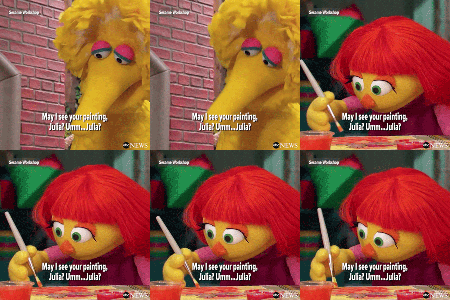
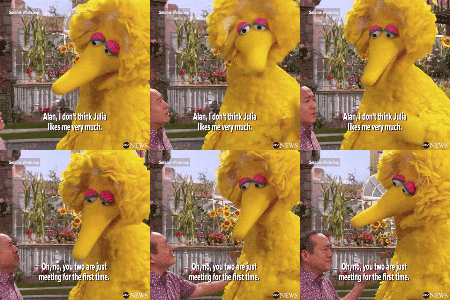
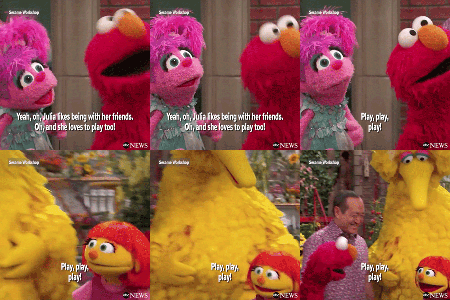
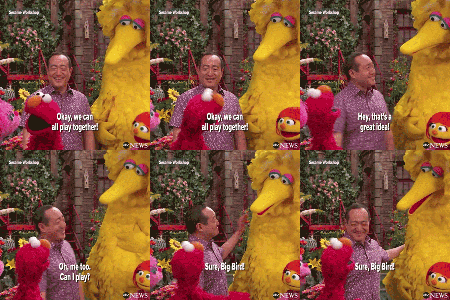
Julia, a Muppet with autism, makes her debut appearance on Sesame Street.
“She does things just a little differently, in a…Julia sort of way.”
It’s great that Sesame Street has designed a character with autism. I think the character will help kids understand autism in a better way and encourage acceptance. Adults can try and explain things like autism to a child, but it can be difficult. I grew up with Sesame Street, I’m glad the show is still helping kids learn and grow!
Media representation always matters, thank you Sesame Street for still teaching us.






 Beltainefaerie's Flights of Fancy