VOTE LIKE YOUR FUTURE DEPENDED ON IT, BECAUSE IT DOES!
❤ ALL OF THIS ❤
Get out and vote regardless of whether it seems like its a “Sure thing” or seems “Hopeless”…there’s no such thing as a sure thing and there is always ALWAYS a chance that your vote can make a difference no matter how hopeless it might seem…
Hey do y’all fucks remember two years ago when just before the election all these “don’t vote both parties are bad” or “vote independent!” Posts were going around and then Trump won and now two weeks before midterms there’s all these “don’t bother voting, revolution is the only way!” And “your vote isn’t gonna matter and is an ineffective way to protest” posts are going around? Yeah knock that shit right the fuck off, don’t fall for it and get your ass to the polls, we are not doing this again.
Voting is a civic duty, not a protest. The two are not mutually exclusive, nor should they be conflated.
The swing voter in November will not be the Republican to Denocrat or Democrat to Republican.
It will be the non-voter to voter.
Young people,
this is your moment.
This is your election.
This is your time to win.
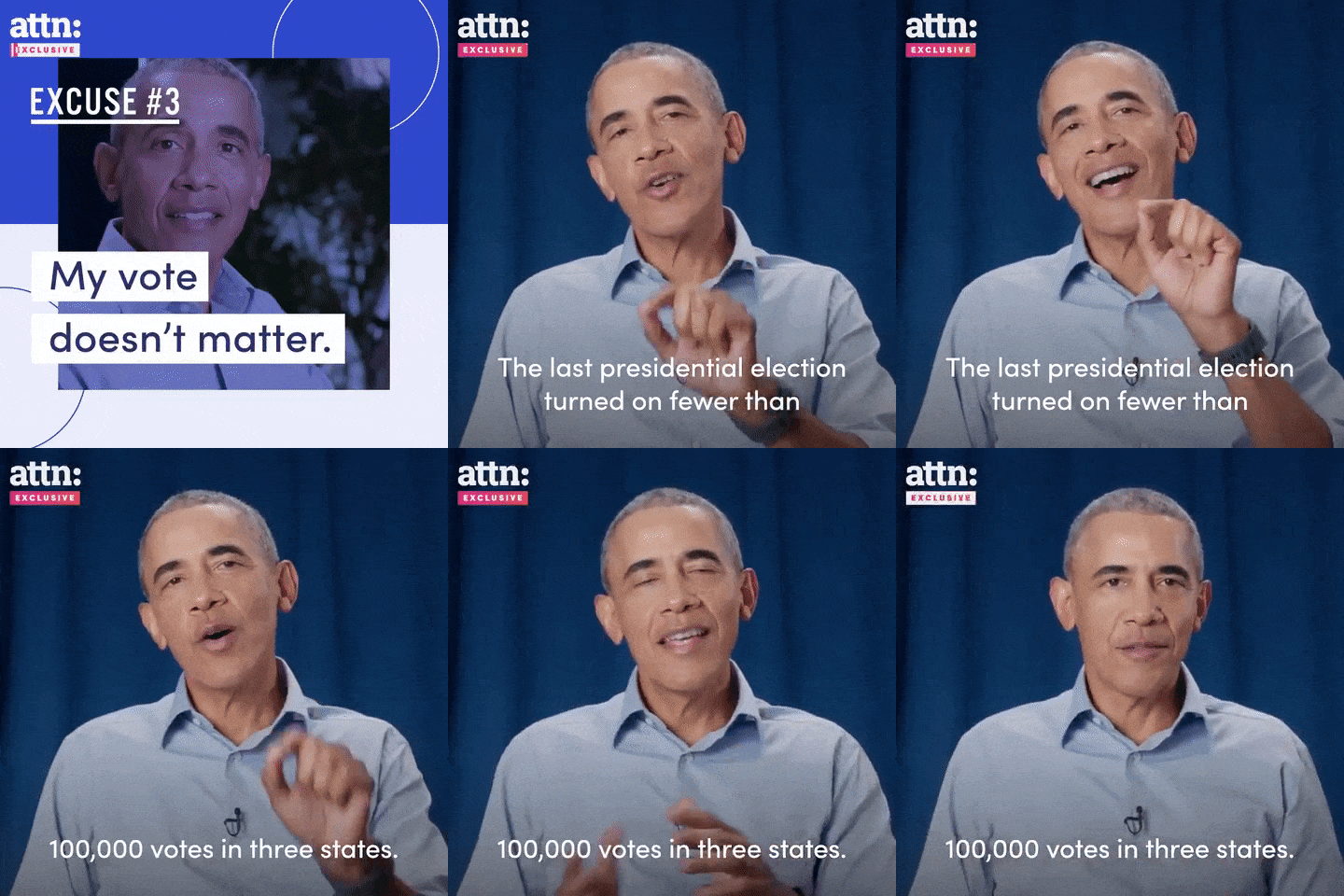
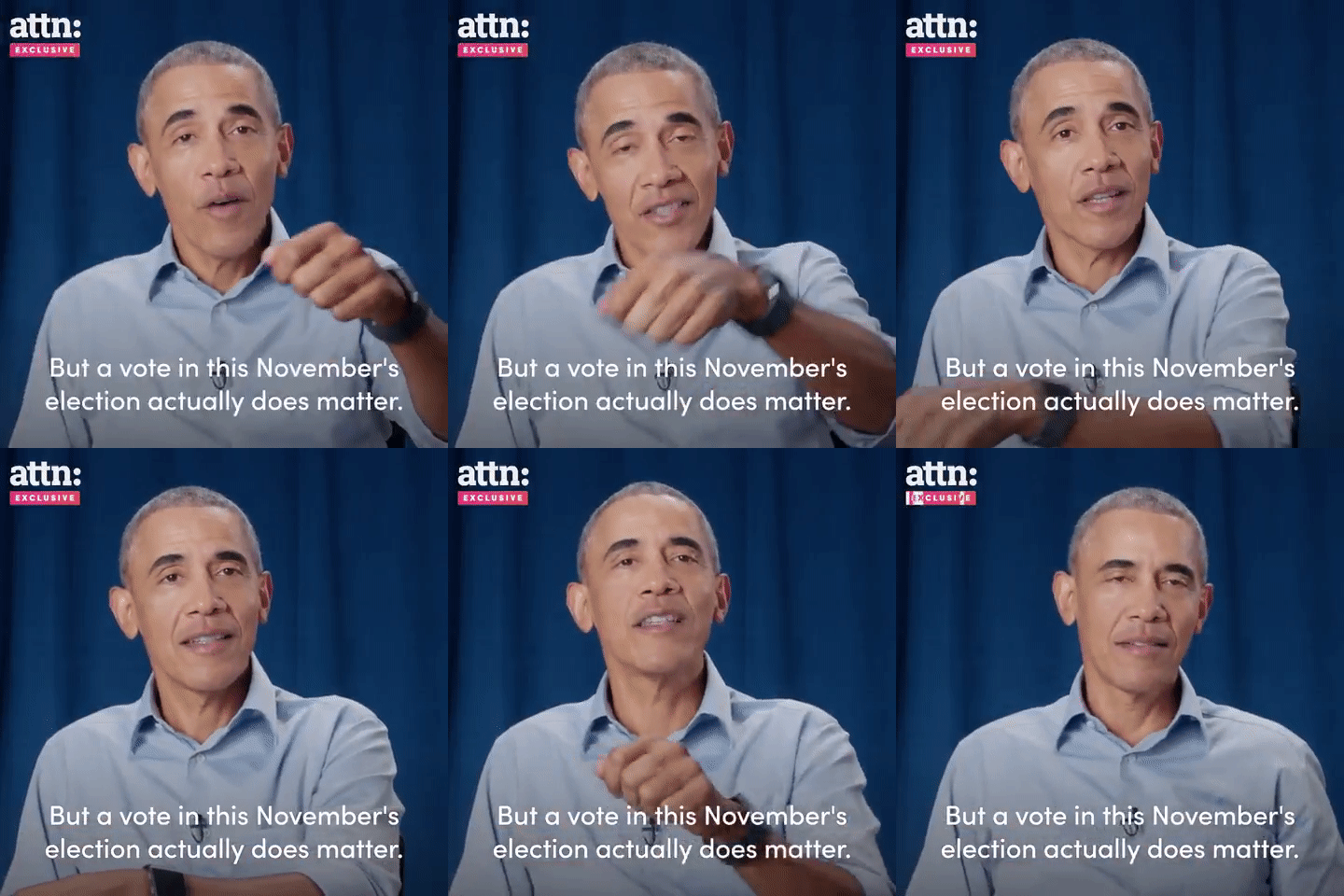
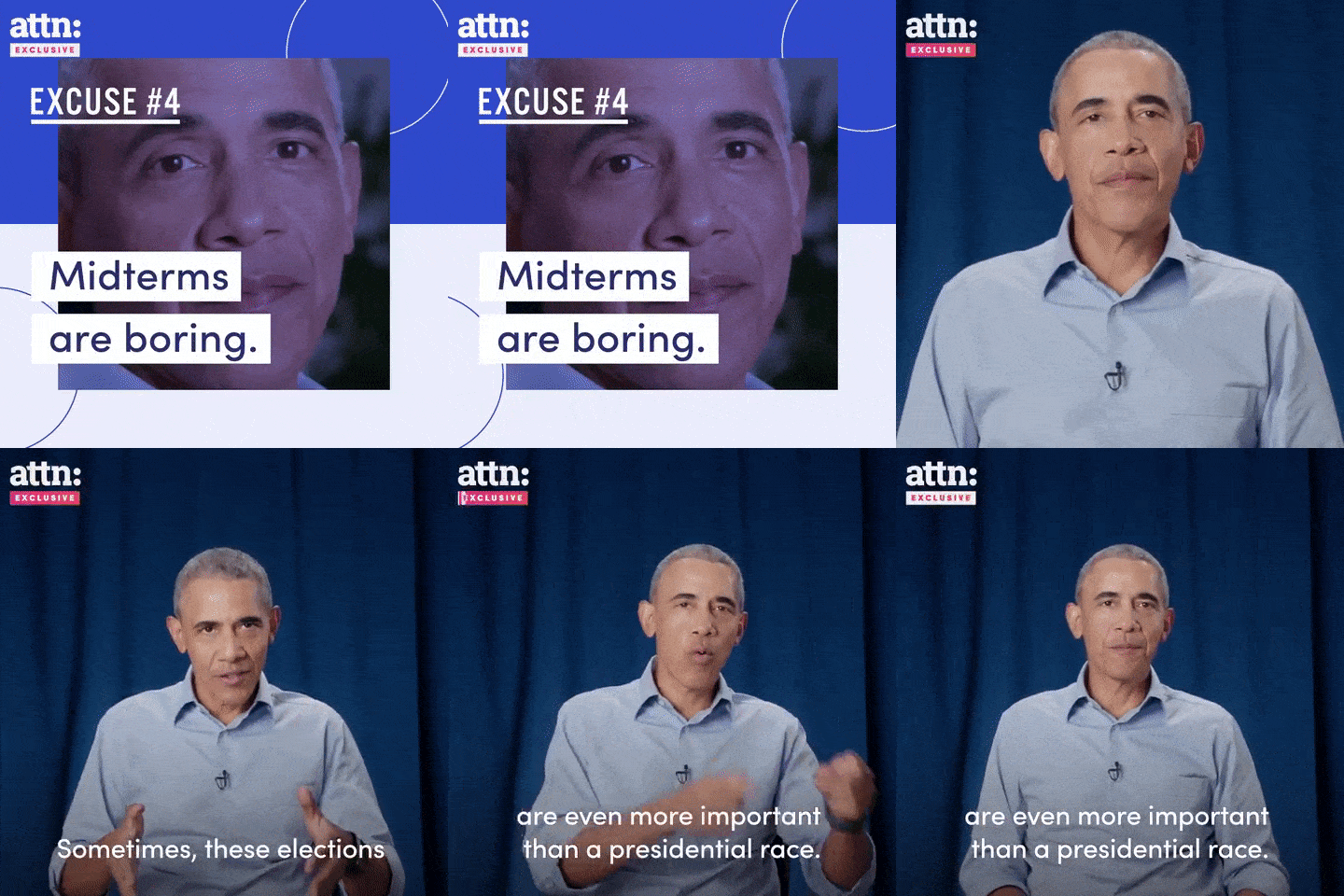
Vote! The lower the voter turnout, the more likely republicans are to win. Young people are majority liberal, but are way less likely to vote. Our voices matter. Vote to enact change!
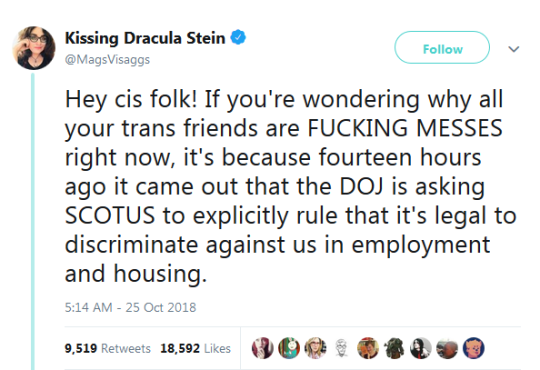
The Pentagon concedes that gender dysphoria is treatable, but asserts there is “considerable scientific uncertainty and overall lack of high-quality scientific evidence demonstrating the extent to which transition-related treatments” address the symptoms associated with gender dysphoria. The report mentions the high suicide rates of the transgender population as a central reason for its ban.
Our findings make it indisputable that gender transition has a positive effect on transgender well-being. We identified 56 studies published since 1991 that directly assessed the effect of gender transition on the mental well-being of transgender individuals. The vast majority of the studies, 93 percent, found that gender transition improved the overall well-being of transgender subjects, making them more likely to enjoy improved quality of life, greater relationship satisfaction and higher self-esteem and confidence, and less likely to suffer from anxiety, depression, substance abuse and suicidality.
Only four studies (7 percent) reported mixed or null findings, and none found that the transitioning created more harm than good. Despite recent media focus on anecdotes about “transgender regret,” actual regret rates across numerous studies were minuscule, generally ranging from 0.3 percent to 3.8 percent. Our review of primary research confirmed the positive findings of at least 16 previous literature reviews.
The research shows that gender transition improves well-being, and that it can redress the specific health conditions that the military claims are its primary concern, particularly suicidality. A 1999 United States study found a “marked decrease of suicide attempts” and substance use in its postoperative population. In a 2014 British study, gender transition “was shown to drastically reduce instances of suicidal ideation and attempts.” The study reported that “67 percent of respondents thought about suicide more before they transitioned and only 3 percent thought about suicide more post-transition.”
Research suggests that gender transition may resolve symptoms completely. A 2016 literature review by scholars in Sweden concluded that, most likely because of improved care over time, transgender “rates of psychiatric disorders and suicide became more similar to controls,” and that for those transitioning after 1989, “there was no difference in the number of suicide attempts compared to controls.” The corollary is also true: Another study found that withholding hormone treatment from transgender people increased the risk of depression and suicide.
While transgender people can still face disproportionate stresses after transition, research suggests that stigma and discrimination are primary causes of such “minority stress.” That’s all the more reason we should provide treatment and social support rather than exclusion and barriers to care.
Suicide and mental health challenges do not, of course, define transgender people, many of whom are just as healthy as their peers. There are other populations that are plagued by suicide, including the military community itself. Children of military members are at much higher risk for suicidal ideation than both the general and the transgender population. Yet children of service members are not barred from enlisting, despite these higher risks. This suggests a double standard in which transgender people are singled out for unequal treatment not because they present an unacceptable risk but simply because of bias.
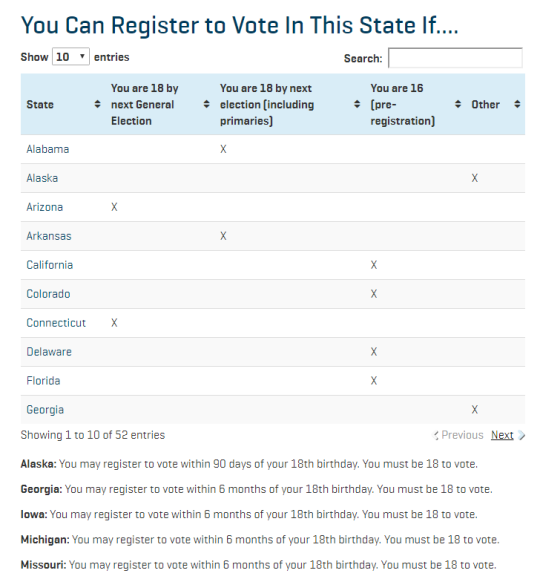
“Think you’re not old enough to register to vote? If you’re 17 and will be 18 by Election Day, chances are you can. Check out our chart below that details when you are eligible to register or preregister in your state, and when you can start voting!”
The info’s all at the site, in table format, but here it is on your dash as a list. The 50 states, Washington, D.C., and Puerto Rico, all alphabetized.
Alabama: you may register to vote if you are 18 by the next election, including primaries.
Alaska: you may register to vote within 90 days of your 18th birthday. You must be 18 to vote.
Arizona: you may register to vote if you are 18 by the next General Election.
Arkansas: you may register to vote if you are 18 by the next election, including primaries.
California: you may pre-register to vote if you are 16.
Colorado: you may pre-register to vote if you are 16.
Connecticut: you may register to vote if you are 18 by the next General Election. Registered 17 year-olds who will be 18 by the general election can vote in primaries.
Delaware: you may pre-register to vote if you are 16. Registered 17 year-olds who will be 18 by the general election can vote in primaries.
Florida: you may pre-register to vote if you are 16.
Georgia: you may register to vote within 6 months of your 18th birthday. You must be 18 to vote.
Hawaii: you may register to vote if you are 18 by the next election, including primaries.
Idaho: you may register to vote if you are 18 by the next election, including primaries.
Illinois: you may register to vote if you are 18 by the next General Election. Registered 17 year-olds who will be 18 by the general election can vote in primaries.
Indiana: you may register to vote if you are 18 by the next General Election.
Iowa: you may register to vote within 6 months of your 18th birthday. You must be 18 to vote.
Kansas: you may register to vote if you are 18 by the next election, including primaries.
Kentucky: you may register to vote if you are 18 by the next election, including primaries. Registered 17 year-olds who will be 18 by the general election can vote in primaries.
Louisiana: you may pre-register to vote if you are 16.
Maine: you may register to vote if you are 18 by the next General Election. Registered 17 year-olds who will be 18 by the general election can vote in primaries.
Maryland: you may pre-register to vote if you are 16. Registered 17 year-olds who will be 18 by the general election can vote in primaries.
Massachusetts: you may pre-register to vote if you are 16.
Michigan: you may register to vote within 6 months of your 18th birthday. You must be 18 to vote.
Minnesota: you may register to vote if you are 18 by the next election, including primaries.
Mississippi: you may register to vote if you are 18 by the next election, including primaries. Registered 17 year-olds who will be 18 by the general election can vote in primaries.
Missouri: you may register to vote within 6 months of your 18th birthday. You must be 18 to vote.
Montana: you may register to vote if you are 18 by the next election, including primaries.
Nebraska: you may register to vote if you are 18 by the next General Election. Registered 17 year-olds who will be 18 by the general election can vote in primaries.
Nevada: you may register to vote if you are 18 by the next election, including primaries.
New Hampshire: you may register to vote if you are 18 by the next election, including primaries.
New Jersey: you may register to vote if you are 18 by the next General Election.
New Mexico: you may register to vote if you are 18 by the next General Election. Registered 17 year-olds who will be 18 by the general election can vote in primaries.
New York: you may register to vote if you are 18 by the next General Election.
North Carolina: you may pre-register to vote if you are 16. Registered 17 year-olds who will be 18 by the general election can vote in primaries.
North Dakota: does not have voter registration. You must be 18 to vote.
Ohio: you may register to vote if you are 18 by the next General Election. Registered 17 year-olds who will be 18 by the general election can vote in primaries.
Oklahoma: you may register to vote if you are 18 by the next election, including primaries.
Oregon: you may pre-register to vote if you are 16.
Pennsylvania: you may register to vote if you are 18 by the next election, including primaries.
Puerto Rico: you may register to vote if you are 18 by the next General Election.
Rhode Island: you may pre-register to vote if you are 16.
South Carolina: you may register to vote if you are 18 by the next election, including primaries. Registered 17 year-olds who will be 18 by the general election can vote in primaries.
South Dakota: you may register to vote if you are 18 by the next election, including primaries.
Tennessee: you may register to vote if you are 18 by the next election, including primaries.
Texas: you may register to vote within 2 months of your 18th birthday. You must be 18 to vote.
Utah: you may pre-register to vote if you are 16.
Vermont: you may register to vote if you are 18 by the next General Election. Registered 17 year-olds who will be 18 by the general election can vote in primaries.
Virginia: you may register to vote if you are 18 by the next General Election. Registered 17 year-olds who will be 18 by the general election can vote in primaries.
Washington: you may register to vote if you are 18 by the next election, including primaries.
Washington D.C.: you may register to vote if you are 18 by the next General Election.
West Virginia: you may register to vote if you are 18 by the next General Election. Registered 17 year-olds who will be 18 by the general election can vote in primaries.
Wisconsin: you may register to vote if you are 18 by the next election, including primaries.
Wyoming: you may register to vote if you are 18 by the next election, including primaries.
you know, when i said i wanted the real world to be more like harry potter i just meant the teleportation and the butterbeer, not the entire plot of book 5 where the government refuses to do anything about a deadly threat so the teenagers have to rise up and fight back
































 Beltainefaerie's Flights of Fancy