And NOWADAYS, the Electoral College heavily favors states with high prison populations for exactly the same reasons.
This is literally why the 3/5ths compromise was created.
Well, this and seats in Congress. Yes.
I’m trying to figure out how to check the second part of this premise. I guess I gotta look at prison populations by state and then cross check to electoral seats.
That prison is used as a way to disenfranchise people of color is a fact, but I had thought that because seats were awarded based on population, more densely populated states, tending to be more urban, tend to be more Democratic. And I had figured that prison populations tended to follow the general population numbers. Time to research.
shit, so much math…I got a list of incarceration per population and a list of electoral seats. I think where I’m getting lost is the proportion of seats per population, which is what I need to compare incarceration rates against.
Yeah, I’m not seeing much correlation between rate of incarceration and proportion of electoral seats. But maybe I’m missing the point somewhere?
Within states of high incarceration, prisoners count as part of the population(and thus, more electoral points for that state) but CAN NOT VOTE, thus the power of all the other votes is raised.
oh, now I see what I missed in the comparison. Effectively white voters count more in high incarceration states. The proportion of electoral seats is already odd depending on population and further skewed by voter disenfranchisement compounded by disproportionately incarcerating people of color. It’s not so much an issue of how the electoral seats are awarded on the federal level (which is what I was thinking about) but how voter disenfranchisement by states affects federal level elections.
So Alabama, with its high incarceration rate, although it looks on the electoral map to be fairly balanced, is actually very imbalanced because the number of people eligible to vote doesn’t match the population number that determined the number of electoral seats.
Exactly, yes. The point distribution by population looks…ok (smaller states do get more points proportionally) but voter disenfranchisement through incarceration and other means can skew that really badly within a state (like slavery did with the 3/5 compromise.)
I knew all these facts individually – the 3/5 compromise, electoral college votes determined by population, people convicted of felonies lose voting rights, black people are imprisoned at a higher rate than whites – but I never put all those together to realize what they meant.
That is an entire new level of horrifying.
This is probably stupid, and a stretch, but is this why so many Republicans push for marijuana to stay illegal? I always thought it was strange that they were against the legalization of marijuana–Republicans are usually about individual freedoms and less government control, as they are with guns, but for some reason this doesn’t apply to weed… Even though it’s overall a safe recreational drug (safer than alcohol anyways) that could immensely help the economy. Do they want it to stay illegal so that the prisons stay full, and so that they get more power in the electoral college?
Well, yeah. The war on drugs is absolutely a tool in this.
“The Nixon campaign in 1968, and the Nixon White House after that, had two enemies: the antiwar left and black people,” former Nixon domestic policy chief John Ehrlichman told Harper’s writer Dan Baumfor the April cover story published Tuesday.
“You understand what I’m saying? We knew we couldn’t make it illegal to be either against the war or black, but by getting the public to associate the hippies with marijuana and blacks with heroin. And then criminalizing both heavily, we could disrupt those communities,” Ehrlichman said. “We could arrest their leaders. raid their homes, break up their meetings, and vilify them night after night on the evening news. Did we know we were lying about the drugs? Of course we did.”
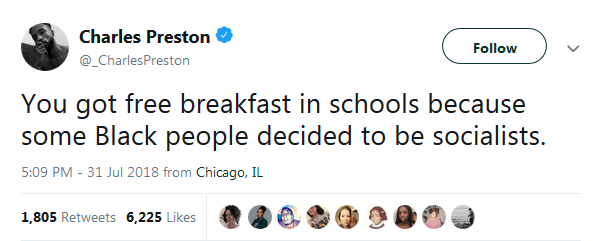
In 1969, a group of children sat down to a free breakfast
before school. On the menu: chocolate milk, eggs, meat, cereal and fresh
oranges. The scene wouldn’t be out of place in a school cafeteria these
days—but the federal government wasn’t providing the food. Instead,
breakfast was served thanks to the Black Panther Party.
At the time, the militant black nationalist party was
vilified in the news media and feared by those intimidated by its
message of black power and its commitment to ending police brutality and
the subjugation of black Americans. But for students eating breakfast,
the Black Panthers’ politics were less interesting than the meals they
were providing.
“The children, many of whom had never eaten breakfast before the Panthers started their program,” the Sun Reporterwrote, “think the Panthers are ‘groovy’ and ‘very nice’ for doing this for them.”
The program may have been groovy, but its purpose was to
fuel revolution by encouraging black people’s survival. From 1969
through the early 1970s, the Black Panthers’ Free Breakfast for School
Children Program fed tens of thousands of hungry kids. It was just one
facet of a wealth of social programs created by the party—and it helped
contribute to the existence of federal free breakfast programs today.
When Black Panther Party founders Huey P. Newton and Bobby
Seale founded the party in 1966, their goal was to end police brutality
in Oakland. But a faction of the Civil Rights Movement led by SNCC
member Stokeley Carmichael began calling for the uplift and
self-determination of African-Americans, and soon black power was part
of their platform.
At first, the Black Panther Party primarily organized
neighborhood police patrols that took advantage of open-carry laws, but
over time its mandate expanded to include social programs, too.
Free Breakfast For School Children was one of the most
effective. It began in January 1969 at an Episcopal church in Oakland,
and within weeks it went from feeding a handful of kids to hundreds. The
program was simple: party members and volunteers went to local grocery
stores to solicit donations, consulted with nutritionists on healthful
breakfast options for children, and prepared and served the food free of
charge.
School officials immediately reported results in kids who
had free breakfast before school. “The school principal came down and
told us how different the children were,” Ruth Beckford, a parishioner
who helped with the program, said later. “They weren’t falling asleep in class, they weren’t crying with stomach cramps.”
Soon, the program had been embraced by party outposts
nationwide. At its peak, the Black Panther Party fed thousands of
children per day in at least 45 programs. (Food wasn’t the only part of
the BPP’s social programs; they expanded to cover everything from free medical clinics to community ambulance services and legal clinics.)
For the party, it was an opportunity to counter its
increasingly negative image in the public consciousness—an image of
intimidating Afroed black men holding guns—while addressing a critical
community need. “I mean, nobody can argue with free grits,” said
filmmaker Roger Guenveur Smith in A Huey P. Newton Story, a 2001 film in which he portrays Newton.
Free food seemed relatively innocuous, but not to FBI head
J. Edgar Hoover, who loathed the Black Panther Party and declared war
against them in 1969. He called
the program “potentially the greatest threat to efforts by authorities
to neutralize the BPP and destroy what it stands for,” and gave carte
blanche to law enforcement to destroy it.
The results were swift and devastating. FBI agents went
door-to-door in cities like Richmond, Virginia, telling parents that BPP
members would teach their children racism. In San Francisco, writes
historian Franziska Meister, parents were told the food was infected
with venereal disease; sites in Oakland and Baltimore were raided by
officers who harassed BPP members in front of terrified children, and
participating children were photographed by Chicago police.
“The night before [the first breakfast program in Chicago] was supposed to open,” a female Panther told historian Nik Heynan, “the Chicago police broke into the church and mashed up all the food and urinated on it.”
Ultimately, these and other efforts to destroy the Black
Panthers broke up the program. In the end, though, the public visibility
of the Panthers’ breakfast programs put pressure on political leaders
to feed children before school. The result of thousands of American
children becoming accustomed to free breakfast, former party member
Norma Amour Mtume toldEater, was the government expanded its own school food programs.
Though the USDA had piloted free breakfast efforts
since the mid 1960s, the program only took off in the early 1970s—right
around the time the Black Panthers’ programs were dismantled. In 1975,
the School Breakfast Program was permanently authorized. Today, it
helps feed over 14.57 million children before school—and without the radical actions of the Black Panthers, it may never have happened.




 Beltainefaerie's Flights of Fancy