Jewish people who type the word “god” as “g-d”: Do you think you can fool the big man upstairs with a technical work around? When he goes through your emails/texts/facebook posts after you die, you don’t think he’s gonna see that dash and think “this sneaky fuck here, enjoy h-ll.”
this thought comes from someone who has no idea how Judaism works, but okay.
People avoid writing out God’s name, because you aren’t ever allowed to destroy or desecrate something with God’s name on it – you have to bury it instead. That’s what a genizah is. The most well known is probably the Cairo Genizah. It’s a box where Jews can put anything with God’s name on it to ensure that it gets buried.
So obviously Jews do write out God’s name. In fact, it used to be traditional to mark the top of pages with God’s name as a kind of blessing or mark of honesty. That’s why there are so many miscellaneous texts in genizahs.
Judaism reads “do not use my name in vain” pretty literally as a command to revere and respect the Y-H-V-H name of God.
Most rabbis agree that this commandment only holds for the hebrew, so not typing out God is more something people do out of respect or as a nod to this tradition. Some people use G-d because they want to parallel the fact that the tradition was put in place for people who would be speaking and writing in hebrew or a very near identical language like Aramaic.
It’s a matter of respect, not a matter of “don’t do this or you will be punished.”
Besides, Judaism deals almost exclusively with punishment in life and Judaism very explicitly doesn’t have a clear and codified notion of עולם הבא (the world to come). And there is certainly no notion of hell.
Also, Judaism is not nearly that harsh in response to small mistakes. We have a holiday every year explicitly devoted to the idea that we all fuck up and that we need to ask forgiveness from each other and God (and during which God does all the judging – God doesn’t wait until after we die. It’s an active thing that can be constantly adjusted).
Maybe world religions is not the best topic of contemplation during your shower.
As a tangentially related note, the Cairo Genizah basically didn’t get emptied for like, a thousand years, and in the late 19th century historians started going through it and found all kinds of writing in Hebrew and Arabic about day-to-day Jewish life, trading activity, etc. throughout the Islamic world and Indian Ocean region, there’s even writings from famous people like Maimonides.There’s hundreds of thousands of manuscripts. Some of them have been translated and published and it’s really neat to look at if you’re into that kind of thing.
So this tradition gave us a historical treasure whose value cannot even be described.
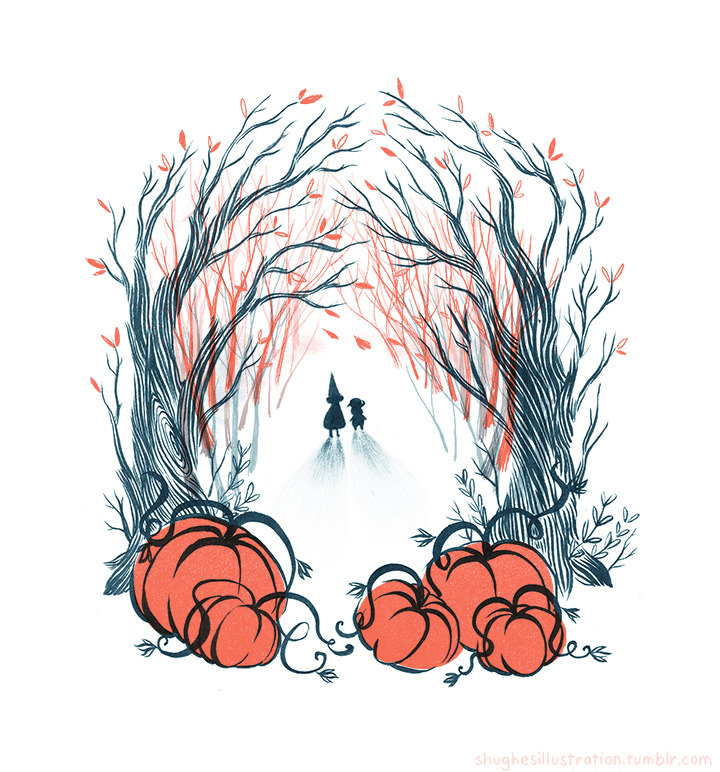
I’ve been neglecting my tumblr… oops. Here’s an Over the Garden Wall colour experiment I did a while ago, based on an even older inktober drawing of mine.
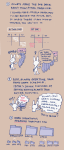
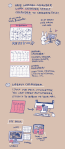
I’ve got a lot of questions about this during my Art Center time, so I drew it ! This system came from when I had to manage my time during art high school (8am-5pm everyday) with 2 waitress jobs. Everybody has different working method, but I will be more than happy if anyone gets new idea from it !
Wow this is so helpful!
This so great! If I can get permission from the artist, I would love to use this in a PowerPoint for my classes!
Today, on the way to work, I said to myself: “I’m 46. It’s 2016. I have a job, a wife, a daughter…why am I still yelling at Chris Carter?”
You spend a lot of time yelling at male showrunners, I said to myself. All of it wasted. Does Steven Moffat care what you think about what he did to Doctor Who? Or about the end of Season 3 of Sherlock? Poor Gene Roddenberry is dead now, and you couldn’t rewatch Star Trek TOS without yelling at him, poor man. And back in the day, how you used to yell at Piller and Berman and Brannon Braga about Next Generation and Deep Space Nine! It’s a good thing you don’t care enough about the J. J. Abrams Star Trek movies to waste time yelling at him too.
What is it that these showrunners all have in common? You know, apart from being men? Are there ANY male showrunners you’re not yelling at?
I thought, well, there’s John Finnemore.
You all might not know who John Finnemore is. He ran/wrote/starred in a radio sitcom called “Cabin Pressure” whose cast included Benedict Cumberbatch. I love “Cabin Pressure.” This does not mean that I am never critical of it. Ask me sometime about the whole “Martin doesn’t get paid” thing. BUT, even when I am disappointed with something about it, “Cabin Pressure” doesn’t make me angry the way I get when things go south in, say, The X-Files. Why not?
Considering this question, I have arrived at these points:
1) Finnemore put a lot of effort into plotting. Of course you have to do this with a sitcom; take the plot out and you just have a random collection of one-liners and sight gags. But at its best, “Cabin Pressure” is very well-constructed and if you look at what he’s said about the writing process it’s clear that a lot of thought goes into that.
OK, so I’m a plot geek and not everyone is about that. I get it. But then there’s
2) Finnemore put the show ahead of his own ego. He played one of the characters, and I’m not saying he never did himself a solid by writing something special for Arthur; but it’s always an ensemble show, and the final product always matters more than anything any one character gets to do–including the one Finnemore was playing.
Maybe that’s what really makes me angry–when I see the Big Cheese screwing everything up for the company and the creative team by insisting on something that serves his own ego but makes no sense for anyone else who’s invested in the show. Cause I see that happen a lot in my real life and I KNOW how pissed off I get about that.
Then I thought, you know what, Russell T. Davies might be an interesting borderline example here. I became a fan of Doctor Who during his era, and kind of became a fan of Torchwood even though, oh my God, the problems with Torchwood you could write a fucking book about. Why was I tolerant of Davies and his mistakes–even when the individual mistakes made me extremely angry–in a way that I was not tolerant of Moffat? And so I formulated postulate 3:
3) I can put up with a lot of crap as long as the characters and their relationships work.
And I guess this is why I end up yelling so much at the other guys. Back when I was trying to figure out how to write science fiction short stories, and reading the models, I did notice that most of the ones that made it into the big magazines were about 90% premise and 10% characterization. This mix does not work for me. I like speculative fiction but I also need characters whose emotions feel real to me and whose relationships are treated as if they are important. When the show’s emotional plot is broken, that’s when I get pissed off.
For instance, I really hated the end of Doctor Who’s fourth season because of the way it got rid of one of my favorite characters. Much yelling at RTD over that. BUT, I will say that what RTD did to Donna Noble in that episode, he did BECAUSE he understood her relationship to the Doctor and why it mattered and why we cared about her as a character. Same thing for the way he ended “Children of Earth.” I mean that was awful. But it was not awful in a way that made no emotional sense. It was awful because actually it did. I mean RTD was not nice to the viewers; he was not nice to his characters. But I believe that he knew them better than we did and that they felt at least as real to him as they did to us.
I don’t believe that about Carter, when it comes to Mulder and Scully; and I guess I’ve never believed it about Moffat either. So maybe that’s the source of it. I don’t know. I have work to do.
Reblogging this because YES. YES YES YES.
1000000% agree about John Finnemore, and he is the example I bring up every single time when I want to point to a writer who constructed beautiful character arcs and actually pulled them off. The characters developed as people, everything made so much sense emotionally. The characters felt REAL because Finnemore treated them like they were.
(My poor husband, he’s the one who usually has to listen to me rant about John Finnemore. I mean, he totally agrees with me. But I can’t stop.)
And here, right here, is the difference between John Finnemore and Chris Carter and Moffat and Gatiss. Does the writer treat the characters as if they are real, or do they start treating them like a way to have fun?
“Jeremy Brett was a very big, famous actor in England who played Sherlock Holmes in many shows in the 1980s and 1990s, and he was an eccentric, grand old-school actor and a very charming man. I was going to do this show ‘Coasting’ as a co-lead and knew nothing about cameras or films. In those days, it took 30 days to shoot an hour of television, which beggars belief today. So I was only on his show for six days as a guest and asked him for tips. And he said, ‘My dear boy, I will have you called for every day of the shoot,’ and he did, and I sat on set and he took me through all of it, how to hit your mark, how to walk down a dolly track without looking at it. It was a very concentrated course in film acting.”













 Beltainefaerie's Flights of Fancy