Harnessing the sun’s radiation to help rid the oceans of microplastics contamination is one of several technical innovations to be developed by a new EU-funded project. Beginning in November 2017, a system developed at KTH Royal Institute of Technology in Sweden for breaking down microplastics from personal care products will be tested for implementation in homes and wastewater treatment plants.
While exposure to sunlight can degrade plastics into harmless elements, it’s a slow process. In some cases plastics can take several years to decompose. Joydeep Dutta, chair of the Functional Materials department at KTH, said this system will speed up that process by making more efficient use of available visible light and ultraviolet rays from the sun.
The system involves coatings with material of nano-sized semiconductors that initiate and speed up a natural process called photocatalytic oxidation, Dutta said. In a test household, these nano material coated filter systems will be placed at the exit of wastewater from homes. Similarly, in wastewater treatment plants, these devices will be used to initiate microplastics degradation after the classical treatments are completed.
The photocatalytist membranes were created in partnership with the Swedish company, PP Polymer AB.
Photocatalytic oxidation with titanium oxide and zinc oxide semiconductors has been used to convert volatile pollutants, oils and other substances into harmless elements such as water and CO2. Similar in concept to photosynthesis, photocatalysis activates the breakup of compounds by exciting electrons, which then causes water molecules to split into their constituent parts, hydrogen and oxygen. The material captures enough solar radiation from a minimum of available light to set off a reaction with the molecules of the plastic. The radicals then exchange electrons with the atoms that comprise plastic molecules, effectively pulling these contaminants apart into harmless compounds of CO2 and water.
‘The semiconductor material is able to excite the molecules and set off this process using the 40 percent of solar radiation that is visible light,’ Dutta said.
Nearly every beach worldwide is reported to be contaminated by microplastics, according to the Norwegian Institute for Water Research. And, as if that weren’t bad enough, marine life ingest these plastics, which also adsorb pollutants such as DDT and PCB.
‘These plastics will start accumulating in the food chain, transferring from species to species, with direct adverse consequences to human population,” Dutta says. “Tackling plastic pollution at its source is the most effective way to reduce marine litter.’
The project, titled Cleaning Litter by Developing and Applying Innovative Methods in European Seas (CLAIM), will also deploy floating booms at river mouths in Europe to collect visible plastic waste; and ferry routes in Denmark, the Gulf of Lyon, Ligurian Sea and Saronikos Gulf will be used to test a plastics measuring system that could be later deployed on shipping vessels.
I’ve decided to tell you guys a story about piracy.
I didn’t think I had much to add to the piracy commentary I made yesterday, but after seeing some of the replies to it, I decided it’s time for this story.
Here are a few things we should get clear before I go on:
1) This is a U.S. centered discussion. Not because I value my non U.S. readers any less, but because I am published with a U.S. publisher first, who then sells my rights elsewhere. This means that the fate of my books, good or bad, is largely decided on U.S. turf, through U.S. sales to readers and libraries.
2) This is not a conversation about whether or not artists deserve to get money for art, or whether or not you think I in particular, as a flawed human, deserve money. It is only about how piracy affects a book’s fate at the publishing house.
3) It is also not a conversation about book prices, or publishing costs, or what is a fair price for art, though it is worthwhile to remember that every copy of a blockbuster sold means that the publishing house can publish new and niche voices. Publishing can’t afford to publish the new and midlist voices without the James Pattersons selling well.
It is only about two statements that I saw go by:
1) piracy doesn’t hurt publishing.
2) someone who pirates the book was never going to buy it anyway, so it’s not a lost sale.
Now, with those statements in mind, here’s the story.
It’s the story of a novel called The Raven King, the fourth installment in a planned four book series. All three of its predecessors hit the bestseller list. Book three, however, faltered in strange ways. The print copies sold just as well as before, landing it on the list, but the e-copies dropped precipitously.
Now, series are a strange and dangerous thing in publishing. They’re usually games of diminishing returns, for logical reasons: folks buy the first book, like it, maybe buy the second, lose interest. The number of folks who try the first will always be more than the number of folks who make it to the third or fourth. Sometimes this change in numbers is so extreme that publishers cancel the rest of the series, which you may have experienced as a reader — beginning a series only to have the release date of the next book get pushed off and pushed off again before it merely dies quietly in a corner somewhere by the flies.
So I expected to see a sales drop in book three, Blue Lily, Lily Blue, but as my readers are historically evenly split across the formats, I expected it to see the cut balanced across both formats. This was absolutely not true. Where were all the e-readers going? Articles online had headlines like PEOPLE NO LONGER ENJOY READING EBOOKS IT SEEMS.
Really?
There was another new phenomenon with Blue Lily, Lily Blue, too — one that started before it was published. Like many novels, it was available to early reviewers and booksellers in advanced form (ARCs: advanced reader copies). Traditionally these have been cheaply printed paperback versions of the book. Recently, e-ARCs have become common, available on locked sites from publishers.
BLLB’s e-arc escaped the site, made it to the internet, and began circulating busily among fans long before the book had even hit shelves. Piracy is a thing authors have been told to live with, it’s not hurting you, it’s like the mites in your pillow, and so I didn’t think too hard about it until I got that royalty statement with BLLB’s e-sales cut in half.
Strange, I thought. Particularly as it seemed on the internet and at my booming real-life book tours that interest in the Raven Cycle in general was growing, not shrinking. Meanwhile, floating about in the forums and on Tumblr as a creator, it was not difficult to see fans sharing the pdfs of the books back and forth. For awhile, I paid for a service that went through piracy sites and took down illegal pdfs, but it was pointless. There were too many. And as long as even one was left up, that was all that was needed for sharing.
I asked my publisher to make sure there were no e-ARCs available of book four, the Raven King, explaining that I felt piracy was a real issue with this series in a way it hadn’t been for any of my others. They replied with the old adage that piracy didn’t really do anything, but yes, they’d make sure there was no e-ARCs if that made me happy.
Then they told me that they were cutting the print run of The Raven King to less than half of the print run for Blue Lily, Lily Blue. No hard feelings, understand, they told me, it’s just that the sales for Blue Lily didn’t justify printing any more copies. The series was in decline, they were so proud of me, it had 19 starred reviews from pro journals and was the most starred YA series ever written, but that just didn’t equal sales. They still loved me.
This, my friends, is a real world consequence.
This is also where people usually step in and say, but that’s not piracy’s fault. You just said series naturally declined, and you just were a victim of bad marketing or bad covers or readers just actually don’t like you that much.
Hold that thought.
I was intent on proving that piracy had affected the Raven Cycle, and so I began to work with one of my brothers on a plan. It was impossible to take down every illegal pdf; I’d already seen that. So we were going to do the opposite. We created a pdf of the Raven King. It was the same length as the real book, but it was just the first four chapters over and over again. At the end, my brother wrote a small note about the ways piracy hurt your favorite books. I knew we wouldn’t be able to hold the fort for long — real versions would slowly get passed around by hand through forum messaging — but I told my brother: I want to hold the fort for one week. Enough to prove that a point. Enough to show everyone that this is no longer 2004. This is the smart phone generation, and a pirated book sometimes is a lost sale.
Then, on midnight of my book release, my brother put it up everywhere on every pirate site. He uploaded dozens and dozens and dozens of these pdfs of The Raven King. You couldn’t throw a rock without hitting one of his pdfs. We sailed those epub seas with our own flag shredding the sky.
The effects were instant. The forums and sites exploded with bewildered activity. Fans asked if anyone had managed to find a link to a legit pdf. Dozens of posts appeared saying that since they hadn’t been able to find a pdf, they’d been forced to hit up Amazon and buy the book.
And we sold out of the first printing in two days.
Two days.
I was on tour for it, and the bookstores I went to didn’t have enough copies to sell to people coming, because online orders had emptied the warehouse. My publisher scrambled to print more, and then print more again. Print sales and e-sales became once more evenly matched.
Then the pdfs hit the forums and e-sales sagged and it was business as usual, but it didn’t matter: I’d proven the point. Piracy has consequences.
That’s the end of the story, but there’s an epilogue. I’m now writing three more books set in that world, books that I’m absolutely delighted to be able to write. They’re an absolute blast. My publisher bought this trilogy because the numbers on the previous series supported them buying more books in that world. But the numbers almost didn’t. Because even as I knew I had more readers than ever, on paper, the Raven Cycle was petering out.
The Ronan trilogy nearly didn’t exist because of piracy. And already I can see in the tags how Tumblr users are talking about how they intend to pirate book one of the new trilogy for any number of reasons, because I am terrible or because they would ‘rather die than pay for a book’. As an author, I can’t stop that. But pirating book one means that publishing cancels book two. This ain’t 2004 anymore. A pirated copy isn’t ‘good advertising’ or ‘great word of mouth’ or ‘not really a lost sale.’
That’s my long piracy story.
This is worth reading for about a hundred reasons. Including the brilliant publishing-day exploit.
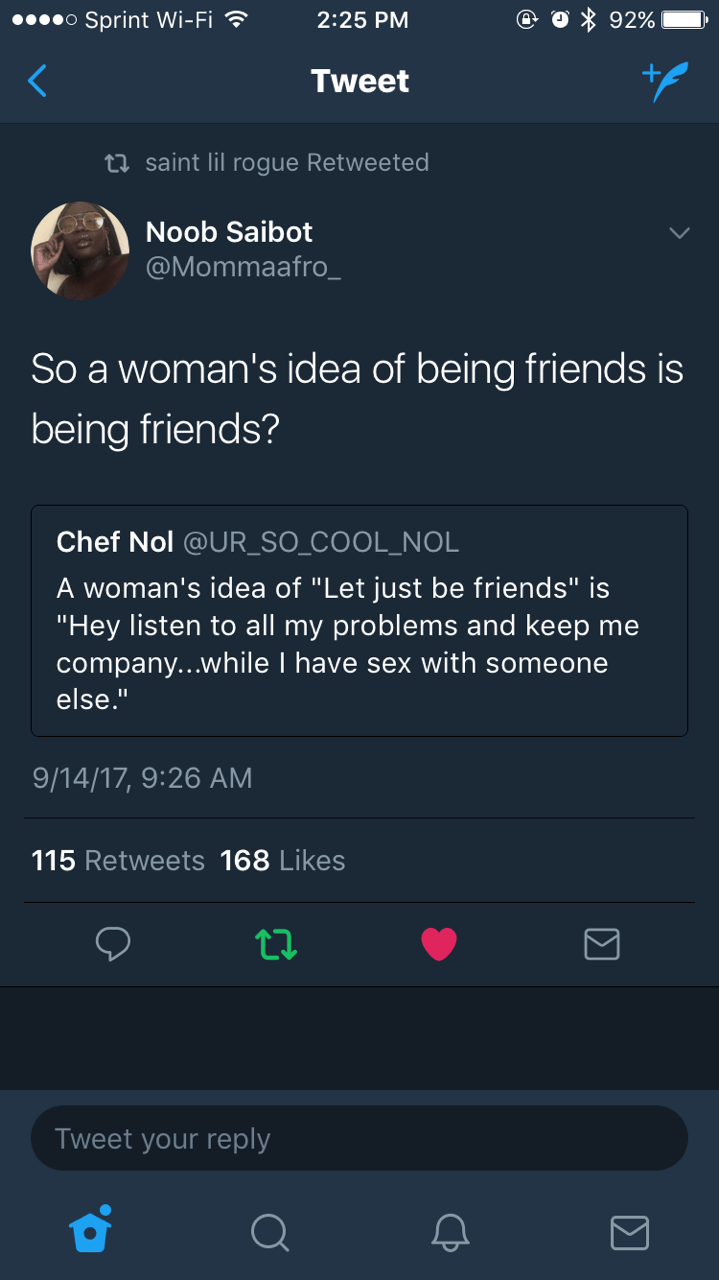
So there’s a known thing in the study of human psychology/sociology/what-have-you where men are known to, on average, rely entirely on their female romantic partner for emotional support. Bonding with other men is done at a more superficial level involving fun group activities and conversations about general subjects but rarely involves actually leaning on other men or being really honest about emotional problems. Men use alcohol to be able to lower their inhibitions enough to expose themselves emotionally to other men, but if you can’t get emotional support unless you’re drunk, you have a problem.
So men need to have a woman in their lives to have anyone they can share their emotional needs and vulnerabilities with. However, since women are not socialized to fear sharing these things, women’s friendships with other women are heavily based on emotional support. If you can’t lean on her when you’re weak, she’s not your friend. To women, what friendship is is someone who listens to all your problems and keeps you company.
So this disconnect men are suffering from is that they think that only a person who is having sex with you will share their emotions and expect support. That’s what a romantic partner does. But women think that’s what a friend does. So women do it for their romantic partners and their friends and expect a male friend to do it for them the same as a female friend would. This fools the male friend into thinking there must be something romantic there when there is not.
This here is an example of patriarchy hurting everyone. Women have a much healthier approach to emotional support – they don’t die when widowed at nearly the rate that widowers die and they don’t suffer emotionally from divorce nearly as much even though they suffer much more financially, and this is because women don’t put all their emotional needs on one person. Women have a support network of other women. But men are trained to never share their emotions except with their wife or girlfriend, because that isn’t manly. So when she dies or leaves them, they have no one to turn to to help with the grief, causing higher rates of death, depression, alcoholism and general awfulness upon losing a romantic partner.
So men suffer terribly from being trained in this way. But women suffer in that they can’t reach out to male friends for basic friendship. I am not sure any man can comprehend how heartbreaking it is to realize that a guy you thought was your friend was really just trying to get into your pants. Friendship is real. It’s emotional, it’s important to us. We lean on our friends. Knowing that your friend was secretly seething with resentment when you were opening up to him and sharing your problems because he felt like he shouldn’t have to do that kind of emotional work for anyone not having sex with him, and he felt used by you for that reason, is horrible. And the fact that men can’t share emotional needs with other men means that lots of men who can’t get a girlfriend end up turning into horrible misogynistic people who think the world owes them the love of a woman, like it’s a commodity… because no one will die without sex. Masturbation exists. But people will die or suffer deep emotional trauma from having no one they can lean on emotionally. And men who are suffering deep emotional trauma, and have been trained to channel their personal trauma into rage because they can’t share it, become mass shooters, or rapists, or simply horrible misogynists.
The only way to fix this is to teach boys it’s okay to love your friends. It’s okay to share your needs and your problems with your friends. It’s okay to lean on your friends, to hug your friends, to be weak with your friends. Only if this is okay for boys to do with their male friends can this problem be resolved… so men, this one’s on you. Women can’t fix this for you; you don’t listen to us about matters of what it means to be a man. Fix your own shit and teach your brothers and sons and friends that this is okay, or everyone suffers.
The next time a guy says, “What? You don’t want to be my friend?” I’ll text him this and then ask if he really wants to be friends or just have another potential girlfriend.
y’all I am living for these analyses where the new way to fight the patriarchy is to teach men to love each other and themselves
Apropos of nothing, that is the sound of my world getting smaller. (Stands on a stack of Bird Scramble APAs and waves) HI @alarajrogers!
Honestly…It makes me really uncomfortable when people draw Leia’s Episode 4 Dress as being really tight with a big slit up the leg, because that’s not how it was at all??
It doesn’t even cling to her breasts or anything?? There’s like…a Small knee length slit, I guess, if you look hard enough. But this, and most other outfits of Leia’s, strike me as incredibly modest and professional. In fact, Lets take a look at that for a second.
Look at what she chooses to wear on Cloud City in Episode 5.
Like…It’s a dress with pants? And I think this was probably an outfit she either A.) Packed for the trip on the falcon or B.) Was provided to her by Lando, And I find it hard to believe that Lando would force an outfit on her, considering he was very nice to her in previous scenes. She would have chosen it out of several different options.
I won’t add pictures, but her White Hoth outfit also consists of a jacket and pants. It’s sensible. They’re in the freezing cold. Why would she wear something sexy. She Wouldn’t.
There are honestly only two instances over the course of three movies where she /kind/ of shows skin. Instance 1 is at the end of Episode 1 where she…Kind of, I guess, Has some cleavage showing?
Like Barely. Keep in mind as well that this dress is floor length and has long sleeves. The second instance is at the end of Episode 6 on Endor
This slit is definitely more revealing, but to be honest, I can’t remember a single time in Episode 6 where it was apparent? They Honestly may have just done this for promotional material? Other pictures of the dress come off as much more modest
I’ve worn dresses shorter than this, so, I wouldn’t exactly consider this revealing by any means.
So when does Leia put on something a little sexier? There’s gotta be one instance right?
Yeah, Against her fucking will.
What I’m getting at here is that I hate the weird sexualization of Leia in Nerd Culture. It’s literally so rampant. It’s not surprising to me whatsoever, but it still makes me mad.
Leia Organa, a 19 year old Freedom Fighter personally fucking chose to dress modestly and people still depict her as this oversexualized Male Gaze Fantasy Being and it’s really disappointing tbfh.
Same thing when people draw Sith!Leia art and make her dress in some bikini catalogue get up. Like, no … Sith Leia would dress up in a black cloak/robe and terrify everyone with her half-hidden gaze. She’d put Sidious to shame.
There are a couple of things about current shipping culture that confuse me.
1. The focus on whether or not a pairing will become canon as a reason people should ship something or not. Do you not understand what the “transformative” part of “transformative works” means?”
2. This idea that saying “I ship that” means “I think that, as presented in canon,this is a perfect, healthy relationship that everyone should model their relationship after.”
Sometimes shipping something does mean that. Sometimes shipping something means “Person A is a trash bag who doesn’t deserve person B but I would love to explore how Person A might grow to deserve Person B.” Sometimes it means “I want these characters to live together forever in a conflict free domestic AU.” Sometimes it means “I want Person A to forever pine after Person B. Nothing is beautiful and everything hurts.” And sometimes it just means you like their faces and want to see Person A and Person B bone in various configurations and universes.
Listen to your parents, kids.
This really should be one of a handful of Public Service Announcements randomly and chronically inserted into one’s dash.
Hell man sometimes it means “these two are TERRIBLE and I want to watch them burn like a catastrophic forest fire as a proxy for all the shit I don’t actually want in real life (like to light my own apartment on fire and scream) and then laugh at the destruction at the end.”
All “I ship it” really means – really – is “I think there’s a story in those two, and I want to hear it.”
Sometimes it means “these two characters never met but wouldn’t it be HOT if they did” or even “these characters don’t live in the same universe and don’t have remotely compatible anatomy but goddammit I love a challenge.”
Fanfic is about the “what if” and the “what the hell, why not?”
Just for once I’d like to tell the gate agents and flight attendants that my folding wheelchair is going into the onboard closet and not have them tell me there’s “no room”. Bitch that’s a wheelchair closet, not a “your bags” closet. Move your damn bags where they belong.
Ok, so according to my friendly aviation expert, this is a Big Fucking Deal. In fact, if an airline argues with you about putting your wheelchair in the wheelchair closet or even suggests there may not be room, unless there is already anotherpassenger’swheelchair in that closet, they have violatedfederallaw.
CFR Title 14, Chapter II, Subchapter D, Part 382, Subpart E, Section 382.67, Subsection (e)
“As a carrier, you must never request or suggest that a passenger not stow his or her wheelchair in the cabin to accommodate other passengers (e.g., informing a passenger that stowing his or her wheelchair in the cabin will require other passengers to be removed from the flight), or for any other non-safety related reason (e.g., that it is easier for the carrier if the wheelchair is stowed in the cargo compartment).”
This is hugely important because it means that if this happens to you, you should report their asses to the DOT. Why? Because these statistics are published every year for every airline, and the airline gets a huge ass fine for every violation. If we want to see change, we need to make airlines literally pay every time they treat us this way.
My mom said that today in church her pastor said in the sermon that Jesus told us to help the poor, and taking money away from public schools to give to charter schools only widens the gap between the rich and the poor. She then added that Jesus spoke against adultery and lust and would not have approved of bragging about sexually assaulting women. According to my mom, people got up and walked out.
The pastor also started the sermon by noting that she’d heard of another minister who read the entirety of the Sermon on the Mount at the pulpit, to be told by the so-called Christian parishioners after the service that it was offensive and they didn’t agree.
The Sermon on the Mount is straight up the words of Jesus.
I recently read an article that said, hypocritical Christians in America don’t actually worship Jesus. They worship America, and even then, it’s a very specific, self-centered idea of America.
YES. EXACTLY.
My mom’s church talks almost every Sunday about how Christians are called to welcome strangers and foreigners and does tons of stuff to help refugees because HELLO, IT’S RIGHT THERE. IN THE RED TEXT, NO LESS.
I don’t believe everything they believe, but I REALLY like those people.
What a lot of these people are is idolators.
Not in terms of the realness or unrealness of who they worship, but in terms of how they’ve warped their focus away from the reality and turned it towards a fantasy of their own construction.
By definition, an idol is an image with no god behind it.
What they have done is taken the idea of Jesus and created a false image of him, nothing like the reality, to carry around in their back pocket, or to wave around on signs, and pull out and shove in people’s faces to justify all manner of unChristlike behavior.
It is a “worship” that is fundamentally self-centered rather than deity-centered, wherein the deity in question is more of a pocketbook get-out-of-jail-free card than directive to live by, and more of a status symbol than a guiding light.
That people will, without a shred of self-awareness, rest themselves assured that Jesus would want them to tip their waitress with a Jesus pamphlet made to look like folded-up money (to take only one example out of many) is the ultimate dismissal of everything the original stood for.
There is a line in the Bible about Jesus meeting his false worshipers and saying “I do not know you.” It seems like plenty of so-called Christians have beaten him to the punch with how quick they are to say they don’t know him.
A lot of churches and organizations in America that call themselves Christian churches are in fact Christianist cults. They no more represent Christianity than Daesh represents Islam. In addition to the usual nonsense of so-called Christians being pro-war, anti-immigrant, racist, and so forth, there are a lot of sects/movements that are just completely toxic and not Christian at all, even though they use that label. If you are Christian and want to have some fucking nightmares, google “christian dominionist,” or “prosperity gospel.”
Still think this is the most realistic diagram of the difference between the theological Jesus and the Comfortable Reinterpretation of Jesus.
American Christianity is, at this point, like the Cult of the Emperor in ancient Rome, which is simultaneously both ironic and appropriate given the history involved
“India’s Supreme Court has issued a historic ruling confirming the right of the country’s LGBT people to express their sexuality without discrimination.
Judges ruled that sexual orientation is covered under clauses in the Indian Constitution that relate to liberty, despite the Government claiming there was no legal right to privacy.
The ruling paves the way for discriminatory practices against LGBT people to be challenged in the courts.”






 Beltainefaerie's Flights of Fancy