Text RACE to 73822 to tell Jack Daniels to stop supporting this abusive race
i think light n brief sledding is ok but many work these poor beautiful dogs to death!..I couldn’t let them sleep outside in the cold either, they would be in the tent with me..lol..I wish they could get rescued..I would love to save one!
I have been working with and running sled dogs in various aspects of the sport for a number of years and got into it because I love the dogs and the sheer delight they have for running in harness. I am always disappointed when it is misrepresented, which does happen from time to time. The Iditarod specifically has been targeted in this instance, although it’s only one of numerous races – albeit the one that is most commercialized and therefore in the public eye more.
Some days I’m content to let the misconceptions be and ignore them, secure in the knowledge that I am striving to take the best care possible for my dogs and give them a well-rounded, happy life with lots of attention, playtime, and mental and physical enrichment. Other days the misconceptions get to me and, being a musher who loves her dogs dearly and knows the amount of work and dedication that goes into a sled dog team, I just get overly frustrated and have to say something.
Today is one of the latter days.
Training sled dogs to run a marathon race is a matter of both dogs and conditioning. The dogs are huskies with both the genetic desire and the physical capability to run for long distances – and to do so happily. They have a thick double-coat like a wolf and, like their wild cousins, thrive in subzero Winters.
Conditioning starts with small training runs and gradually builds up miles so that the dogs don’t have difficulty running these longer distances. Last Winter the team was running 40-milers but this Fall we didn’t start with that. We didn’t even start with a 20-miler. Could they do it? Sure, but it would take a toll physically on them since they wouldn’t be conditioned to routinely run that distance. That would be working them too hard. So we started small, doing 3-mile runs with frequent breaks. After that we built up to 5-milers, then 7-milers, then 9. We did two back-to-back 9-milers this weekend and are now taking a few days break before our first 12-miler of the season.
As the dogs become more conditioned and in shape, doing 100-150-mile races in January and February will be no hardship for them. I’m not training for anything like the Iditarod this year (my race team, at eight dogs, is half the size of an Iditarod team) but those mushers who are have their own training and conditioning program to make sure their dogs are fit enough to run a mushing marathon like that.
In addition to a complete physical exam, any dog that is entered in the Iditarod must be microchipped, undergo an EKG as well as have blood drawn for a CBC, full chemistry and electrolyte panel before being allowed to race. This is more screening than the average “pet” dog undergoes before a surgical proceedure. The race’s veterinary crew is stationed at checkpoints along the trail during the race itself – and this hold true for any modern sled dog race, not just the Iditarod. Mushers are required to have a vet book with exam information on each dog in the team with them at all times in every mid-distance race I have been to and, at many races (including the Iditarod), this book must be signed before the team can leave a checkpoint.
Ironically, in the PETA video from the original post, there is actually footage of either mushers or veterinarians checking the health of the dogs. It’s not something someone unfamiliar with sled dogs would pick up on because you wouldn’t even know to look for it, but it definitely made me do a double-take since it’s so contradictory to the message the video clip is trying to push.
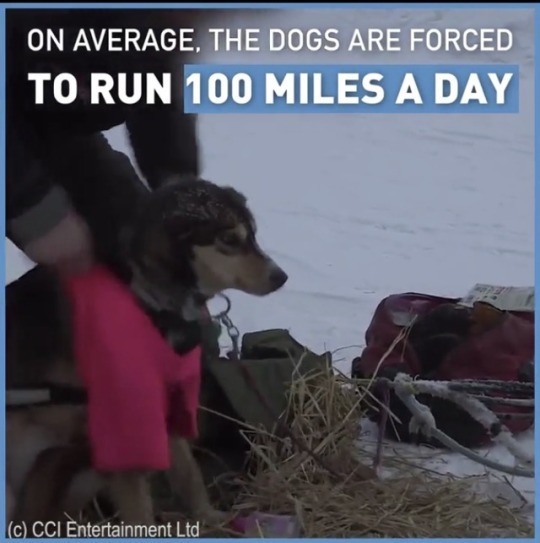
And I’m not just talking about the clip where we see a musher putting a protective coat on their dog.
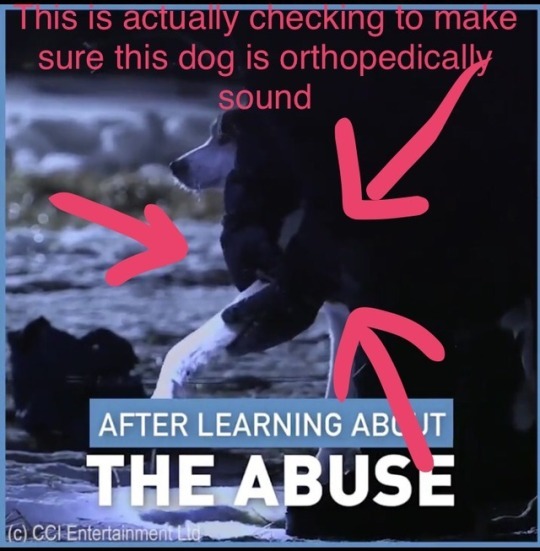
The two things that really stand out to me are actually after the dog-jacket clip. First we see someone extending a forelimb of a dog.
This is something we do a lot, both on sled dogs and on any patient where we want to check flexion and range of motion. With sled dogs, it’s very important to make sure they have good range of motion and that their legs aren’t painful when extended or flexed – especially after a rest.
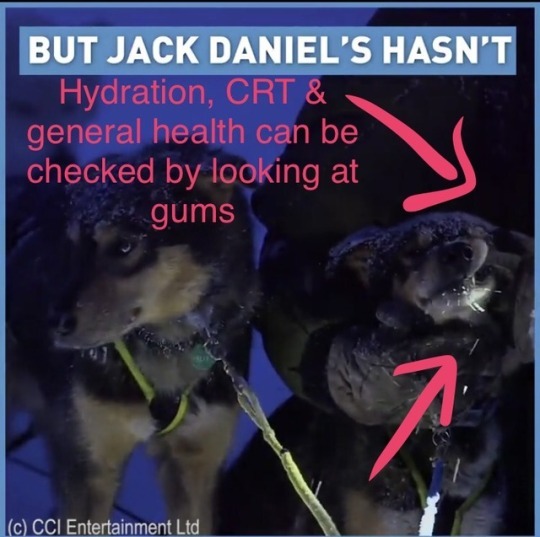
In the very next clip, there’s a blink-and-you’ll-miss-it moment where the musher or veterinarian lifts up a dog’s lip and checks the gum. This is a common method of checking hydration by making sure the gums do not appear tacky, and you can check CRT (Capilary Refill Time) by pressing on the gums and seeing how quickly the pink color returns. Checking the color of the gums is also important as abnormal coloration could be indicitive of a problem.
Veterinary care in all walks of life has improved over the past decades, and sled dog racing is no exception. Understanding of conditioning and the physiology of working dogs has lead to massive improvements in the Iditarod, whereas in the early 1970s when the race began, knowledge of distance racing was scant and resulted in a high number of dog fatalities – especially in the first two years of the race.
There’s a general rule of thumb in sled dog racing that you rest your team for approximately the same length of time you run them, so they are able to recuperate and continue. Every musher’s philosophy and schedule is a bit different of course and each race is different. The Iditarod requires designated amounts of rest time at certain checkpoints but most of it is left up to the musher and team since some might choose to rest at a checkpoint but others prefer to camp along the trail as it’s quieter for the dogs. This is why the amount of “required” rest (ie. rest at checkpoints) seems low.
“My dogs didn’t eat literally the one time when they were filmed in Rainy pass. Because it was warm. And they literally ate 15000 calories 5 hours previous and snacks 2 hours previous. Do you show that? No. Matt filmed me feeding once the whole Iditarod! Now I know why. Dogs don’t eat sometimes. Even house pets.”
It’s also worth noting that the Rainy Pass checkpoint is less than two hundred miles into the Iditarod, teams usually reach it on the second day of the race. No team has been racing for nine days when they reach that checkpoint.
Once again, i feel the need to reiterate: PETA IS NOT A RELIABLE SOURCE OF INFORMATION.
PETA IS NOT A RELIABLE SOURCE OF INFORMATION.
PETA IS NOT A RELIABLE SOURCE OF INFORMATION.
PETA IS NOT A RELIABLE SOURCE OF INFORMATION.
PETA IS NOT A RELIABLE SOURCE OF INFORMATION.
PETA IS NOT A RELIABLE SOURCE OF INFORMATION.
PETA IS NOT A RELIABLE SOURCE OF INFORMATION.
PETA IS NOT A RELIABLE SOURCE OF INFORMATION.
If it’s from PETA, good chance it’s at least questionable, with a not insignificant chance it’s complete bullshit.
PETA are scuuuuum,
What people think polyamory is:
all sex all the time
What polyamory actual is:
I totally told you this important thing, you just don’t remember.
So the other night during D&D, I had the sudden thoughts that:
1) Binary files are 1s and 0s
2) Knitting has knit stitches and purl stitches
You could represent binary data in knitting, as a pattern of knits and purls…
You can knit Doom.
However, after crunching some more numbers:
The compressed Doom installer binary is 2.93 MB. Assuming you are using sock weight yarn, with 7 stitches per inch, results in knitted doom being…
3322 square feet
Factoring it out…302 people, each knitting a relatively reasonable 11 square feet, could knit Doom.
Hi fun fact!!
The idea of a “binary code” was originally developed in the textile industry in pretty much this exact form. Remember punch cards? Probably not! They were a precursor to the floppy disc, and were used to store information in the same sort of binary code that we still use:
Here’s Mary Jackson (c.late 1950s) at a computer. If you look closely in the yellow box, you’ll see a stack of blank punch cards that she will use to store her calculations.
This is what a card might look like once punched. Note that the written numbers on the card are for human reference, and not understood by the computer.
But what does it have to do with textiles? Almost exactly what OP suggested. Now even though machine knitting is old as balls, I feel that there are few people outside of the industry or craft communities who have ever seen a knitting machine.
Here’s a flatbed knitting machine (as opposed to a round or tube machine), which honestly looks pretty damn similar to the ones that were first invented in the sixteenth century, and here’s a nice little diagram explaining how it works:
But what if you don’t just want a plain stocking stitch sweater? What if you want a multi-color design, or lace, or the like? You can quite easily add in another color and integrate it into your design, but for, say, a consistent intarsia (two-color repeating pattern), human error is too likely. Plus, it takes too long for a knitter in an industrial setting. This is where the binary comes in!
Here’s an intarsia swatch I made in my knitwear class last year. As you can see, the front of the swatch is the inverse of the back. When knitting this, I put a punch card in the reader,
and as you can see, the holes (or 0′s) told the machine not to knit the ground color (1′s) and the machine was set up in such a way that the second color would come through when the first color was told not to knit.
tl;dr the textiles industry is more important than people give it credit for, and I would suggest using a machine if you were going to try to knit almost 3 megabytes of information.
It goes beyond this. Every computer out there has memory. The kind of memory you might call RAM. The earliest kind of memory was magnetic core memory. It looked like this:
Wires going through magnets. This is how all of the important early digital computers stored information temporarily. Each magnetic core could store a single bit – a 0 or a 1. Here’s a picture of a variation of this, called rope core memory, from one NASA’s Apollo guidance computers:
You may think this looks incredibly handmade, and that’s because it is. But these are also extreme close-ups. Here’s the scale of the individual cores:
The only people who had the skills necessary to thread all of these cores precisely enough were textile and garment workers. Little old ladies would literally thread the wires by hand.
And thanks to them, we were able to land on the moon. This is also why memory in early computers was so expensive. It had to be hand-crafted, and took a lot of time.
PSA: the main reason that Britain never had a European-style mass fascist movement in the 1930s is because socialists, Jews, trade unionists, black folk and queer people physically dismantled the Blackshirt movement in its infancy by disrupting meetings, toppling stages and assaulting prominent fascists. This meant it never reached critical mass as a street gang capable of controlling public space and providing a pole of attraction for white, working-class youth – a fundamental precondition for the exercise of political power independent of the state by fascist Parties.
my maternal grandfather grew up in a south london working class jewish community and has told me so many stories about this! ❤
DIRECT ACTION WORKS
ATTACKING NAZIS WORKS
All the pathetic fools who say that “Punching Nazis isn’t the answer”…history says otherwise
Violence is ABSOLUTELY the answer to the problem of Nazi terrorists infesting a country
Beating the living shit out of every single Nazi or gathering of Nazis that dares to slither out from beneath its rock IS the answer
MAKE NAZIS AFRAID AGAIN
A lot of Nazi rallies in the US were cancelled last year because those cowards feared for their safety, so beating the shit out of these assholes actually works
It is absolutely an effective tactic at destroying the efforts of these nazi scum to spread their filth
I recently posted a careless response to another post. This is the post I should have made instead:
If you have the bandwidth to correct people’s terminology and assumptions without being an asshole please do, because we only grow from education and experience.
If you lack the bandwidth for that today or any day, it is fine. Bitch to your friends or on Tumblr or whatever you need because self care is important too and it is exhausting to explain things all the time. One of the reasons we need minority spaces, whether that is a GSA or any kind of diversity related high school or college club or center or bar or whatever separate space, is to be with people we don’t have to explain ourselves to.
Tumblr as a culture right now seems to be rife with calling people out and presenting ‘receipts’ of bad behavior which might just amount to misusing a term. Yes, there are people who are doing abusive, horrible things and need to be stopped, but sometimes people are just in a learning curve. If you feel like sending anything, send corrections, not for example, death threats. I wish I was exaggerating. The world would be a little easier to navigate for people who want to be our allies if we try not to yell at people who are making attempts at changing their terminology, or sometimes their whole worldview. They will make mistakes on the way, as we all do. My mom has always had gay friends, is really socially liberal, but used to be a strict enforcer of the gender binary and she’d say really thoughtlessly hurtful things. Often. She’s getting better. Sometimes her attempts at humor or just general inclusivity are cringe-worthy and when I have the bandwidth I help guide her. I hope all those of us who are able will do the same.
OK so I wrote basically an entire ficlet before this and then scrapped it and started over because it was getting way too long. I might go finish it though and will tag you if I do!
John’s text alert sounded and he opened up the message as he stepped inside to see his next patient. What he saw nearly made him drop his phone and certainly made him turn around immediately, making his apologies to Mrs.Horton, telling her he’d be back in a few minutes. He scrambled into the men’s room and went inside a stall, locking the door behind him and sitting on the toilet to open the picture again.
It wasn’t quite a dick pic. John had sent a few of those in his past and received a couple as well. This was more of a nude, really.
The photograph was taken in a mirror –the mirror in the bathroom at 221B to be exact– and captured more than just the subject’s (Sherlock’s, it was definitely Sherlock’s, John reminded himself) cock. It also caught Sherlock’s slim abdomen, the jut of his hipbones and the trail of dark hair that led from his navel down into a closely trimmed thatch of pubic hair. It showed his thighs, which were well muscled and lean, and– only just slightly –the curve of his bum. His face was cropped out, but there was no doubt in John’s mind that it was him. John pulled up his texts from Sherlock and began typing.
Did you just send me a nude? No. Are you certain? I think I’d know if I sent you a nude picture, John. Perhaps it’s one of your dates. No dates right now, git. And none with a cock.
John’s phone showed Sherlock typing, then pausing for a long moment, then finally typing again. He sighed and waited, hoping he could have a few more minutes of privacy. Finally Sherlock’s response came.
Please delete!! It’s ok, Sherlock. I see bodies all the time. I’m a doctor after all. I didn’t mean to share it. I hit delete. I thought I did. It’s fine. You’ve nothing to be ashamed of. I’m not ashamed. I’m embarrassed. There is a difference you know.
John nodded to himself. Of course it had to be embarrassing to know your friend had seen you naked. Not only naked, really, but naked in a sexual way. Sherlock had looked as though he were offering himself up to the camera. It wasn’t the same as seeing him traipsing around the flat in a sheet. It did give John an idea, though.
I’ll send you a nude. Tit for tat, as it were. I don’t mind.
Before he could read Sherlock’s response or allow himself to chicken out, John rucked up his shirt and pulled down his trousers and pants. He wasn’t hard, but after a couple of tugs and a quick look at Sherlock’s picture, he was halfway there. He turned so that the stall door was behind him and did his best to pose before clicking several pictures.
He sent the least blurry one quickly, not wanting to chicken out, and tucked himself back in before washing his hands and heading back to his appointment.
John met Sherlock on January 29th, 1881. That makes their friendship 133 years old today.
“One hundred and thirty-three years, you say.” Holmes accepts the flute of champagne the good doctor holds out to him. “Quite a span of time.”
Watson smiles a little, scoops up his own glass, and brings it to Holmes’s for a resounding ting. “That’s what I thought.”
“And the champagne?” Holmes sips delicately, lifts his eyebrows at the money of the taste. “You have been paying attention, my dear Watson.”
“Kind of hard not to,” Watson admits, and the tips of his ears pink, just barely.
“Why this most excellent champagne, then, if I must repeat myself? We hardly celebrated our centennial.”
Watson grins. “Maybe we did and you just don’t remember it,” he teases.
Holmes sniffs, lifts his chin. “Maybe I deleted it.”
“Look at you, keeping up with the times,” Watson says, and his tone is more fond than the words would imply. “Speaking of which…”
Holmes’s eyebrows pinch together. “What’s got into you?” His eyes widen as Watson sets his glass to a side and takes the detective’s hands into his own. “Watson?”
“It’s been a long time – it’s been the best time, knowing you.”
Holmes draws breath as if to ask him to stop, or explain, but on the exhale it lodges in his throat, words and all.
“And for a long time now, my – regard for you has remained friendly and professional, even as it deepened with the passing years. Affection has bled into my thoughts of you, and now I find myself afflicted with something you will no doubt deem irreconcilable between us.” Watson takes a deep breath. “And thus the reason for the champagne, because this is either the beginning or the end of it.”
“Can it not stay the same? Can we not be as we always have been?” If Holmes’s voice is tremulous, it is most certainly not from sentiment.
And yet, his face pales as Watson shakes his head. “My dear Holmes, no. Without change, we would stagnate. You of all must know how destructive a force ennui can be?”
“Then what would you have us do? Part ways?” Before Watson can continue, Holmes starts to withdraw his hands. “You have had enough of me then.”
The surgeon’s (and now blogger’s) hold tightens about those slender, trembling, violinist fingers.
“God, no,” Watson answers, and it is with a fervor and conviction that sets Holmes’s heart racing; it’s a tone meant for the chase, for moonless nights, for uncovering truths. “I would have us grow closer. I would have you – ” and now the doctor moves so as to be almost flush to the detective, “I would have you for my own.”
There is a silence in 221b, a silence such has never occurred in the flat before – tense and buzzing it is, with all the things unsaid until now, because they have just been summed up, and and quite succinctly, too.
“Why now?” Holmes must ask, because some things change, but never this. He must know why.
“Because the world has changed, and we are in it. Because we have changed so much already,” Watson adds wryly, his eyes tracing the latest of Holmes’s visages, a self-deprecating quirk of his chin indicating his own stature. “Because I am tired of using lukewarm words to garb my love for you. I am tired of choosing lesser actions and greater distances.”
Holmes finds he is, quite suddenly, sitting, which necessitates that Watson crouches, still cupping their hands in the dwindling space between them.
“Easy, Holmes,” Watson says, and there’s almost no hint of cheek as he adds, “I did not know you would be so affected.”
“Sherlock,” comes the reply. “Please,” Verdigris eyes, familiar even in this incarnation, come up to meet his, “John.”
“Alright, then,” John accepts, and then he nods, and he leans in, meaning to come to his detective, but those lips meet his half way.
After a moment’s touch and shared breathing, two sets of eyes flutter open. “Is this alright?” John asks, and his eyes miss not one twitch of Sherlock’s lips and eyes as he thinks through his reply – processes, to use the parliance of their time.
Those eyes focus on his, and those lips curve into a smile. “I think, my dear John, you will find that it’s all…fine.”
The champagne is a fine vintage, like their acquaintanceship – but unlike their bond, it goes to waste that night and is forgotten.




 Beltainefaerie's Flights of Fancy
