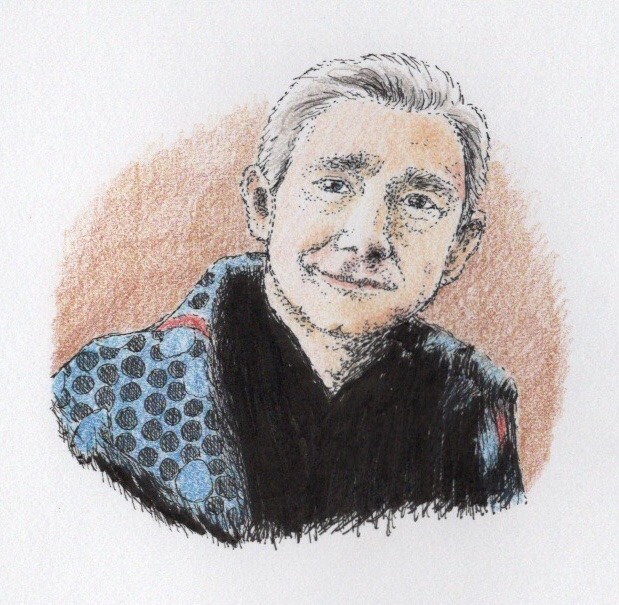
Everett K. Ross, for @honeybeelullaby 💕
*Curtsies* All right. Let me tell you a story:
When I lived in London, I shared a flat with a guy who was 26 years old, getting his PhD in theoretical physics. Let’s call him Ron. Ron could not for the life of him figure out why I was wasting my time with an MA in Shakespeare studies or why my chosen method of providing for myself was writing fiction. Furthermore, it was utterly beyond him why I should take offense to someone whose field literally has the word “theoretical” in the title ridiculing the practical inefficacy of art. My pointing out that he spent his free time listening to music, watching television, and sketching famous sculptures in his notebook somehow didn’t convince him that art is a necessary part of a healthy human existence.
Three other things that happened with Ron:
- I came home late one night and he asked where I’d been. When I told him I’d been at a friend’s flat for a Hanukkah celebration, he said, “What’s Hanukkah?” I thought he was joking. He was not.
- A few weeks later, I came downstairs holding a book. He asked what I was reading and when I said, “John Keats,” he (and the three other science grad students in the room) did not know who that was. This would be like me not knowing who Thomas Edison is.
- One night we got into an argument about the issue of gay marriage, and at one point he actually said, “It doesn’t affect me so I don’t see why I should care about it.”
Now: If Ron had ever read Number the Stars, or heard Ode to a Nightingale, or been to a performance of The Laramie Project, do you think he ever would have asked any of these questions?
Obviously this is an extreme example. This guy was amazingly ignorant, but he was also the walking embodiment of the questions you’re asking. What does art matter compared with something like science, that saves people’s lives? Here’s the thing: There’s a flaw in the question, because art saves lives, too. Maybe not in the same “Eureka, we’ve cured cancer!” kind of way, but that doesn’t make it any less important. Sometimes the impact of art is relatively small, even invisible to the naked eye. For example: as a young teenager I was (no exaggeration) suicidally unhappy. Learning to write is what kept me (literally and figuratively) off the ledge. But I was one nameless teenager; in the greater scheme of things, who cares? Fair enough. Let’s talk big picture. Let’s talk about George Orwell. George Orwell wrote books, the two most famous of which are Animal Farm and 1984. You probably read at least one of those in high school. Why do these books matter? Because they’re cautionary tales about limiting the power of oppressive governments, and their influence is so pervasive that the term “Big Brother,” which refers to the omniscient government agency which watches its citizens’ every move in 1984, has become common parlance to refer to any abuse of power and invasion of privacy by a governmental body. Another interesting fact, and the reason I chose this example: sales of 1984 fucking skyrocketed in 2017, Donald Trump’s first year in office. Why? Well, people are terrified. People are re-reading that cautionary tale, looking for the warning signs.
Art, as Shakespeare taught us, “holds a mirror up to nature.” Art is a form of self-examination. Art forces us to confront our own mortality. (Consider Hamlet. Consider Dylan Thomas.) Art forces us to confront inequality. (Consider Oliver Twist. Consider Audre Lorde. Consider A Raisin in the Sun. Consider Greta Gerwig getting snubbed at the Golden Globes.) Art forces us to confront our own power structures. (Consider Fahrenheit 451. Consider “We Shall Overcome.” Consider All the President’s Men. Consider “Cat Person.”) Art reminds us of our own history, and keeps us from repeating the same tragic mistakes. (Consider The Things They Carried. Consider Schindler’s List. Consider Hamilton.) Art forces us to make sense of ourselves. (Consider Fun House. Consider Growing Up Absurd.) Art forces us to stop and ask not just whether we can do something but whether we should. (Consider Brave New World. Consider Cat’s Cradle.) You’re curious about ecopoetics? The whole point is to call attention to human impact on the environment. Some of our scientific advances are poisoning our planet, and the ecopoetics of people like the Beats and the popular musicians of the 20th century led to greater environmental awareness and the first Earth Day in 1970 . Art inspires change–political, social, environmental, you name it. Moreover, art encourages empathy. Without books and movies and music, we would all be stumbling around like Ron, completely ignorant of every other culture, every social, political, or historical experience except our own. Since we have such faith in science: science has proved that art makes us better people. Science has proved that people who read fiction not only improve their own mental health but become proportionally more empathetic. (Really. I wrote an article about this when I was working for a health and wellness magazine in 2012.) If you want a more specific example: science has proved that kids who read Harry Potter growing up are less bigoted. (Here’s an article from Scientific American, so you don’t have to take my word for it.) That is a big fucking deal. Increased empathy can make a life-or-death difference for marginalized people.
But the Defense of Arts and Humanities is about more than empirical data, precisely because you can’t quantify it, unlike a scientific experiment. Art is–in my opinion–literally what makes life worth living. What the fuck is the point of being healthier and living longer and doing all those wonderful things science enables us to do if we don’t have Michelangelo’s David or Rimbaud’s poetry or the Taj Mahal or Cirque de Soleil or fucking Jimi Hendrix playing “All Along the Watchtower” to remind us how fucking amazing it is to be alive and to be human despite all the terrible shit in this world? Art doesn’t just “improve human lives.” Art makes human life bearable.
I hope this answers your question.
To it I would like to add: Please remember that just because you don’t see the value in something doesn’t mean it is not valuable. Please remember that the importance of science does not negate or diminish the importance of the arts, despite what every Republican politician would like you to believe. And above all, please remember that artists are every bit as serious about what they do as astronomers and mathematicians and doctors, and what they do is every bit as vital to humanity, if in a different way. Belittling their work by questioning its importance, or relegating it to a category of lesser endeavors because it isn’t going to cure a disease, or even just making jokes about how poor they’re going to be when they graduate is insensitive, ignorant, humiliating, and, yes, offensive. And believe me: they’ve heard it before. They don’t need to hear it again. We know exactly how frivolous and childish and idealistic and unimportant everyone thinks we are. Working in the arts is a constant battle against the prevailing idea that what you do is useless. But it’s bad enough that the government is doing its best to sacrifice all arts and humanities on the altar of STEM–we don’t need to be reminded on a regular basis that ordinary people think our work is a waste of time and money, too.
Artists are exhausted. They’re sick and tired of being made to justify their work and prove the validity of what they do. Nobody else in the world is made to do that the way artists are. That’s why these questions upset them. That’s why it exasperates me. I have to answer some version of this question every goddamn day, and I am so, so tired. But I’ve taken the effort to answer it here, again, in the hopes that maybe a couple fewer people will ask it in the future. But even if you’re not convinced by everything I’ve just said, please try to find some of that empathy, and just keep it to yourself.
Is it bad to want to bring someone else joy?
Is it bad to gift someone with something you think they’ll like?
Is it bad to enjoy the reactions of others when you have specifically set out to do something for them?
Nope. Not at all.
In his address to the Oxford Union Society, Patrick Stewart relayed a story from a Boston Conservatory opening-year speech, in which a pianist said to the students:
“One of my parents’ deepest fears, I suspect, is that society would not properly value me as a musician–that I wouldn’t be appreciated. I had very good grades in high school. I was good in science and math, and they imagined that as a doctor or a research chemist or an engineer, I might be more appreciated than as a musician–and they love music! They listened to classical music all the time. They just weren’t really clear about its function….
“If we were a medical school, and you were here as med students, practicing appendectomies, you’d take your work very seriously because you would imagine that on some night at 2:00 AM, someone is going to waltz into your emergency room and you’re going to have to save their life.
“Well, my friends, someday, at 8:00 PM, somebody is going to walk into your concert hall and bring you a mind that is confused, a heart that is overwhelmed, a soul that is weary. Whether they go out whole again will depend partly on how well you perform your craft.”
Everybody has their reasons for making art, and for some, that reason is reaching out to others, establishing contact through the works they do, finding others who enjoy the same things they do. Writing is no different than music in this respect. It has enormous power to reach others and make an impact, and it doesn’t matter if that impact is large or small, on you or on the audience–it’s all worth it. No one’s reason is inherently better or worse than another’s, and wanting to touch those around you is not petty.
My sister’s household has set up an Unnecessary Apology jar in their apartment in an effort to break several of the folks living there of the habit of feeling bad about perfectly normal, acceptable things, and literally apologizing for everything. I admit that they yelled for me to contribute to the jar several times over the three days at Christmas we were together, despite being 4 hours away from that jar. I apologized for liking something and my brother-in-law would shout, “Unnecessary Apology jar!” I would apologize as I second-guessed myself gifting something I thought someone would like and my sister would shout, “Unnecessary Apology jar!”
So to you, my dear anon, my lovely writer, my great source of imagination, my star in the sky, my gift-giver and my gift itself,
Unnecessary Apology jar!
And now? Write. Write for what you love, for the smiles and the kudos and the comments and the likes. Write selfishly, for the reasons that keep you writing and the things that keep your stories growing strong. Thrive off your food, whatever that food may be, and never feel bad for it. We all live off something, and you should never be ashamed of what that is. So go. Go write. Go share. Go grow.
Good luck.
-PearThe reason some of my longer stuff is done and not WIPs and some of my shorter stuff isn’t? Feedback. I literally wrote 400k in 3 months because I have a great writing partner and we give each other feed back on our projects. End result? We both write more.
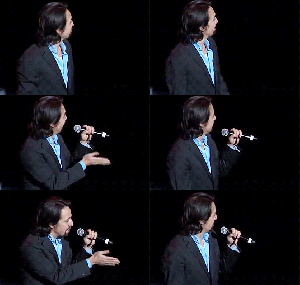
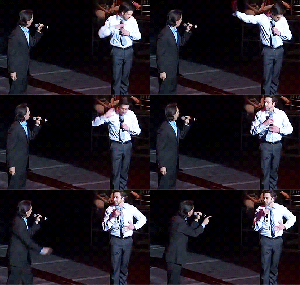
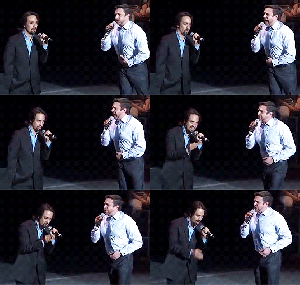
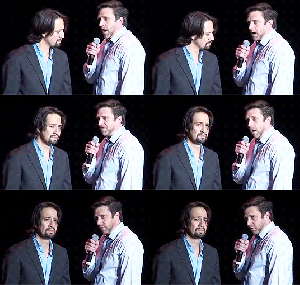

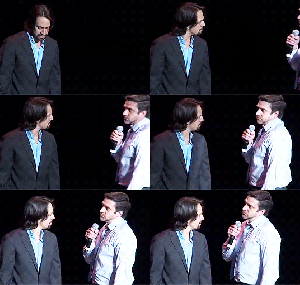
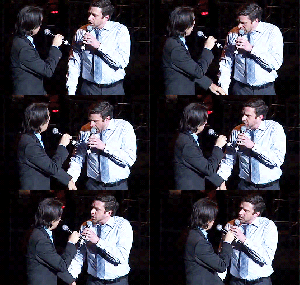
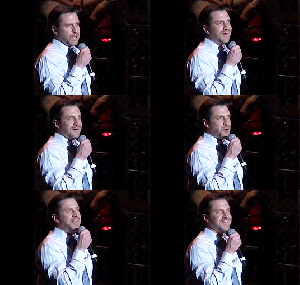
Lin-Manuel Miranda and Raúl Esparza perform “A Boy Like That/I Have A Love” from West Side Story {x}
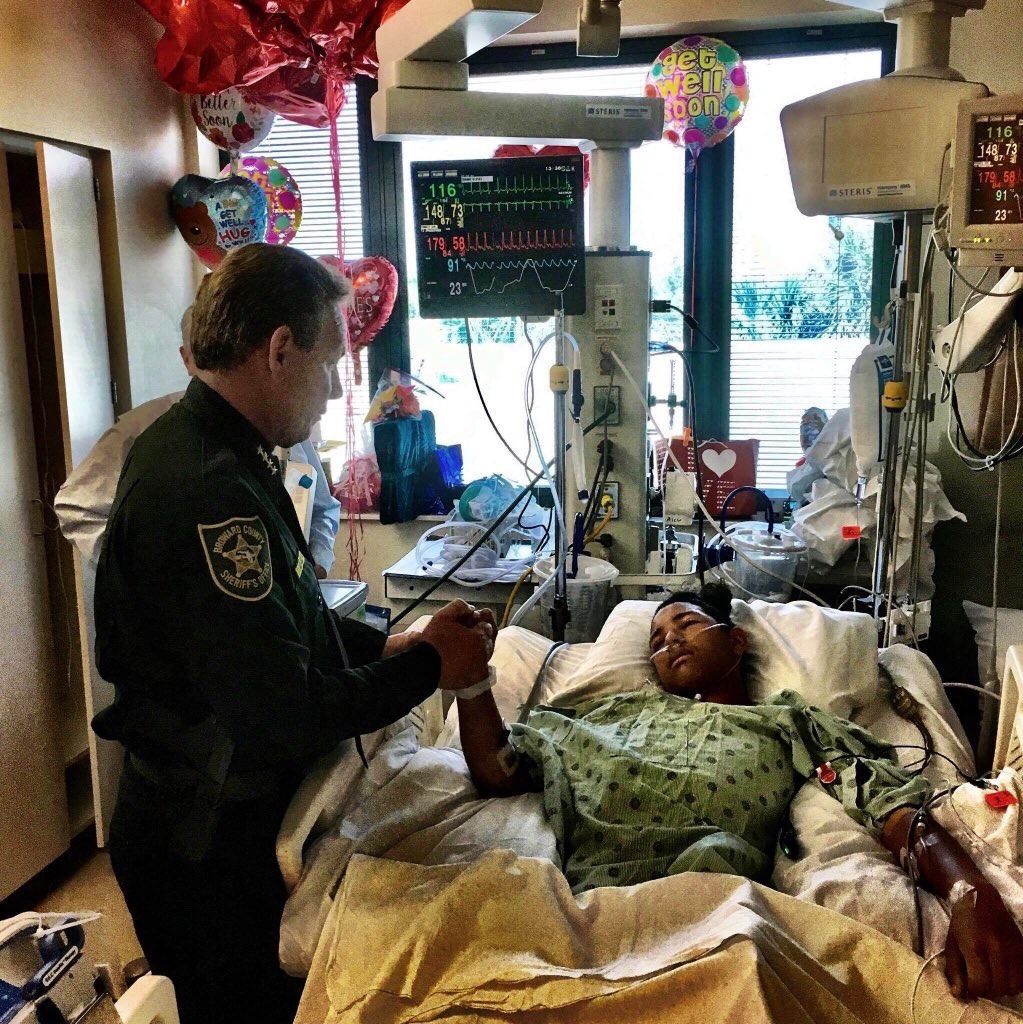
Wishing a speedy recovery to Anthony Borges, 15.
Used his body to hold a door closed to protect his classmates.
Shot 5 times
Hero.There’s a GoFundMe for him. I donated $5 and the total is about $30k as of now (2/18/2018) but hopefully more can be raised to help bills.
https://www.gofundme.com/anthonyborges/donate
Help this hero
I didn’t listen to the parental advisory warning on American Idiot and now I’m gay and I hate the government
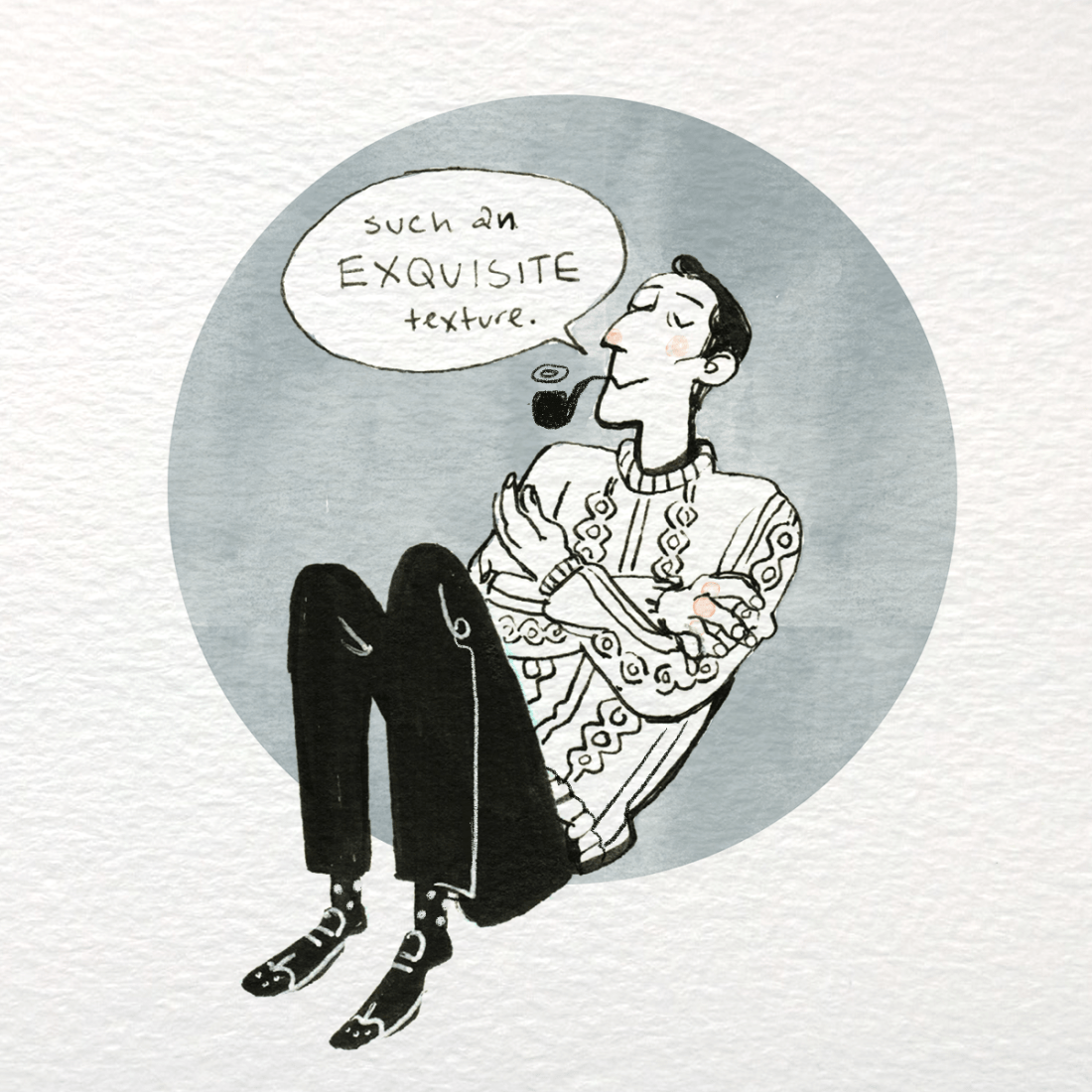
Nothing like time travelling a century to steal your flatmate’s jumper. It’s for a case!!



 Beltainefaerie's Flights of Fancy