havetardiswilltimetravel:

Name: Engie (pronounced like the letters N-G)

Pronouns: She/Her

Age: 28

Located: Northern VA

What do you do in fandom?: Mainly photo manips/graphicsfanfic, and cosplay. I’ve also made some fanvids and sherlock songs!

How long are you staying?: Thursday through Monday

Cosplays: I’ll be wearing my Johnlock Wedding Cake cosplay on Saturday, and I’m making a London inspired lolita outfit that I’ll likely wear on Sunday!

Roomies: @coloringthegreyscale and @astudyinsnoggy!

Where to find me: I’ll be on the Managing Your Cosplay panel on Saturday at 2 pm!  Other than that, I’ll be wandering around, hitting up karaoke and some panels! ^_^

Hugs: I like hugs (but please ask first!)

Drinks: Yep, I have my graduated cylinder ready to go!

Pictures: Yes! Just ask! And please tag me so I can see ^_^

Anything else?: I try to cover it up, but I’m shy. It’s hard for me to go start conversations with people, so I might just be floating about and chickening out on actually initiating conversation. I’m an introvert so even if I’m having a fun time, I might have to leave for a bit to recharge! I can also be bad with names sometimes, but I always try to remember! I really can’t wait to see all of you!

Optional Contact Details: Just send an ask or IM on tumblr!

Reblog: If you want!

A Different Perspective on “Garridebs.”

plaidadder:

I was looking over the post-Return Sherlock Holmes stories, and finally put something together about the dates.

“The Three Garridebs” case begins in June of 1902. All signs indicate that Watson is still resident at 221B at this point. We all know how that case ends.

“Illustrious Client” begins on September 3, 1902, with the famous trip to the Turkish baths. At that point, Watson says, he was “living in my own rooms in Queen Anne street at the time.”

“Blanched Soldier” begins in January, 1903. Holmes is still in his consulting-room in London, but Watson doesn’t appear in this case and Holmes narrates. And he is BITTER: “The good Watson had at that time deserted me for a wife, the only selfish action which I can recall in our association. I was alone.”

“Creeping Man” is dated September, 1903. This is the one where Holmes sends Watson the famous “Come if convenient, if inconvenient come all the same” telegram, and Watson’s narration says that their relations were “peculiar” at that time. Watson is also manifestly annoyed at being summoned for a case about a dog. Turns out it’s a case about a man who is in love with a younger woman and wants to impress her by augmenting his sexual potency via monkey gland secretions.

Holmes’s retirement to the Sussex Downs happens sometime in 1904, since it is announced in the introduction to “Second Stain.”

“Lion’s Mane” is dated 1907 and is the only story set during Holmes’s retirement (he comes out of retirement for “His Last Bow”). He mentions that “my house is lonely” and that “at this period of my life, the good Watson had passed almost beyond my ken.”

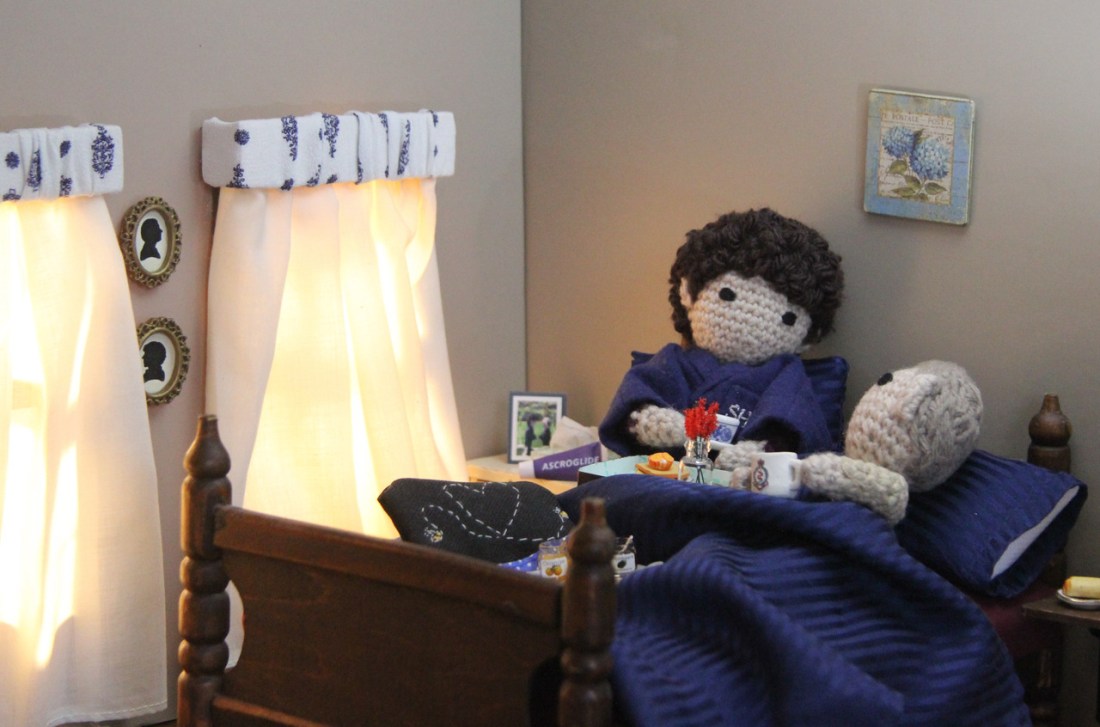
OK. So, in my own headcanon, I always located the Declaration and Consummation pretty soon after “Empty House,” based on the fact that the Return stories indicate a new level of physical and emotional intimacy (plus in “Norwood Builder” Watson sells his practice and moves back into 221B. Really, you don’t do that for a roommate). 

However, if you look at these dates, it occurs to me that another narrative–one which I in no way like as well–would go like this.

Keep reading
conan-doyles-carnations:

materialofonebeing:

conan-doyles-carnations:

Honestly, the impact of the Wilde trials on British society, art, and literature can hardly be overstated; so Conan Doyle was actually incredibly brave to carry on making Holmes act the camp aesthete post-1895, and the fact that he stuck to it shows he had a reason for doing so…  

In the article “A Wilde desire took me”: The homoerotic history of Dracula, T. Schaffer explored the potential impact of the trials on Stoker’s 1895 Dracula with the thesis Stoker was working through stuff about his own sexuality.  Could we speculate along the same lines, maybe less heavy-handedly, about Conan Doyle?  In 1895, his work included two books with the premise of a man admiring a man; he revised The Stark Munro Letters for publication (ACD on the autobiographical Munro in that year:  “a man, complete, unemasculated”) and wrote Rodney Stone (ACD: “strikes a healthy manly patriotic note”).  Did Conan Doyle see these and later masculine works as a contrast to Wilde’s degenerate ones, was ACD making a statement that men admiring men was wholesome after all, or was he going about his business without any self-conscious effect from the news about his acquaintance?  

Sorry for the long response, and how long it took to reply – I’ve been away with no access to my books.  See below the cut 🙂

Keep reading

butterflyinthewell:

The next time somebody gives you shit about your late autism diagnosis, remember that Anthony Hopkins was diagnosed as autistic when he was 70 years old. 

People can go almost their whole lives and never know they’re autistic, but recognize they feel different from their peers.

And BTW Anthony Hopkins stims by rubbing his hands together, and being autistic is exactly why he’s such a good actor. He studies people’s mannerisms with an analytical mind, adopts those mannerisms for characters and turns out awesome performances. He’s a chameleon.

And he’s one of us, autistic community.